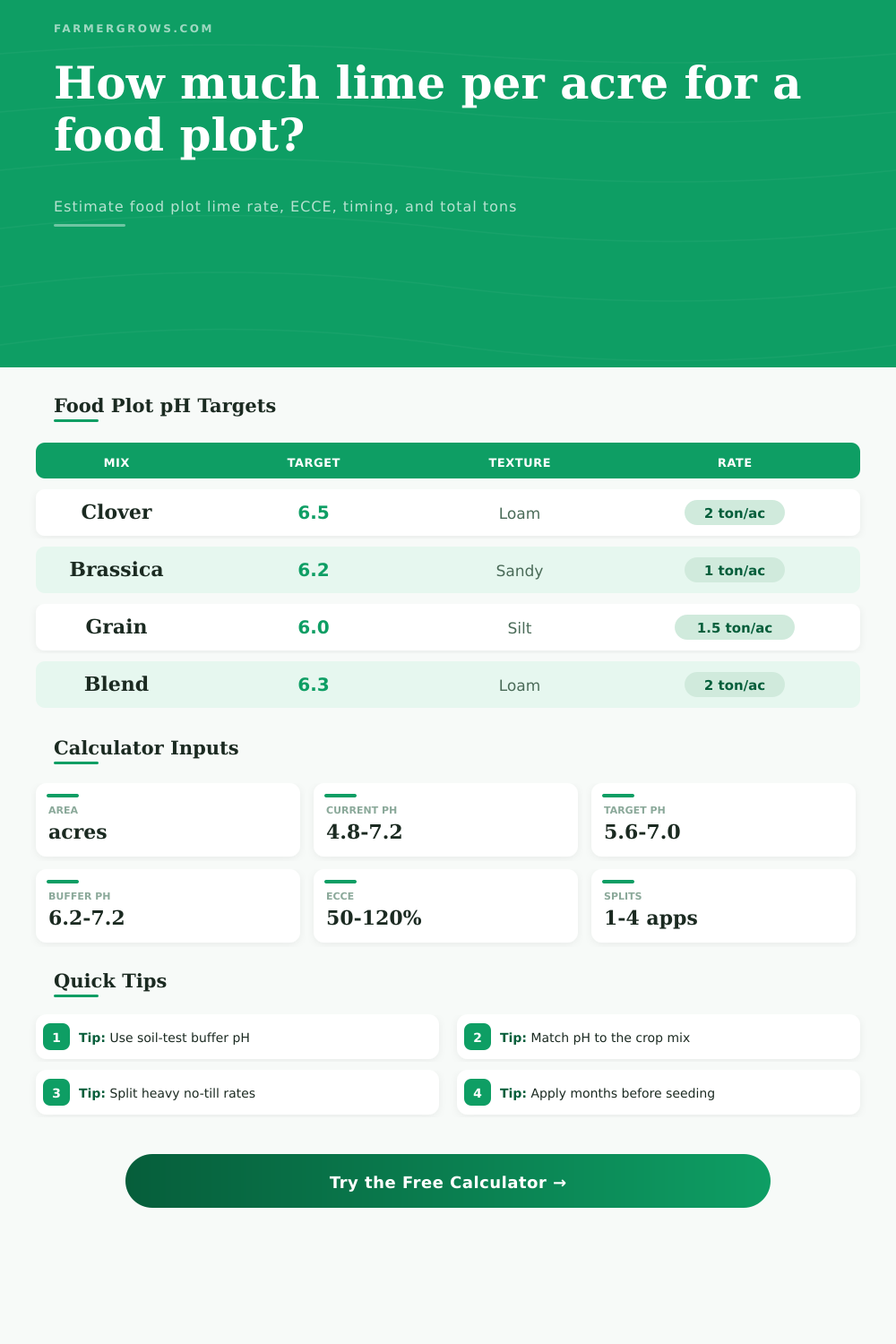
Lime per Acre for Food Plot Calculator
Estimate lime tons per acre and total lime for a deer, turkey, or wildlife food plot from crop mix, current pH, target pH, buffer pH, soil texture, ECCE, acreage, placement, and timing.
Choose a real food plot situation, then adjust acreage, soil-test pH, buffer pH, lime quality, timing, and no-till or incorporated placement for your site.
Spreading plan
Food Plot Lime Results
Lime rate and total load will appear here.
Calculation Breakdown
Best for established clover or remote plots where you cannot disturb the seedbed. Keep each pass modest and expect a topsoil-first reaction.
Useful after mowing or spraying. A shallow scratch improves contact while keeping erosion and seedbank disturbance lower than disking.
Works best before a new food plot. Mixing lime into the sampled soil depth gives the most even correction.
Fits plots near target pH. Use a fresh soil test rather than repeating the same rate every year.
| Food plot mix | Common target pH | Lime priority | Planning note |
|---|---|---|---|
| Clover and chicory | 6.3 to 6.8 | High | Correct pH before seeding perennial legumes. |
| Brassica fall plot | 6.0 to 6.5 | Medium high | Apply lime early so fall seedlings are not stalled. |
| Oats, rye, wheat | 5.8 to 6.3 | Medium | Useful as a nurse crop while lime reacts. |
| Annual legume blend | 6.2 to 6.6 | High | Soybean, pea, and cowpea benefit from better pH. |
| Native browse opening | 5.6 to 6.0 | Low medium | A modest target may be enough for remote sites. |
| Buffer pH | Reserve acidity | Typical lime response | Calculator effect |
|---|---|---|---|
| 7.2 | Very low | Soil changes readily | Lowest factor |
| 7.0 | Low | Sandy or low CEC soil | Light factor |
| 6.8 | Medium | Common loam baseline | Standard factor |
| 6.6 | Moderately high | More acidity to neutralize | Raised factor |
| 6.4 or lower | High | Clay or organic matter influence | Heavy factor |
| Soil texture | Relative factor | No-till caution | Best use |
|---|---|---|---|
| Sand or loamy sand | 0.65 | Watch over-liming | Small, frequent corrections |
| Sandy loam | 0.85 | Moderate leaching risk | Brassica and grain plots |
| Loam | 1.00 | Normal split limit | General food plot baseline |
| Silt loam | 1.15 | Surface rate may need time | Clover and blend plots |
| Clay loam or clay | 1.35 to 1.55 | Split heavy surface rates | Incorporate before renovation |
| Application timing | Reaction expectation | Good fit | Field note |
|---|---|---|---|
| Fall | Strong by spring | Perennial clover prep | Most forgiving timing window. |
| Winter | Moderate by spring | Dormant maintenance | Avoid spreading on frozen runoff-prone slopes. |
| Spring | Partial by planting | Summer or fall plots | Fine lime reacts faster than coarse material. |
| Summer | Good for fall plot | Brassica and grain blends | Spread before final seedbed work. |
| Same day | Mostly future benefit | Emergency correction | Plant tolerant crops while pH catches up. |
Sample the plot, not the whole farm. Food plots are often small, shaded, eroded, or recently cleared, so a separate soil test keeps the lime recommendation from drifting away from the actual seedbed.
Pair lime timing with crop choice. When lime goes on late, plant tolerant cereal grains first and reserve clover or other legumes for the next window after pH has had time to move.
Lime is a slow chemical reaction, so don’t expect miracles overnight. But it are also necessary.
Most guys use fertilizer, thinking they’re doing the same thing with lime; they aren’t. Fertilizer provide food for one season; lime change the soil chemistry for several years. If your soil’s pH is 4.5, you can throw all the nitrogen you want on there, but it won’t do anything for your clover since the roots won’t be able to take up the available nutrients. The soil has chemically locked itself up and it has to be unlocked. That takes time and accurate calculation.
Why Lime Takes Time
By entering your soil test results into the calculator, all the heavy lifting is done for you (you don’t have to guess at neutralizing values). Your lab report contain a number called “buffer pH” that most of us never look at. This is perhaps even more significant than current pH; it’s a measure of how much reserve acidity remains in your soil and thus how difficult it will be to change. If your buffer pH is low, your soil still have plenty of reserve acidity and won’t cooperate with lime. The calculator takes that into account, bumping up the rate if there’s a lot of reserve and making sure you really move the needle, instead of just putting down a skim coat on top. It sounds like a little thing in the inputs but it makes a huge difference in the outcome.
It also have to do with soil type, though not as loudly. Sandy soils change pH quickly and can easily be over-limed, as if they were dense clay. In contrast, acidic clay soils has a higher cation exchange capacity. This means they hold onto acidity tightly and take much more lime to change the pH different than sand does. That’s why the calculator adjust its base rate based off soil texture, so you don’t waste money on too little (if it’s a stubborn clay) or too much (on sandy soil). Your homework: make sure the math match what’s under your feet.
Most plans go south at this point: Timing. Lime doesn’t react quickly if soil is cool and wet. If you apply it right after sowing seed, you might as well of thrown your money out the window because the seeds hasn’t started to grow yet. It is generally best to apply in fall, which provides several month of warm, moist conditions for the lime to start breaking down and neutralizing the acidity before spring planting. Short on time? The tool offer both split applications and emergency adjustment as stopgaps, but you can’t speed up the chemical process any more. The page’s reference table spells out these timing window. Fall-planted plots benefit from a summer prep, but spring-planted ones is risky when prepped in spring.
Targeting: Your crop determine your target. Around a neutral pH (6.5 to 6.8), perennial clover and chicory do best. Cereal grains and brassicas will tolerate a slightly lower pH (about 6.0) but are tougher plant. Wasting lime on a brassica plot is a waste. Wasting the seed on clover… well, that’s wasting money. The calculator helps get the target aligned with plant biology. Raising the number isn’t the only goal, it’s also about getting into the “sweet spot” for each species you want to grow.
And then there are the lies told by those who spread them. Broadcast spreaders are notorious for being inconsistent, particulary on small irregularly shaped food plots. To compensate for this we added an option to the calculator called handling allowance. If you figure five to ten percent of your total load, you can cover the overlaps and the misses with plenty of lime. It is better to use too much than to see spots where the spreader missed and left it bare.
Lastly, keep in mind that lime is a long game. You’re not just doing this for this year’s yield. Instead, you are making an investment in the long-term health of the plot. This year’s yield will be better and require fewer inputs if the pH is right now. It takes time but it’s a necessity in a serious wildlife manager’s world.