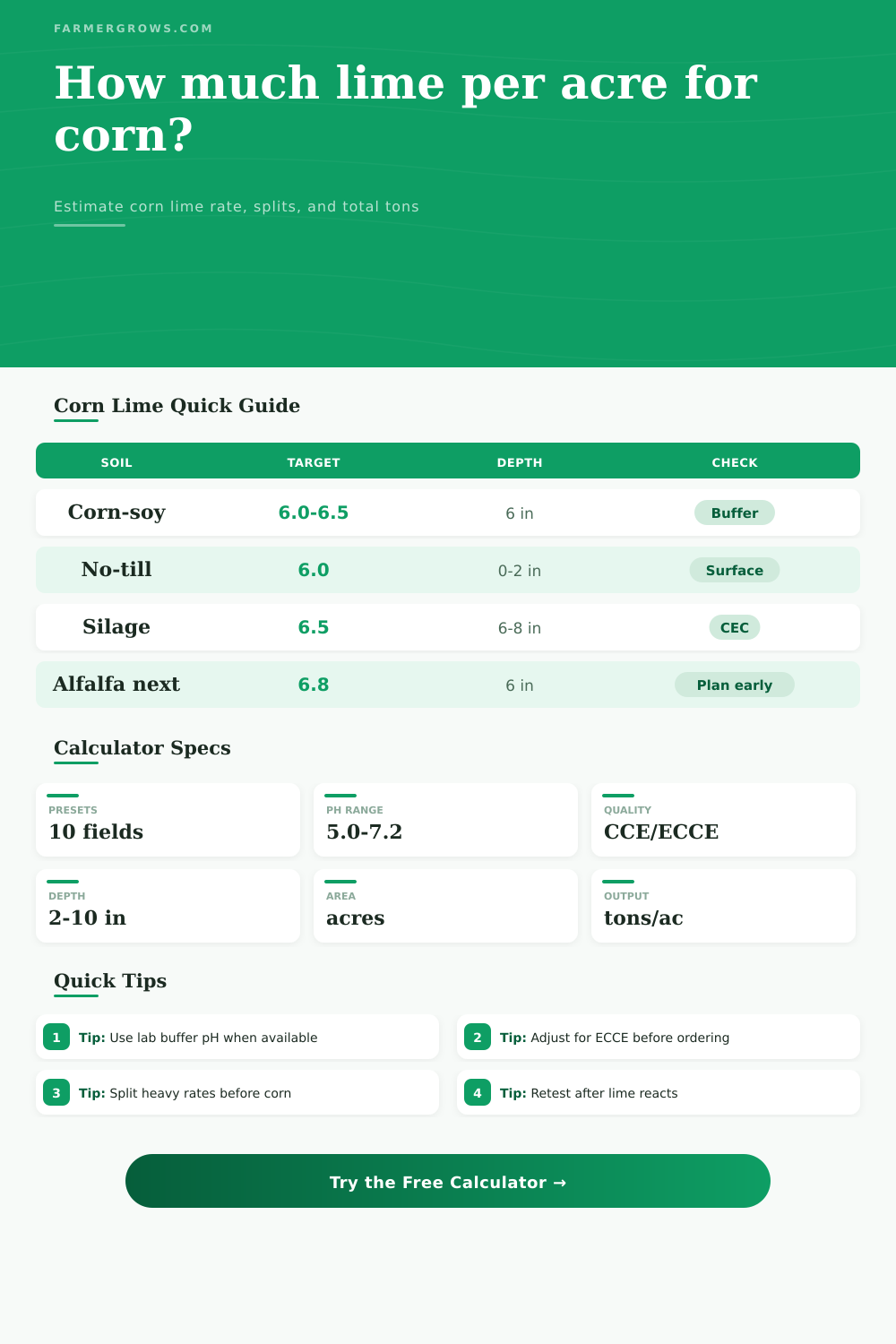
Lime Per Acre for Corn Calculator
Estimate agricultural lime tons per acre for corn from current pH, corn target pH, buffer pH, soil texture, CEC, lime quality, tillage depth, acres, splits, and rotation timing.
Choose a field scenario, then adjust the soil-test values and lime analysis from your own report or product tag.
Corn Lime Estimate
Soil-test lime estimate for a corn field.
Usually chosen when magnesium is already adequate and calcium carbonate is the main neutralizer.
Useful where soil tests show low magnesium along with acidity in a corn rotation.
Finer particles react sooner, but the product rate still depends on effective neutralizing value.
Use the lab analysis, moisture, and state approval data before substituting for quarry aglime.
| Corn system | Typical target pH | Why it matters | Calculator setting |
|---|---|---|---|
| Corn-soybean with calcareous subsoil | 6.0 | Higher-pH subsoil can reduce the need to push surface soil higher | 6.0 target |
| Continuous corn maintenance | 6.0 to 6.2 | Keeps phosphorus and nitrogen processes in a productive range | 6.2 target |
| Corn-soybean with acid subsoil | 6.5 | Common target where the root zone below the surface is also acidic | 6.5 target |
| Corn before alfalfa or legume hay | 6.8 to 6.9 | Legumes usually need a higher pH than grain corn | 6.8 target |
| Buffer pH or soil reserve acidity | Texture signal | Lime-rate effect | Field interpretation |
|---|---|---|---|
| Buffer pH 6.9 or higher | Sand to sandy loam | Low reserve acidity | Smaller lime rate raises pH more quickly |
| Buffer pH 6.5 to 6.8 | Loam or silt loam | Moderate reserve acidity | Common corn-belt planning range |
| Buffer pH 6.1 to 6.4 | Clay loam or high CEC | High reserve acidity | More tons per acre are needed for the same pH change |
| Buffer pH below 6.1 | Clay or organic soil | Very high reserve acidity | Use a lab recommendation and consider staged correction |
| Lime quality label | Effective rating example | Rate adjustment | Meaning for ordering |
|---|---|---|---|
| 100% ECCE or ENV | 100% | 1.00x | One ton equals one ton of effective neutralizing value |
| High-quality aglime | 90% | 1.11x | Order about 1.11 product tons per effective ton |
| Common aglime | 80% | 1.25x | Order about 1.25 product tons per effective ton |
| Lower-ECCE lime | 70% | 1.43x | More product is needed for the same neutralizing effect |
| Application and tillage | Depth factor | Corn timing fit | Practical note |
|---|---|---|---|
| No-till surface maintenance | 0.33x at 2 inches | Best well ahead of planting | Surface pH changes first; subsoil acidity changes slowly |
| Shallow vertical tillage | 0.67x at 4 inches | Fall or early spring | Works for modest correction near the seed zone |
| Conventional incorporation | 1.00x at 6 inches | Standard planning basis | Mixing improves contact between lime and acidic soil |
| Deep mixing before rotation shift | 1.33x at 8 inches | Before alfalfa or major reset | Deeper correction requires more total lime per acre |
Start with a soil-test recommendation when available. Buffer pH equations differ by state and lab method, so use this calculator to check tons, product quality, acreage totals, depth, and split passes after your soil report sets the agronomic target.
Give lime time before corn needs it. Fine lime reacts faster than coarse lime, but pH correction still depends on moisture, particle contact, incorporation depth, and months of reaction before the main corn root system develops.
The truck comes by with green corn and you see some but the roots is struggling in this acidic soil. Acid soil limits potential of crops, and it isn’t fixed with a shovelful of powdered fixin’s.
How much lime? More than that: You want to know the math, how those numbers add up, and how much you should of spend. That’s what the calculator does, runs the math for you, but you need to learn the numbers first. Lime is no fertilizer. It don’t feed the plants; it alters soil chemistry to make other nutrient available. Why that difference? Because patience figures into the plan.
Why You Need the Right Amount of Lime
The common question that trips people up is: What’s the target pH? Well, corn prefer it, but it’s flexible. For a typical corn-soybean rotation on silt loam, 6.2 or 6.5 is good.
Here’s how it thinks about the soil reserves‘ acidity, called buffer pH. After you add lime, the reserves pull the pH down. So if your buffer pH are low, there’s more reserve to neutralize. That sounds counter-intuitive, but imagine heating a big warehouse compared than a small room. A bigger space need more fuel. The calculator factors that into the tonnage. That saves you from the trial-and-error that cost thousands each season.
The type of soil are very important. A highly acidic clay will require more lime compared to a sandy soil because it has such high cation exchange capacity, binding up the acidity tight. It takes more lime to raise an inch (one point) in pH on clay soils compared to sands. The calculator accounts for this, adjusting the need based off your soil type and its CEC (texture). Sand do not buffer well either. That means that each time you apply lime, the pH can goes crazy one way or another.
How much lime should you apply? Apply enough to correct the acidity issue without overdoing it and causing a manganese or iron deficiency (which many folks miss). They get low pH and then double their rate, creating yet another issue.
There are also variables like lime quality. Not all agricultural lime is created equal,” he says. “A coarse product doesn’t do as much work in a ton compared to one that has a higher effective calcium carbonate equivalent (ECCE).” The calculator takes into account the ECCE rating on your specific lime tag. If you buy lower-quality lime at a discount price, the tool tell you it’ll take more tons to achieve the same effect. This prevents the mistake of under-liming your field by trying to save money with cheap lime.
The last piece is timing and how deep you incorporate. Lime is slow to react. It requires contact with soil particles and moisture. Apply in fall, and your first-year benefit will be greater than applying just before planting. The calculator accounts for these timing factor. The same applies to depth of application. Lime on top of the soil (if you’re no-tilling) will take longer to integrate than lime incorporated into the soil at a depth of, say, six inches where reaction would be more uniform and faster.
It’s a long term thing, not an instant fix that solves everything. You are building soil health that lasts into the next three to five years instead of just one season. You must maintain a stable pH where nitrogen is used efficienty and phosphorus isn’t tied up. Knowing how it works on the soil-chemistry level gives you the strategy to use it to your advantage; you are not guessing, but managing.