Lime per Acre for Pasture Calculator
Estimate pasture lime tons per acre and total tons from current pH, target pH, buffer pH, soil texture, lime CCE, fineness, ECCE, application depth, acreage, pasture type, and split application limits.
Choose a pasture situation, then adjust the soil-test pH, buffer pH, lime quality, depth, acreage, and split plan for the exact field.
Pasture Lime Estimate
Your lime recommendation will appear here.
Typical ground limestone with calcium carbonate value. Best for broad pasture acreage when soil magnesium is adequate.
Useful where soil tests show low magnesium. Rate still depends on ECCE and the soil buffer recommendation.
Usually easier to spread in small fields. Often reacts faster but is commonly used at lower touch-up rates.
Can be effective if analyzed. Use the tested CCE, moisture, and fineness values rather than assuming ag-lime strength.
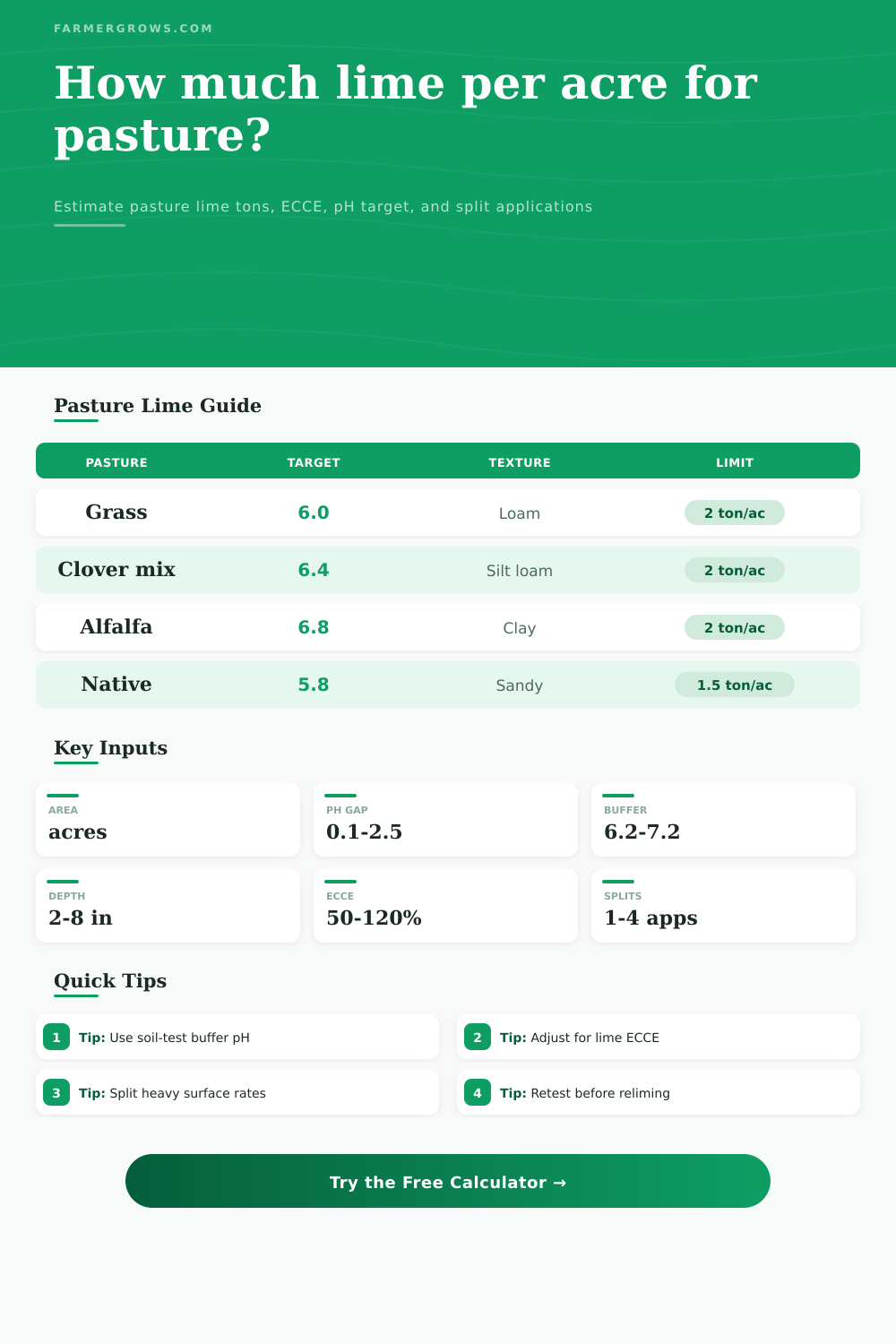
| Pasture type | Common target pH | Why it matters | Calculator preset |
|---|---|---|---|
| Grass pasture | 6.0 to 6.2 | Supports nutrient availability for cool-season or warm-season forage grasses. | 6.2 |
| Grass and clover mix | 6.2 to 6.5 | Clover persistence improves when acidity is corrected. | 6.4 |
| Legume-forward pasture | 6.4 to 6.8 | Rhizobia activity and molybdenum availability are more sensitive to low pH. | 6.6 |
| Alfalfa or alfalfa-grass | 6.7 to 7.0 | Alfalfa generally needs the highest lime target among common forage stands. | 6.8 |
| Native warm-season grass | 5.6 to 6.0 | Many native grasses tolerate moderate acidity better than legumes. | 5.8 |
| Soil condition | Buffer pH clue | Relative lime need | Field interpretation |
|---|---|---|---|
| Sandy or low organic matter | 7.0 to 7.2 | Lower | pH changes quickly, but acidity can return quickly under nitrogen fertilizer. |
| Loam pasture soil | 6.7 to 6.9 | Moderate | Usually close to the middle of a lab lime table. |
| Silt loam or clay loam | 6.4 to 6.7 | Higher | Greater reserve acidity means more lime for the same pH correction. |
| Clay, muck, or high organic matter | 6.2 to 6.5 | Highest | Large pH changes may need split applications and retesting. |
| Label value | What it means | Calculator use | Rate effect |
|---|---|---|---|
| CCE or ENV | Neutralizing strength compared with pure calcium carbonate | Entered as percent | Higher CCE lowers tons needed. |
| Fineness factor | How much of the lime reacts in the expected season | Multiplies CCE | Coarser lime needs more as-applied tons. |
| ECCE or effective CCE | CCE corrected for fineness and sometimes moisture | Final quality adjustment | Rate is divided by ECCE percent. |
| Application depth | Soil layer being corrected | Scaled from 6 inches | Deeper correction needs proportionally more lime. |
| Pasture situation | Suggested split plan | Why split? | Follow-up |
|---|---|---|---|
| Established sod, 0.5 to 1.5 ton/ac | Single pass | Low enough to spread evenly over the canopy. | Retest in 12 to 24 months. |
| Established sod, 2 to 4 ton/ac | Two passes | Limits surface loading and improves spread uniformity. | Separate passes by rainfall or season. |
| Renovation with incorporation | One or two passes | Incorporation mixes lime through the seedbed. | Apply before final tillage or seeding. |
| Severe acidity on clay soil | Two to four passes | Large reserve acidity may not be corrected quickly at the surface. | Retest before adding another full rate. |
Let the soil test lead. This calculator estimates a planning rate, but a lab buffer pH recommendation is the best number to use for field spreading.
Watch surface-applied limits. On established pasture, heavy lime rates react slowly at depth; splitting the rate can improve distribution and reduce surface buildup.
Bad weather? Bad seed? No. Those aren’t most reasons why pastures fails. They’re due to invisible soil chemistry, which only reveals itself when the clover dissapears and your grass begins to turn yellow. Soil acidity is slow and stubborn, it locks up nutrients and starves your forage in what appears to be fertile ground.
Estimate how much lime is needed per acre. This isn’t simply a math exercise. It is a rescue mission for your soil. Once you know your soil type, its pH gap and the lime quality, this calculator do all the work for you. It saves you from having to guess about depth adjustments and neutralizing coefficients.
Why Your Pasture Fails and How to Fix It
Second, the pH scale are logarithmic. A drop from six point five to five point five isn’t “just a bit,” like you’d think. It’s ten times more acid. No, your soil didn’t just get a bit more sour; it got ten times worse. By raw pH alone, it’s a lousy indicator of lime requirement. You can have a soil test at 4 and still require half a ton of lime per acre, or another at 4 and be down for three tons. The reason: reserve acidity, known as buffer pH.
Soils with low reserve acidity tend to be sandy ones, with low amounts of organic matter. These soils change pH easily, but also shed their pH quickly when subjected to fertilizer pressure. Contrast this with clay soils, which hold onto a lot of acidity. It takes some serious tonnage to move the pH needle a tenth of a point there. The real cost of correction depend on buffer levels, which are indicated in reference table on the page.
Lime is not all lime; some product vary greatly by fineness and strength. A product’s effective Calcium Carbonate Equivalent (ECCE) is a single number that shows both aspects. The higher the number, the stronger effect. So if your lime has a high CCE but is crushed too coarse, it won’t have enough time to do its job and react quick enough to improve your pasture this spring. It’ll just lay there on top. On the other hand, ultra-fine lime with lower CCE may require more tonnage to get the same effect. You aren’t only paying for reactivity, you’re also paying for weight.
This is something most calculators don’t account for, they assume all lime are the same. This tool does, so you won’t be underapplying based off the assumption that cheaper lime is the same as premium lime. That might seem like a minor distinction, but when you’re talking about hauling out hundreds of ton, it matters.
This is very species-specific; that is, it all depends on what you’re growing. Tough things: cool-season grasses can handles a soil pH as low as 5.8. Other things include legumes. Alfalfa and clover want nearly neutral soil (typically more than 6.5). Those plants depend on rhizobia bacteria to fix their nitrogen, but those bacteria is fragile. Low pH will kill them. Without them, there is no free nitrogen. Your legume dies, and then your grass starves because it is not getting any fertilizer. You have a mixture of legumes and grasses in your pastures? Aim higher. The tool presets takes that into account and shift their target to match whether you’re running pure grass, a grass-clover mix, or a lot of alfalfa.
Don’t expect miracles overnight. Applying three tons of lime all at once on established sod is asking for trouble. That is asking for trouble. Lime doesn’t incorporate; it washes off in a hard rain, burns hot spots under plants, or just lays on the surface. Spread out lime applications over a couple or even three years so that rain and root activity will work the lime down into soil profile gradually. That’s kinder on the pasture and cheaper on your budget. You can incorporate it slowly by spreading it on top. Fast incorporation when renovating. Do you want to maintain or repair? You decide how to do it.
No matter how much you test: You can’t negotiate retesting. The soil has changed chemically. Fertilizing acidifies it. Rain leaches out the bases. Two years later what was effective then may no longer apply. Lime is a prescription, not a paint job. Adjust to today’s condition, not your last memory.
Until then, acidity steals crops without warning, leaving nothing to track but a loss in yield. What follows can only be corrected by time (patience), material (the proper stuff) and insight (what’s going on down there under the ground). And when you do get the chemistry correct, the other aspects of managing the pastures fall in line.
The grass comes back. The clover reappears. The field appears alive once more.