Starter Fertilizer Per Acre Calculator
Plan liquid or dry starter fertilizer by acre, row spacing, planter rows, band rate, fertilizer analysis, seed-safe N plus K2O limit, tank size, and total product needed.
Choose a common starter placement and crop scenario, then adjust the band rate, row spacing, acres, tank size, analysis, and seed-safe limit for your local recommendation.
Guaranteed analysis on product label (%)
Starter Fertilizer Results
Rate, row delivery, tank acres, and safety status will appear here.
Starter Plan Breakdown
Best for very low-salt products and low rates. Safety limit should be conservative, especially on sandy or dry seedbeds.
Lets the plan carry more nutrient because fertilizer is separated from the seed while staying near early roots.
Useful when planter equipment cannot place fertilizer below the seed, but placement and rainfall affect early access.
Handles larger rates, especially P and K, but should be planned separately from true seed-applied starter safety.
Use these as planning ranges only. Local product labels, opener spacing, soil moisture, salinity, seed size, and extension guidance should override generic starter fertilizer limits.
| Crop | Typical cautious N plus K2O limit | Sandy or dry seedbed | Notes for in-furrow use |
|---|---|---|---|
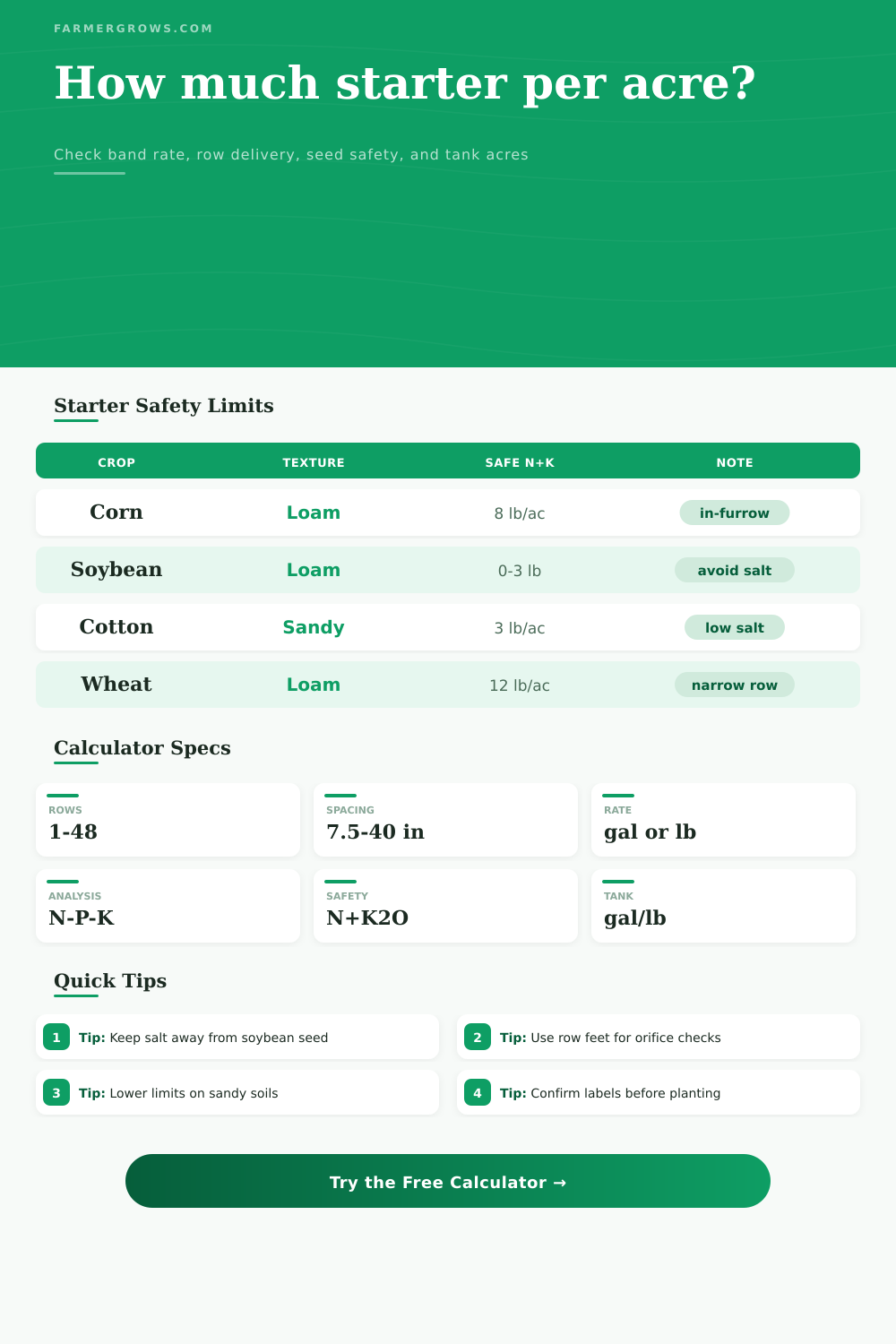
| Corn | 6 to 8 lb/ac | 3 to 5 lb/ac | Usually more tolerant than soybean, but salt injury can still reduce stand. |
| Soybean | 0 to 3 lb/ac | 0 to 2 lb/ac | Many agronomists avoid fertilizer directly with soybean seed unless the product is very low salt. |
| Cotton | 3 to 5 lb/ac | 2 to 3 lb/ac | Small seed and dry beds call for conservative rates and careful placement. |
| Wheat or small grain | 8 to 12 lb/ac | 5 to 8 lb/ac | Narrow rows spread product across more row feet, reducing concentration per row foot. |
| Sorghum | 4 to 6 lb/ac | 2 to 4 lb/ac | Watch ammonia and salt sources closely near the seed. |
| Placement | Distance from seed | Seed-contact factor | Planning use |
|---|---|---|---|
| In-furrow | With seed | 100% | Use the strictest N plus K2O safety check. |
| Dribble over row | Surface above row | 60% | Risk depends on rainfall, residue, product salt, and seed slot closure. |
| Surface band near row | 1 to 2 in aside | 40% | Less seed contact, but still avoid high-salt concentration over the row. |
| 2x2 band | 2 in aside, 2 in below | 15% | Usually supports higher rates than true pop-up fertilizer. |
| Deep strip band | 4 plus in from seed | 5% | Track as fertility placement rather than seed-applied starter. |
| Product analysis | Typical form | N plus K2O per 5 gal/ac at 11.2 lb/gal | Best-fit starter role |
|---|---|---|---|
| 3-18-18 | Liquid | 11.8 lb/ac | Usually better separated from seed because K2O raises salt load. |
| 6-24-6 | Liquid | 6.7 lb/ac | Common pop-up analysis when rates and soil conditions are suitable. |
| 7-21-7 | Liquid | 7.8 lb/ac | Balanced starter where a little K2O is desired near early roots. |
| 10-34-0 | Liquid | 5.6 lb/ac | Phosphorus-focused band, commonly used away from direct seed contact at higher rates. |
| 11-52-0 | Dry MAP | 11 lb per 100 lb | Dry phosphate source for banding or dry starter systems. |
| Starter rate | 300 gal tank | 500 gal tank | 800 gal tank |
|---|---|---|---|
| 3 gal/ac | 100 ac | 166.7 ac | 266.7 ac |
| 5 gal/ac | 60 ac | 100 ac | 160 ac |
| 7 gal/ac | 42.9 ac | 71.4 ac | 114.3 ac |
| 10 gal/ac | 30 ac | 50 ac | 80 ac |
| 15 gal/ac | 20 ac | 33.3 ac | 53.3 ac |
Seed-safety tip: Treat the calculator as a planning check, then confirm the final in-furrow rate with the product label and local extension guidance for crop, soil texture, and seedbed moisture.
Planter setup tip: Use the per 1,000 row feet result to compare against metering charts, orifice charts, pump calibration, and catch-test measurements before planting the field.
The first week of planting always seem rushed. It’s threatening to rain, and you’ve got a planter standing by and you want those seeds in the ground fast. What about starter fertilizer? It is an afterthought. What’s in the tank goes into the planter; the meter gets turned up to what feels comfortabley, then…hope for the best.
Wrong move: Because starters are intended to get your crop up and running quickly, getting them wrong can be risky business. Too much might burn seedling or prevent roots from developing. Knowing where they go and how heavy (or light) to make the load can mean the difference between a good stand and a patchy one.
How to Use Starter Fertilizer Safely
Not merely “a little bit more.” Phosphorus (because it’s immobile in soil) are an important factor for early root growth and is the main reason most growers concentrate their efforts here. In reality, though, the nitrogen and potassium parts of the equation are where things get tricky. They affect what agronomists refer to as salt index. Salt pulls moisture away from embryo close to the seed, essentially dehydrating it prior to even having a shot at sprouting, and is particularly hazardous if soil moisture is already low (as with sandy soils or dry conditions). Therefore, you want to be aware precisely of your level of potassium and nitrogen in relation to the seed in the furrow.
Once you input your analysis and desired levels into the calculator above, it will do the math for you so that you don’t have to guess about whether you’re using too-strong a mix for the seed.
The placement makes all the difference. Applying fertilizer right along with the seed impose some pretty narrow limits on what works. Corn can generally handle a bit more salt than soybeans, which are notoriously sensitive. Some soils can get away with applying a few pounds of total N and K to the soil alongside corn without issue, where the same dose will smother a soybean crop in sandier bed.
Getting the fertilizer out of contact with the seed open up the options considerably. With a two-by-two band, you’re putting the nutrient right next to the young roots, but not actualy in direct contact with the seed itself. That means you can safely apply greater amounts without fear of burning the seed. It’s a volume-versus-proximity trade-off: closer is better, but you have to use less. Further away is OK, but you need to apply more.
Row spacing also matter, and is an underused piece of the equation. Narrower rows mean more total row feet to cover, so there is less fertilizer in any specific spot on the ground compared to wide-spaced corn. Even if you’re applying the same per-are rate of fertilizer, the local salt concentration will be lower if you’re sowing in narrow rows, like with wheat. Considering all of this, the tool convert your acre-based rates into what’s happening at the seed level (how intense it actualy is in terms of row feet). So it saves us from making the too-common error of thinking that a safe rate for 30-inch-wide rows must also be a safe rate for 12-inch-wide rows.
Operational efficiency depend on both tank size and field coverage. For example, a tank that’s too small means you’re going to be filling half the time you should of been planting. Too big and you risk spilling or not getting consistent mixing. Knowing exactly how much acreage you can cover per fill allow you to plan out your planting strategy while factoring in lunch breaks and other fuel stops. It is a small logistical detail that adds up during a busy season. You don’t want to be constantly interrupted as you move throughout the field.
In the end, it’s all about balance when applying starter fertilizer. You don’t want to harm the plant, but you also want to give it what it needs. To protect your labor and seed investment, use a careful safe limit to check your N plus K2O load. This is a quick check before committing to a rate, and the reference table on the page does a nice job of laying it out for various soil types and crops. Use the safety numbers as a starting point. Make adjustments based off soil moisture conditions. Then, let the equipment take care of the rest.
A good start makes for a strong finish.