Liquid Nitrogen Per Acre Calculator
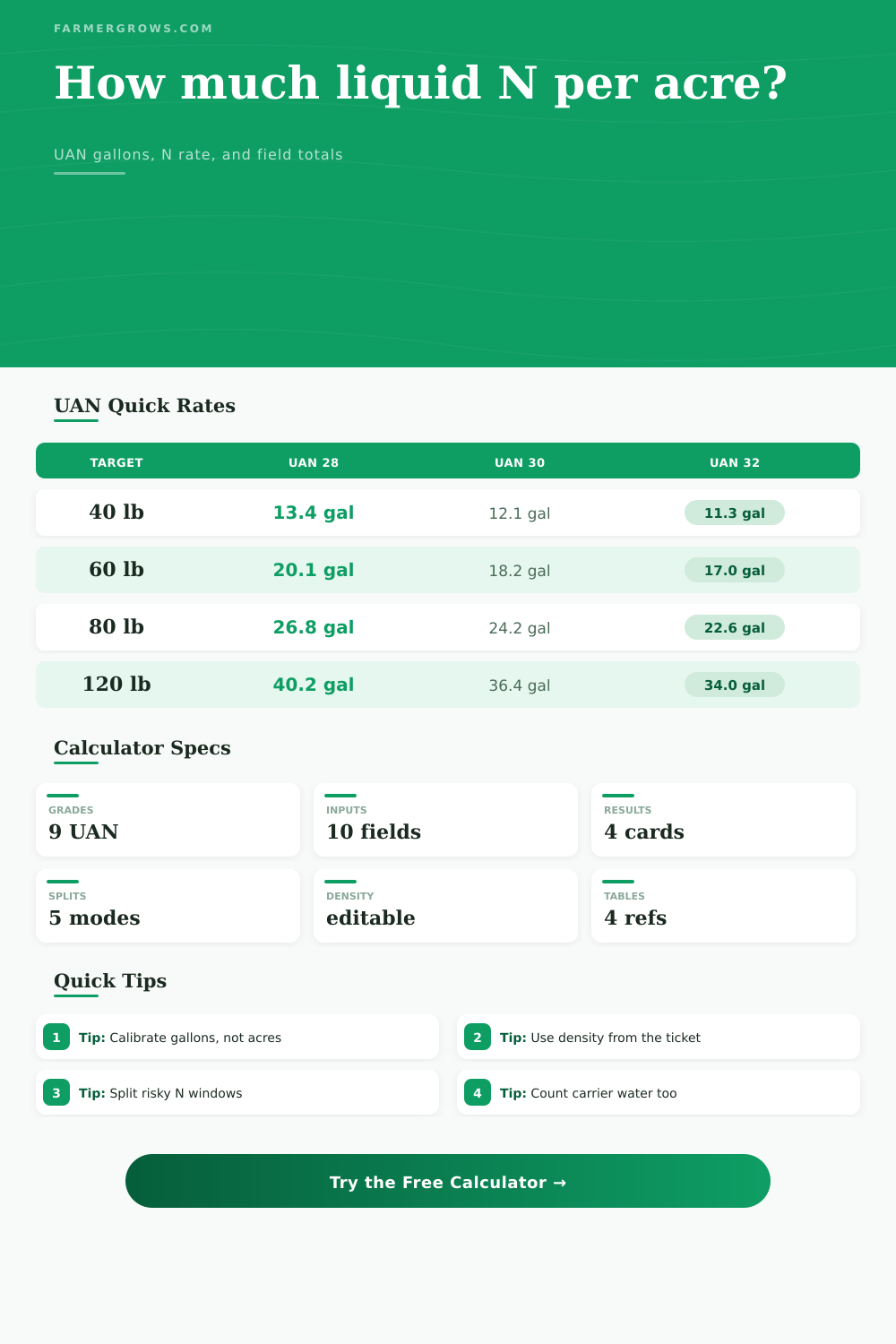
Estimate UAN gallons per acre, total liquid nitrogen gallons, pounds of N delivered, carrier water volume, split timing, and tender loads from grade, density, efficiency, acreage, and target N.
Load a realistic UAN plan, then adjust the target N, known gallons per acre, density, efficiency, carrier water, total gallons, acreage, and split timing to fit the field.
Starts with a crop N goal and converts it into liquid gallons after efficiency is applied.
Starts with entered gallons per acre and reports the N actually delivered at the selected grade.
Adds water gallons per acre so total spray solution and tender loads are visible before filling.
Divides UAN gallons, carrier water, and N across starter, base, and sidedress passes.
Liquid Nitrogen Results
Your UAN plan will appear here after the calculation updates.
| Liquid N grade | Typical density | N analysis | Pounds N per gallon | Use in calculator |
|---|---|---|---|---|
| UAN 28-0-0 | 10.65 lb/gal | 28% N | 2.98 lb N/gal | Cooler storage or common regional grade |
| UAN 30-0-0 | 10.90 lb/gal | 30% N | 3.27 lb N/gal | Middle-grade supplier blend |
| UAN 32-0-0 | 11.06 lb/gal | 32% N | 3.54 lb N/gal | Highest common UAN concentration |
| UAN 25-0-0 | 10.30 lb/gal | 25% N | 2.58 lb N/gal | Custom blend or sulfur blend adjustment |
| UAN 24-0-0-3S | 10.45 lb/gal | 24% N | 2.51 lb N/gal | Liquid N plus sulfur program |
| Target available N | UAN 28 at 85% | UAN 30 at 85% | UAN 32 at 85% | UAN 32 at 95% |
|---|---|---|---|---|
| 30 lb/ac N | 11.8 gal/ac | 10.8 gal/ac | 10.0 gal/ac | 8.9 gal/ac |
| 50 lb/ac N | 19.7 gal/ac | 18.0 gal/ac | 16.6 gal/ac | 14.9 gal/ac |
| 70 lb/ac N | 27.6 gal/ac | 25.2 gal/ac | 23.3 gal/ac | 20.8 gal/ac |
| 90 lb/ac N | 35.5 gal/ac | 32.4 gal/ac | 29.9 gal/ac | 26.8 gal/ac |
| 120 lb/ac N | 47.3 gal/ac | 43.2 gal/ac | 39.9 gal/ac | 35.7 gal/ac |
| Split timing | Starter share | Base share | Sidedress or late share | Best fit |
|---|---|---|---|---|
| Single pass | 0% | 100% | 0% | Injected preplant or modest topdress rate |
| Starter plus base | 15% | 85% | 0% | Planter-safe starter plus main liquid pass |
| Starter, base, sidedress | 10% | 40% | 50% | Balanced corn, sorghum, or vegetable timing |
| Sidedress heavy | 5% | 20% | 75% | Sandy, leachable, or adaptive N programs |
| Four equal passes | 25% | 25% | 50% | Fertigation-style or long-season spoon feeding |
| Carrier water plan | Added water | Total solution example | Operational reason | Calculator check |
|---|---|---|---|---|
| Concentrated dribble band | 0 to 5 gal/ac | UAN rate plus little water | Lower hauling volume where placement is controlled | Watch nozzle flow and band uniformity |
| Standard sidedress mix | 8 to 12 gal/ac | UAN plus enough carrier for coverage | Common sprayer setup for row crops | Tank loads include UAN plus water |
| Leaf-safe broadcast blend | 15 to 25 gal/ac | Diluted solution for better spread | Reduces concentration on foliage or residue | Check total gallons per acre |
| High-volume fertigation batch | 25+ gal/ac | Large carrier volume | Useful for irrigation or specialty vegetables | Separate UAN gallons from water gallons |
Use actual density when available. UAN density shifts with grade and temperature, so supplier tickets or scale weights are better than a generic book value for final load planning.
Keep UAN and carrier water separate in records. Total spray solution matters for tank loads, but the nitrogen rate comes only from gallons of liquid N and pounds N per gallon.
Fertilizer can be dangerous.
Liquid ureanitrogen ammonium nitrate (UAN) works fast, then vanishes if not applied correctlyy. How much N did I put down? Am I risking an environmental mess (or even fire? It’s easy math). But you have to think right, too: You’re gambling that it will rain before some time X after treatment. That’s a very small window; you want a fast assessment of how big a load to haul out to the field.
How to Calculate UAN Fertilizer Needs
With your desired amount of N (nitrogen) and your chosen UAN strength, the calculator do all the math for you. Because UAN is a solution, not pure nitrogen; it takes more than one gallon to apply a given number of pounds of N. A gallon of UAN 32 provide roughly 3.54 lbs/gal of N. Lower concentrations require more volume to achieve equal pounds of N.
Most of us think of the application in terms of pounds of N… But plan our tank volumes in generic gallons. As you can see from this chart, more gallon are needed with lower concentrations. That’s important on those days you’re tendering loads for 500 acres.
The other key: Efficiency makes the plan happen. Enter an application efficiency percentage into the tool. That’s how much nitrogen is not lost to runoff, leaching, or evaporation, as you might expect. If you’re injecting into moist soil, it might be 90 percent or more. If you’re just dribbling on top in windy weather while things are still warm, go down to less than 80 percent. Better to side dress later if necessary after the rain comes, then to apply too much early and have some get lost to the air instead of the ground.
The strategy lies in split timing. From a one-heavy shot to a four-pass system, the calculator let you model various pass structures. It’s about risk management. Conveniently applying all the nitrogen at planting are risky. If it gets wet in spring, the nitrogen is lost. If it doesn’t get wet, the roots don’t see it until too late. By splitting applications, you apply fertilizer when the crop requires it, not when it’s convenient for you to drive.
Exactly how much UAN and carrier water to put in each pass? The feature shows that. That’s shown by the feature. This aids both load planning and calibration. Can your sidedress pass be managed given your tank size? Yes.
Carrier water is often an afterthought until it isn’t. With this tool, you can include amount of carrier water in the mix. This will be important when determining total solution volume. For example, you may believe you’re applying 15 gallons of UAN per acre. But what happens when you double that by adding 10 gallons of water? This impact your pressure setting and nozzle flow rates. It also changes how much you can produce per field load from a single tender fill. You may rush through refills to get back into the field or run out of time before reaching the end of the field if you don’t account for carrier water.
The density adjusts by both grade and temperature. Book averages is not as safe as using the supplier ticket value. You can override the default density via the tool. Why? Because a gallon of UAN 32 weigh less in July compared to January. That weight mean something relative to scale tickets and also the amount of nitrogen that was actualy delivered. The tool will back-calculate the actual nitrogen delivered. This helps when auditing a known gallon rate to see if it hit the mark.
Nitrogen planning is always about managing risk, never exact science. You want to apply enough N for best yield, but not so much that you lose too much. This tool would of help you see how rate, volume, and timing interact. It translates a general plan into specific numbers. There’s no substitute for reading the field, watching the sky, and trusting your gut feelings. But getting the math part right lets you spend more time looking at the weather. And the peace of mind is worth a couple minutes to enter in the inputs.