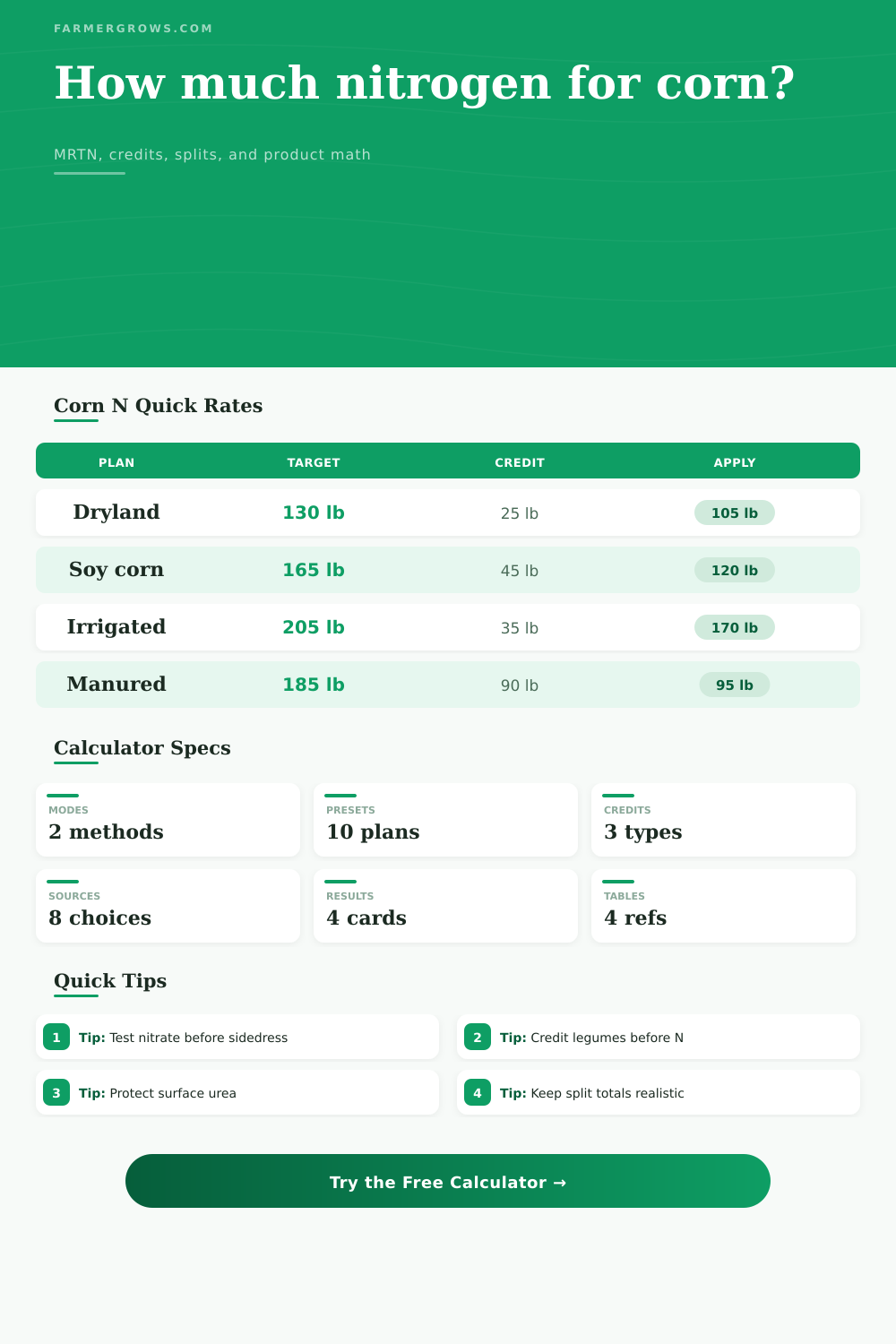
Nitrogen Per Acre For Corn Calculator
Plan corn nitrogen by MRTN or yield-goal method, then subtract soil nitrate, previous crop, and manure credits before converting the rate into fertilizer product and split timing.
Choose a starting scenario, then adjust the MRTN rate, yield goal, nitrate sample, previous crop, manure credit, N source, efficiency, acreage, and timing.
Uses your chosen maximum-return-to-nitrogen rate as the starting target before credits.
Estimates gross N from bushels per acre times a selected nitrogen factor.
Soil nitrate, legumes, and manure are subtracted before fertilizer efficiency is applied.
Converts fertilizer N into pounds, tons, and liquid gallons where a density is known.
Corn Nitrogen Recommendation
Results update as inputs change.
| Credit source | Calculator value | How it is entered | When to adjust | Planning note |
|---|---|---|---|---|
| Soil nitrate-N | ppm x depth feet x 4 x 80% | Test ppm and sample depth | After heavy rain or shallow sampling | Most useful near pre-sidedress timing |
| Soybean rotation | 30 lb N/ac | Previous crop dropdown | Low residue or weak nodulation history | Common credit before corn after soybeans |
| Alfalfa rotation | 50 to 80 lb N/ac | Previous crop dropdown | Stand density and termination timing | Good stands often justify the higher preset |
| Manure available N | User-entered lb N/ac | Manure credit field | Use lab analysis and incorporation timing | Enter first-year available N, not total N |
| Recent manure history | 20 lb N/ac | Previous crop dropdown | When no current-year manure is entered | Use only when local guidance supports it |
| Source | N analysis | Product for 100 lb N | Useful placement | Calculator equivalent |
|---|---|---|---|---|
| UAN 32-0-0 | 32% N | 313 lb or 28.3 gal | Injected, dribbled, or sidedress | Shows lb/ac and gal/ac |
| UAN 28-0-0 | 28% N | 357 lb or 33.5 gal | Preplant or sidedress liquid | Shows lb/ac and gal/ac |
| Urea 46-0-0 | 46% N | 217 lb | Broadcast with incorporation or protection | Shows lb/ac and tons total |
| Anhydrous ammonia | 82% N | 122 lb | Injected preplant or sidedress | Shows lb/ac and tons total |
| Ammonium sulfate | 21% N | 476 lb | Sulfur plus nitrogen program | Shows lb/ac and tons total |
| Custom source | User N% | Based on N percentage | Local blends or specialty materials | Uses custom N analysis field |
| Corn situation | Typical starting target | Yield-goal check | Credit priority | Good timing fit |
|---|---|---|---|---|
| Dryland moderate yield | 120 to 150 lb N/ac | 130 to 170 bu/ac | Soil nitrate and soybean credit | Preplant plus small sidedress |
| Corn after soybeans | 145 to 180 lb N/ac | 170 to 210 bu/ac | Rotation credit first | Starter plus V5 to V8 sidedress |
| Continuous corn | 170 to 220 lb N/ac | 170 to 230 bu/ac | Residual nitrate and manure | Injected base plus sidedress |
| Irrigated high yield | 200 to 260 lb N/ac | 220 to 300 bu/ac | Nitrate, manure, fertigation N | Multiple split applications |
| Manured corn ground | Rate after manure credit | Use realistic yield goal | Lab-tested available N | Sidedress adjustment after testing |
| Split option | Starter share | Base share | Sidedress share | Best fit |
|---|---|---|---|---|
| Mostly preplant or injected | 5% | 80% | 15% | Lower-loss injection, spring incorporation, or stable soils |
| Starter plus sidedress split | 10% | 30% | 60% | Broad fit for corn that gets early N and responsive sidedress |
| Sidedress heavy | 5% | 15% | 80% | Sandy, leachable, or adaptive nitrogen programs |
| Late rescue sidedress | 0% | 10% | 90% | Rescue applications after early loss or delayed N plans |
| Starter and base blend | 25% | 60% | 15% | Planter starter plus a larger preplant or strip-till base |
Credit before product: Subtract nitrate, previous crop, and manure credits before converting to urea, UAN, anhydrous ammonia, or a custom N source.
Check local guidance: MRTN rates, nitrate credits, and manure availability vary by state, soil, weather, timing, and price ratio.
Around planting time, a certain type of quiet panic settles in. You realize that your guess about how much nitrogen to apply is foundation of your nitrogen plan. Yes, you’ve got the tractor. And yes, you’ve got the yield goal. But how do you tie all this together, the soil test, the yield goal, the tractor? How do you make it add up?
That’s where the nitrogen per acre for corn calculator (above) comes in. This tool does heavy lifting, translating your agronomic targets into rates for the real thing: products. But what goes into the calculator? Knowing the number logic are equally important. Ultimately, it is the difference between buying fertilizer and buying yield. So that’s where the calculator comes in.
How to Use the Corn Nitrogen Calculator
At its heart, it offers two very different perspectives. You may begin with what we call a yield-goal approach by multiplying your desired number of bushels per acre by some fixed factor. Or, you might work backward to a maximum return to nitrogen rate, a figure based off economic theory and past results from your area.
One isn’t right and one isn’t wrong (each answers a different question). If I want this many bushels, how much nitrogen will get me there? That’s the yield-goal approach. How much nitrogen will maximize my profits? That’s the approach for finding the nitrogen rate that gives maximum return.
With the calculator, you can go back and forth between the two perspectives, seeing how your ultimate recommendation changes depending on whether you’re looking at field through view of maximizing yield, or maximizing profit.
Then comes the tricky part: You start with a gross number and then take away what’s already being offered by the soil. The most accurate method is the soil nitrate test. But few understand it. A shallower sample doesn’t count available nitrates below; a deeper one may include ones the crop can’t access until after its need have passed.
The calculator uses a standard conversion factor that converts those parts per million to pounds per acre, but discounts them for availability, since not all those nitrate ions remains in place long enough to benefit the corn. Yes, it’s a rough guess. But it’s still much better than assuming there isn’t anything in the reservoir.
A second complicating factor is that people over-simplify their rotation credits. If last crop was alfalfa or soybeans, the soil contains a residual bonus of extra nitrogen, but how big is that bonus? That depends on how healthy the stand was. Nitrogen fixation isn’t the same in an early-terminated alfalfa field as it is with a vigorous, full-season stand. It’s also not so high in a thin crop of soybeans. The tool defaults to typical credit values, but make adjustments if your rotation was weak.
Then there is manure, which is another variable. The amount of available nitrogen depends on your pile’s analysis, when it was applied, and whether it were mixed in. To avoid double-counting nutrients that won’t mineralize for years, enter only the available nitrogen (the “first-year” number).
Finally, nitrogen is converted into a product. Nitrogen sources (urea, anhydrous ammonia, UAN) provides nitrogen, but differently. If urea is applied to the surface without an inhibitor to prevent volatilization, it will suffer significant losses (particularly under warm, windy conditions). You should of accounted for this.
The calculator accounts for your application efficiency. It takes into account benefits of using an injection method or loss mechanisms like volatilization. Then it translates the net nitrogen requirement to pounds or gallons of whichever product you happen to have available. That way you can be sure the amount of truck load ordered matches the agronomic need based on size of field and a little wiggle room for calibration errors.
The bottom line is that this is only a model. It doesn’t consider your weird weather patterns this year or the microclimates in your lowest field. But it makes you think about the timing, the source and the credit before pulling the trigger.
And when you know how each input affects the outcome, you don’t treat it as a commodity anymore. You treat it as a crop input. That’s what the real saving comes from: a change in mindset. From there, you aren’t just filling a tank; you are feeding a plant. Actualy, you are livig for your crops.