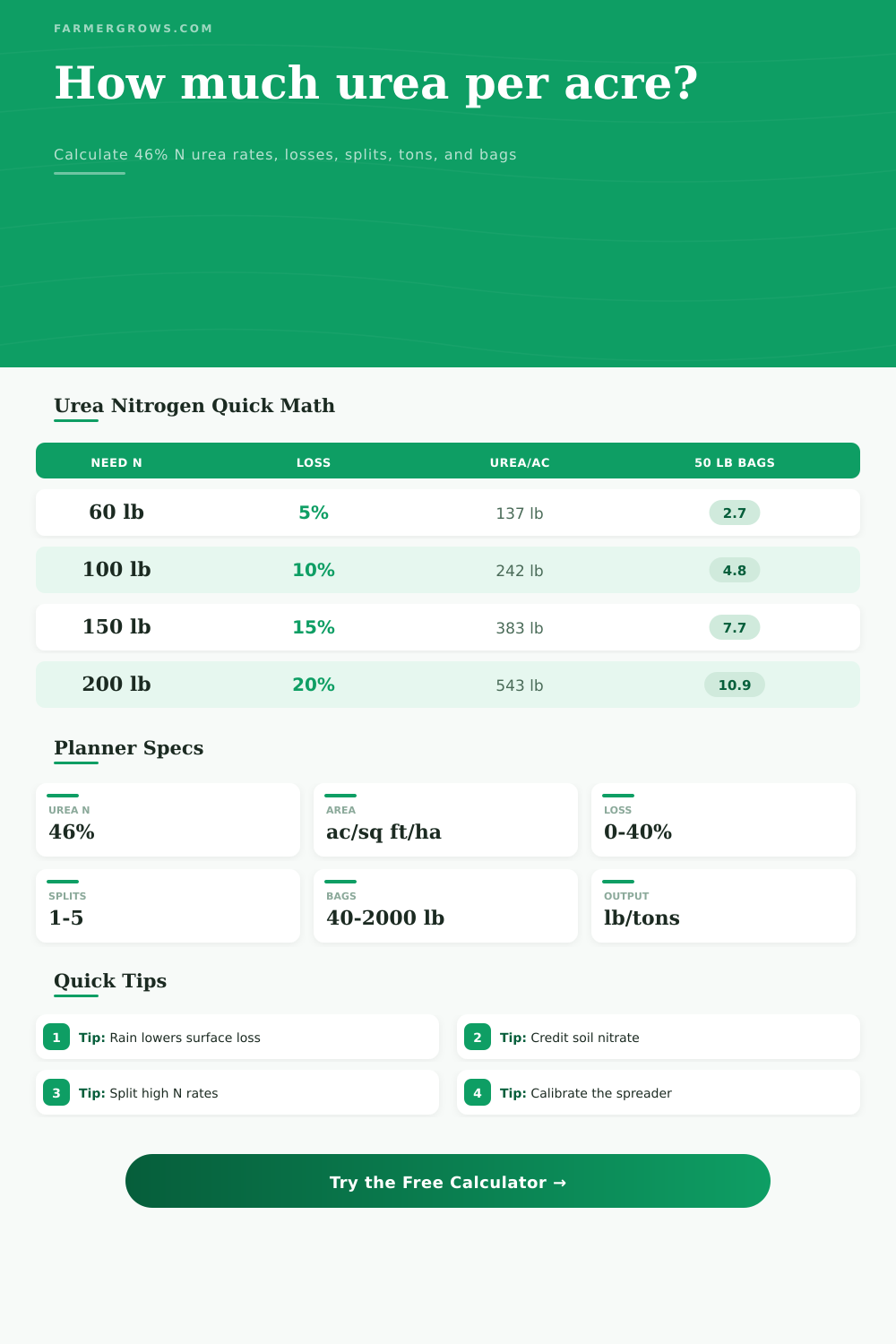
Urea Fertilizer per Acre Calculator
Estimate 46% nitrogen urea rates from target N, acres, credits, volatilization risk, urease inhibitor use, rainfall or incorporation timing, split applications, tons, and bag count.
Choose a common urea plan, then adjust the N target, acreage, credits, inhibitor setting, surface-loss assumption, rainfall or incorporation timing, split count, and bag size.
Fixed product analysis
Urea Application Results
Enter your target N, acreage, timing, loss, inhibitor, and split settings to calculate a urea plan.
Calculation Breakdown
| Target N after credits | Urea at 0% loss | Urea at 10% loss | Urea at 20% loss |
|---|---|---|---|
| 50 lb N/ac | 109 lb/ac | 121 lb/ac | 136 lb/ac |
| 75 lb N/ac | 163 lb/ac | 181 lb/ac | 204 lb/ac |
| 100 lb N/ac | 217 lb/ac | 242 lb/ac | 272 lb/ac |
| 150 lb N/ac | 326 lb/ac | 362 lb/ac | 408 lb/ac |
| 200 lb N/ac | 435 lb/ac | 483 lb/ac | 543 lb/ac |
| Field timing | Starting loss range | Inhibitor effect | Calculator use |
|---|---|---|---|
| Incorporated or irrigated same day | 0% to 5% | Small benefit | Use low loss when urea moves into soil quickly. |
| Rain within 24 hours | 3% to 8% | Small to moderate | Good fit for surface urea with reliable rain. |
| Rain in 2 to 3 days | 8% to 15% | Moderate benefit | Useful where light rain is forecast but not immediate. |
| Warm, dry, high residue surface | 15% to 30% | Large benefit | Consider inhibitor, irrigation, incorporation, or split timing. |
| Inhibitor setting | Loss reduction used | Best fit | Planning note |
|---|---|---|---|
| No inhibitor | 0% reduction | Incorporated urea or fast rain | The entered volatilization loss is used as-is. |
| Standard inhibitor | 35% reduction | Surface urea waiting on rain | Example: 20% loss becomes 13% planned loss. |
| Enhanced treated urea | 55% reduction | Higher loss weather window | Example: 20% loss becomes 9% planned loss. |
| Manual override | User controlled | Local guidance | Edit loss directly if your agronomist gives a specific value. |
| Urea rate | 50 lb bags per acre | Tons per 40 acres | Split example |
|---|---|---|---|
| 100 lb/ac | 2.0 bags/ac | 2.00 tons | 2 splits = 50 lb/ac/pass |
| 200 lb/ac | 4.0 bags/ac | 4.00 tons | 2 splits = 100 lb/ac/pass |
| 300 lb/ac | 6.0 bags/ac | 6.00 tons | 3 splits = 100 lb/ac/pass |
| 400 lb/ac | 8.0 bags/ac | 8.00 tons | 4 splits = 100 lb/ac/pass |
Best when tillage, irrigation, or enough rainfall can move urea into soil before urease activity drives ammonia loss.
Urease inhibitor can reduce the planning loss when urea stays on residue, warm soil, or higher pH surfaces before rain.
Splitting large rates can lower single-pass exposure and keep nitrogen closer to the crop uptake window.
Use the loss setting as a field assumption. Surface-applied urea can behave very differently after a fast soaking rain than it does on warm residue with no rain. Adjust the loss percentage to match the actual application window.
Do not double count nitrogen credits. Soil nitrate, manure, legume, irrigation water, and starter fertilizer credits should reduce the target before urea pounds are calculated.
The weather app won’t tell you much, so there you are standing in the field with a spreader loaded with white granules, hoping for rain sometime soon, tomorrow? Later this week? If so, it’ll help the urea add to crop yield; otherwise it turns to ammonia in the atmosphere. On paper, urea is great; out in the field, it’s a mess. It doesn’t move belowground till either tillage do it, or else water. And while it waits, an enzyme called urease breaks down the fertilizer, turning it into ammonia. If the weather’s dry and warm, the ammonia may evaporates into the air. You’re up against an enzyme-clock; not a clock of hours.
After entering assumed losses, acres and target amount of nitrogen, calculator does the math for you. It avoids any guesswork regarding conversions and coefficients. But it’s important to realize that output numbers will only be as good as the inputs. Volatilization loss percent is most important variable to set correctly because it varies depending on residue cover and soil pH. High pH soils accelerates the chemical reaction that creates ammonia gas. A 7.5 pH soil might lose considerably more nitrogen then a 6.0 pH soil, for example. If you broadcast urea onto corn stubble with high residues in July, you’re probably going to be disappointed if you assume a low loss rate. Use the tool to dial in your loss percentage according to what you know about your fields. That’s much better than using one-size-fits-all recommendation from your extension.
How to Use Urea Fertilizer Better
Urease inhibitors are often forgotten by many growers; they see them as optional extras, not requirements. Urease inhibitors slows down the urease reaction. This gives you time to either incorporate it or wait for rain. When you choose an inhibitor option in the calculator, it will reduce amount of estimated loss you’ve inputted accordingly. Depending on which product you choose, a basic product could reduces loss by a third, while an enhanced product could reduce it even more. It’s not marketing but actualy chemistry that affects your bottom line. Use an inhibitor as insurance against a possible rainless prediction. Save yourself the cost of lost nitrogen.
Another option to reduce risk is to split your applications. Instead of applying all your nitrogen at the time of planting, apply half initially and the remaining half as needed during peak crop demand later in the growing season. To do this, use the calculator to split up your total urea application rate into several passes. In terms of planning, this will help you make those splits. For example, it makes the job easier by spreading out the load on your spreader. This is better for even distribution throughout the field, and it increases efficiency by matching nitrogen availability with crop uptake and reducing the chance of early-season leaching or loss.
The last part of the puzzle is calibration. If you do not calibrate your spreader correctly, all that accurate application means nothing. Even if your rate calculation are correct, inaccurate calibration will cause too little or to much to be applied. By using the tool, you’ll know how many bags (or tonnage) are required for your entire operation. Do I need two tons of bulk urea or does my field require ten 50-pound bag? That allows for proper planning based off logistics and buying. It takes what was once a theoretical rate and makes it something practical that you can shop for.
“Urea has value because it’s concentrated,” he says. By weight, it’s 46 percent nitrogen; that means you can move large amounts of nutrient with less material. As long as you account for the volatility, it’s really easy to handle and cost effective.” The tool’s reference tables illustrates just how fast the needed pounds of urea skyrocket once you start accounting for losses, even 10 percent doesn’t sound like much until you realize it translates into actual dollars on a big farm.
You can manage uncertainty by fertilizing with urea. The way I look at it, you have no control over the weather, but you do have control over your assumptions. Adjusting your estimate for losses based off what kind of weather you’re expecting (or what the ground feels like) allows you to transform a gamble into a calculated risk. And so we have the framework: The calculator gives us that. The rest is up to your knowledge of the field; the wisdom. You should of wanted nitrogen up in the sky when the rain finally arrives; you want it in the soil.