46-0-0 Fertilizer Per Acre Calculator
Estimate 46-0-0 urea fertilizer from target nitrogen, acreage, product analysis, volatilization loss, incorporation timing, split applications, bag size, and spreader allowance.
Load a starting N program, then adjust the recommendation to match your soil test, crop plan, yield goal, weather, and local nutrient management rules.
Straight 46-0-0 supplies nitrogen only. The calculator increases product for volatilization, handling allowance, and selected efficiency so the planned effective N still reaches the crop target.
High-analysis dry N source. Watch surface volatilization when it stays warm, moist, and unincorporated.
Good for sidedress or injection systems, with roughly 3.13 lb solution per lb N before losses.
Supplies ammonium N and sulfur, but needs over twice as much product for the same N target.
Often quicker acting with lower volatilization concern, but leaching risk can rise on wet soils.
46-0-0 Urea Application Plan
Results show loss-adjusted product needs, actual nitrogen delivered, total tons, bag count, and per-pass rates for the selected acre count.
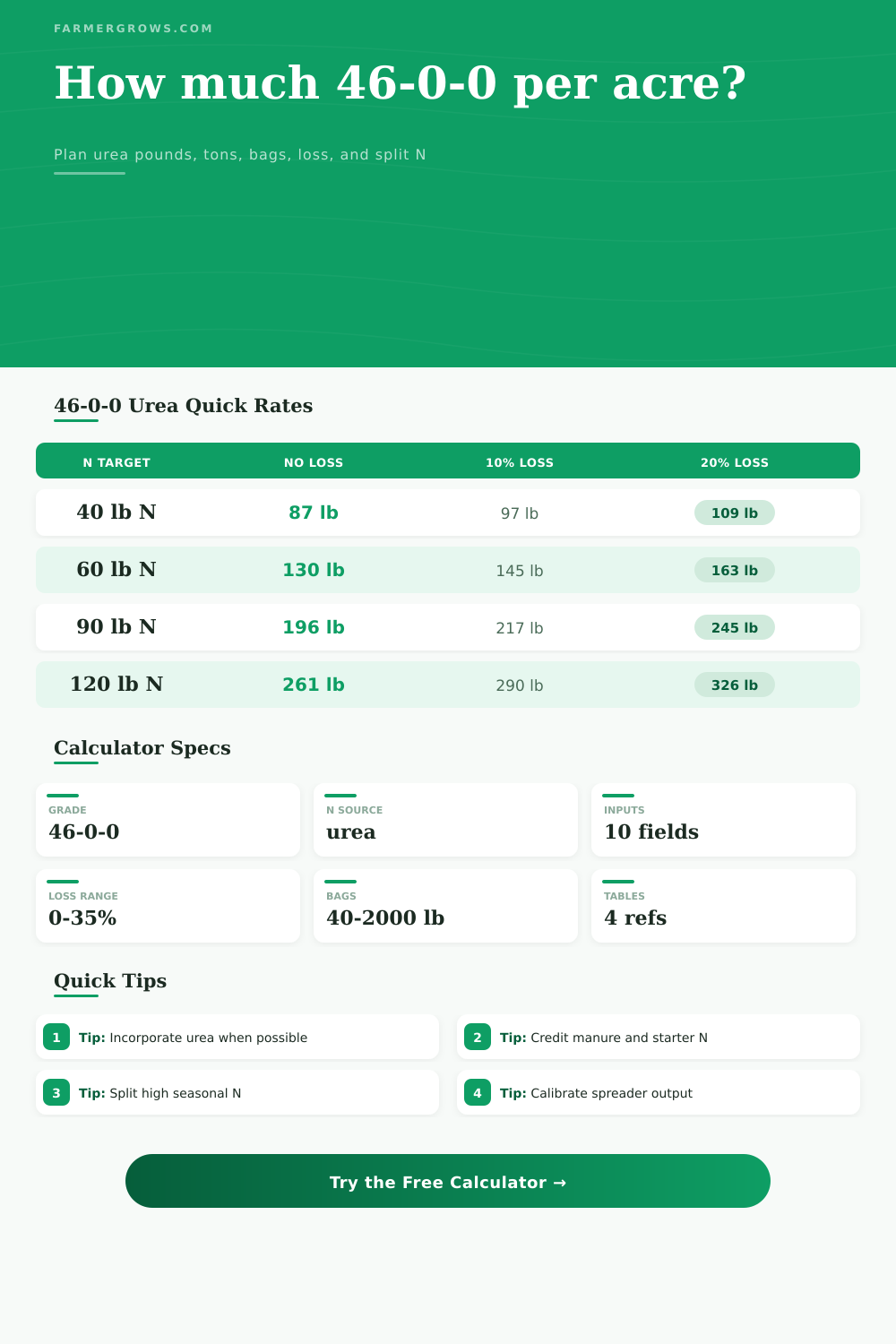
| Target N | Urea at no loss | Urea at 10% loss | Urea at 20% loss | 50 lb bags per acre |
|---|---|---|---|---|
| 40 lb N/ac | 87 lb/ac | 97 lb/ac | 109 lb/ac | 2-3 bags |
| 60 lb N/ac | 130 lb/ac | 145 lb/ac | 163 lb/ac | 3-4 bags |
| 90 lb N/ac | 196 lb/ac | 217 lb/ac | 245 lb/ac | 4-5 bags |
| 120 lb N/ac | 261 lb/ac | 290 lb/ac | 326 lb/ac | 6-7 bags |
| 160 lb N/ac | 348 lb/ac | 386 lb/ac | 435 lb/ac | 8-9 bags |
| Timing or placement | Typical loss input | Use when | Product effect |
|---|---|---|---|
| Incorporated same day | 0-3% | Tillage, banding, injection, or quick mixing | Lowest urea rate |
| Rain within 24 hours | 3-6% | Enough rainfall or irrigation moves urea into soil | Small rate bump |
| Rain within 2-3 days | 6-10% | Moderate delay after broadcast spreading | Normal planning bump |
| Warm surface broadcast | 15-25% | Residue, high pH, warm soil, no incorporation | Large rate bump |
| Split plan | Common share | Best fit | N management note |
|---|---|---|---|
| 1 pass | 100% | Small N rates or preplant incorporation | Simple but higher exposure window |
| 2 passes | 40/60 or 50/50 | Corn, cotton, hay, mixed vegetables | Matches uptake better |
| 3 passes | 30/40/30 | Long-season crops or irrigated fields | Reduces single-pass burn risk |
| 4 passes | 25 each | High-value crops and spoon-feeding | Needs tighter logistics |
| N source | Analysis | Product for 100 lb N | Strength vs urea |
|---|---|---|---|
| Urea | 46-0-0 | 217 lb | Baseline |
| UAN solution | 32-0-0 | 313 lb | 44% more product |
| Ammonium sulfate | 21-0-0 | 476 lb | 119% more product |
| Ammonium nitrate | 33-0-0 | 303 lb | 39% more product |
Protect the N: Urea is most efficient when it is incorporated, irrigated in, rained in, banded, or treated with an appropriate stabilizer before high-volatilization weather.
Respect the recommendation: This calculator converts a nitrogen target into product weight. Confirm crop rates, setbacks, maximum single applications, and manure credits with your local agronomy guidance.
Nitrogen: Nitrogen fertilizer come as a liquid (UAN solution) or as a dry form, such as urea or ammonium sulfate. Solid forms is typically more concentrated versions of their dry counterparts, urea is a solid form of concentrated nitrogen. Because urea has 46 percent nitrogen, you’ll use fewer pounds of urea for a given level of nutrients than either UAN solution or ammonium sulfate.
The catch is stability. Urea are unstable if left sitting on the ground. Especially if it’s warm and moist, urea will turn into ammonia gas, which then escape upward in the air. You have lost your nitrogen. You’ve paid for fertilizer that won’t benefit the crop.
How to Use Nitrogen Fertilizer Correctly
Soil conditions and weather will account for this loss, and by doing so, help you save it. How? When urea is applied to your ground, soil urease enzymes causes it to turn into gas. Once you plug in your field size and expected loss rates, the calculator handles math to help you order only amount of urea necessary. No more guessing.
Nitrogen retention depend on the time of incorporation. When nitrogen (for instance from urea) is banded in the seed row or tilled into soil, it remains trapped and little loss occurs. But when urea is broadcast onto no-till corn residue, there’s potential for loss if warm winds blow for three dry days without rainfall. To account for that possibility, the tool will ask how you incorporated the fertilizer so it can tweak the estimated percentage of loss. A slight rise in that number alter the needed tonnage.
Split applications lower risk. If you apply all the N at pre-plant, you give yourself time to run off or have it washed out of your soil. Not every plant want that nutrient right now. Splitting the application feeds the crop as it’s actualy growing. That means less waste and fewer potential burns on plants. The calculator will tell you how much product in total is needed, then divide it up across passes. Two splits? Four? Your choice. It matches up the curve where a plant take up nutrients with when they’re available. And that lowers risk of burning the crop, while making things more efficient.
Next, consider nitrogen credits. Existing nitrate in the soil profile, as well as manure applied last fall, contribute additional nitrogen. If you ignore those, you would of fertilized too heavily. Too much fertilizer is expensive, and it pollutes groundwater. To get a handle on this, the nitrogen credit input allow you to subtract what you already have from what you need. Then the calculator rounds up your needs to whole bags and adds a bit extra for calibration and overlap to make sure you have enough.
The number of bags handled and the bag size is practical and make sense. The tool rounds up your needs to whole bags. It includes an allowance for overlap and calibration drift. That is important for managing multiple field.
The reference tables illustrate that a higher nitrogen target mean more physical product weight. A jump in nitrogen from sixty to ninety pounds per acre involves a lot of extra product. It is high-analysis fertilizer. Cheap. Easy to store. Demands attention to detail. Plan for the soil conditions. Plan for the weather conditions. Plan for split applications.
If you manage those, the nitrogen in the urea stays in the ground. It feed the roots. The harvest pays for input.