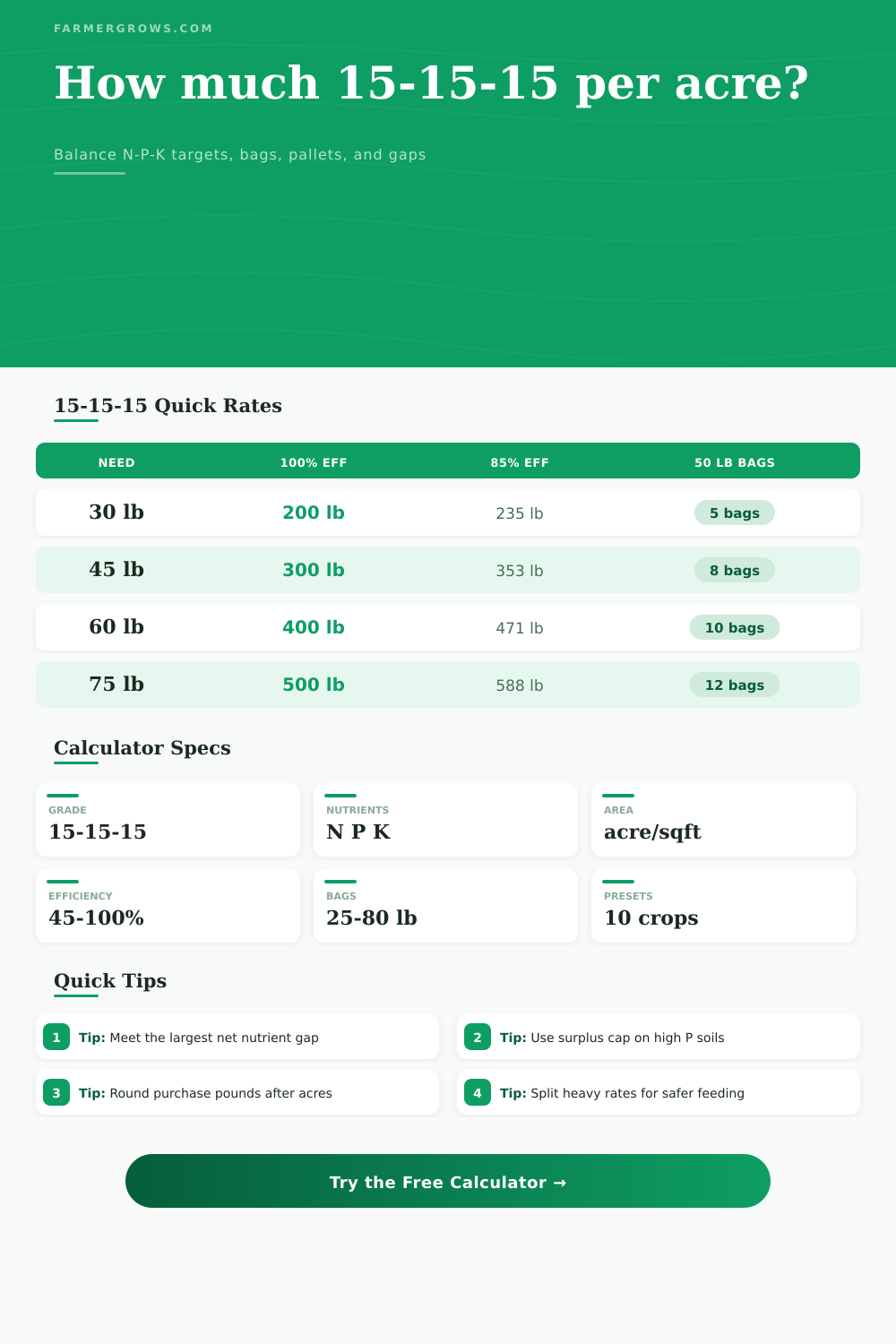
15-15-15 Fertilizer Per Acre Calculator
Estimate a fixed 15-15-15 balanced fertilizer plan from acreage, crop N-P-K targets, soil credits, efficiency, placement method, surplus limits, product pounds, bags, pallets, and split applications.
Load a crop pattern, then adjust targets from your soil test. The calculator keeps the product locked to 15-15-15, so each pound of fertilizer carries equal label pounds of N, P₂O₅, and K₂O.
Chooses the largest product rate needed by N, P₂O₅, or K₂O, then reports excess on the other nutrients.
Limits the rate when low-demand nutrients would exceed your allowed surplus, even if one target remains short.
Sizes product by N, P₂O₅, or K₂O when one recommendation is the only nutrient you want to satisfy.
Enter a known lb/ac product rate and use the calculator to audit delivered nutrients, bags, pallets, and gaps.
Target nutrient need, lb per acre
Soil, manure, compost, or carryover credits, lb per acre
15-15-15 Fertilizer Plan
Enter acreage and nutrient targets to calculate the balanced product rate.
| Net nutrient target | Product at 100% | Product at 90% | Product at 85% | Product at 75% |
|---|---|---|---|---|
| 30 lb/ac N, P₂O₅, or K₂O | 200 lb/ac | 222 lb/ac | 235 lb/ac | 267 lb/ac |
| 45 lb/ac N, P₂O₅, or K₂O | 300 lb/ac | 333 lb/ac | 353 lb/ac | 400 lb/ac |
| 60 lb/ac N, P₂O₅, or K₂O | 400 lb/ac | 444 lb/ac | 471 lb/ac | 533 lb/ac |
| 75 lb/ac N, P₂O₅, or K₂O | 500 lb/ac | 556 lb/ac | 588 lb/ac | 667 lb/ac |
| 90 lb/ac N, P₂O₅, or K₂O | 600 lb/ac | 667 lb/ac | 706 lb/ac | 800 lb/ac |
| Product rate | Gross N-P-K | Available at 90% | Available at 85% | Available at 75% |
|---|---|---|---|---|
| 200 lb/ac | 30-30-30 lb/ac | 27-27-27 | 25.5-25.5-25.5 | 22.5-22.5-22.5 |
| 300 lb/ac | 45-45-45 lb/ac | 40.5-40.5-40.5 | 38.3-38.3-38.3 | 33.8-33.8-33.8 |
| 400 lb/ac | 60-60-60 lb/ac | 54-54-54 | 51-51-51 | 45-45-45 |
| 500 lb/ac | 75-75-75 lb/ac | 67.5-67.5-67.5 | 63.8-63.8-63.8 | 56.3-56.3-56.3 |
| 600 lb/ac | 90-90-90 lb/ac | 81-81-81 | 76.5-76.5-76.5 | 67.5-67.5-67.5 |
| Bag size | Gross nutrient per bag | Bags at 300 lb/ac | Bags at 500 lb/ac | Pallet note |
|---|---|---|---|---|
| 25 lb bag | 3.75 lb each | 12.0 bags/ac | 20.0 bags/ac | Often 60-80 bags per pallet |
| 40 lb bag | 6.0 lb each | 7.5 bags/ac | 12.5 bags/ac | Often 40-50 bags per pallet |
| 50 lb bag | 7.5 lb each | 6.0 bags/ac | 10.0 bags/ac | Default calculator setting |
| 80 lb bag | 12.0 lb each | 3.75 bags/ac | 6.25 bags/ac | Useful for fewer lifts |
| Crop preset style | Likely limiting nutrient | Why 15-15-15 fits | Watch item | Calculator response |
|---|---|---|---|---|
| Balanced garden | N or K | Moderate equal feed before crop-specific sidedress | High soil P can create surplus | Use cap mode if P is already high |
| Food plot | P₂O₅ or K₂O | Works as a simple establishment blend | Lime and pH still drive response | Credits reduce the product rate |
| Pasture | K₂O | Maintenance blend for moderate removal | May underfeed K on hay ground | Shortfall row flags the gap |
| Tomato rows | K₂O | Useful base before flowering and fruit set | N surplus can push vines | Split count lowers each pass |
| Manual trial | Entered rate | Audits a known spreader or supplier recommendation | Wrong rate may miss one target | Gap card shows shortage or excess |
Balance against soil-test credits. A 15-15-15 blend is cleanest when N, P₂O₅, and K₂O needs are similar after compost, manure, and carryover are credited.
Use the cap when one nutrient is already high. Surplus cap mode can intentionally leave the highest-demand nutrient short so a separate targeted source can finish the plan.
You walk down the fertilizer aisle in a hardware store and are confused by all those bags. Each one displays three numbers on the front side. Sounds like an easy enough code, right? Nope. That’s actualy hiding a pretty complicated math puzzle.
A typical balanced fertilizer such as 15-15-15 means equal amounts of nitrogen, phosphate and potash. So that’s good, no overdoing things with any particular component and no underdoing others. But knowing you need balance is different than knowing how much of that balance your land actualy requires.
How to Use the Fertilizer Calculator
The calculator up top do all this work for you. It turns raw information from your soil test plus acreage into a full grocery list.
What’s in the bag? The label tells you that, but it’s not necessarily what your plants will absorb. What’s on the label. That’s not what your plants is getting.
Phosphate is the middle number. It is important for fruiting and root development. Potash is the third number. It helps regulate water and resist disease.
Nitrogen: First number. Drives green leafy growth. The kind you’re hoping to see.
If it says 15-15-15, by weight it contains fifteen percent of each. In one-hundred pounds of the stuff there are fifteen pounds of each nutrient. This makes the math easy, because it’s a clean ratio.
Now here’s where the real world comes into play: the dirt under your feet doesn’t begin at zero. Maybe you left some leftovers from last year’s growing season. Or maybe you added compost that is still breaking down. Those are credits. If you don’t count your credits, chances are you’re over-applying.
Over-applying is a waste of money and also bad for the environment since it washes off into local waterways. You can remove the credits using the tool on this page. Then it will calculate the post-subtraction product rate. That way you’ll know how much you need to replace what’s missing (if anything at all).
There’s a variable that we don’t see: efficiency. That gets most rookie farmers and gardeners. When you’re spreading around pounds of fertilizer, not all those pounds makes their way onto the plant. Some bind tightly to soil particles. Some wash out with the next heavy rain. Some turn into gas in the air.
The calculator has an efficiency slider. You’ll use that to tweak for lost material. For example, if you’ve got a dry field, and you’re spreading dry fertilizer over it, you’d use a lower efficiency setting than if you were incorporating the nutrients in the soil directly. A 10% change in efficiency mean a significant change in overall product requirement. It is a small thing, but it matters. Doing so keeps you from making a common error: believing that you have applied enough when you really has fallen short by a wide margin.
Then there’s another level: the physical reality of doing this work. Typically, fertilizer is purchased by the bag, not by the pound. That means the calculator translates your estimated requirements to bags (and even sometimes pallets) that you will physically purchase. And it rounds up, so you’ll never run short of material on any section of the ground.
It takes account of split applications. Split applications are a good tactic for heavy-feeding crops; applying the whole dose of something like nitrogen all at once can literally burn tender plants. Nutrients can also wash away, leaving the plants lacking before they has a chance to absorb them. Split applications distribute the nutrients gradually, without waste, and with less risk of losing any along the way.
For common situations, the layout reference tables shows the impact of lower efficiency at a glance. This applies as the product rate changes from 100-percent efficiency to, say, 85 percent. Those aren’t arbitrary figures. They reflect real choices about efficiency, labor and cost, and caring for the environment.
Soil chemistry is another factor, which brings us back to the topic of using a balanced fertilizer such as 15-15-15. Generalists’ tools: About managing expectations. Managing soil chemistry. This is not necessarily the final answer for feeding specialty crops that really require additional nutrients, such as extra potassium or even specific micronutrients, depending on the crop.
For those crops, the calculator gets you to a good starting point. It is a plan that closes the biggest net gap of the missing nutrients. It also doesn’t wildly overshoot on the rest. Turns the vague objective of “feed the plant” into something real. It is something with measurable input and output.
There’s still work to do. You have to watch your soil, adjust based off weather, and read what happens on the crops leaves. But you should of at least start with knowledge instead of guessing.
That’s where the best gardeners aren’t just lucky: They’re precise. And precision begins by knowing what’s inside that bag. And knowing how much the ground will hold.