Cabbage Plants Per Square Foot Calculator
Estimate cabbage plant density for beds, blocks, and short rows using head type, maturity group, spacing, usable bed area, transplant survival, and succession timing.
Choose a real cabbage planting pattern, then adjust the bed dimensions, head type, maturity, spacing, and succession settings to match your garden plan.
Cabbage Square-Foot Planting Plan
Spacing and bed size summary will appear here.
Best for 4-foot beds, small plots, and compact varieties where each square is filled evenly.
Best when hoeing, drip tape, or row cover hoops define the cabbage spacing.
Offsets every other row to use bed width efficiently while keeping leaves from crowding stems.
Repeats smaller cabbage plantings so mature heads arrive over several weeks instead of all at once.
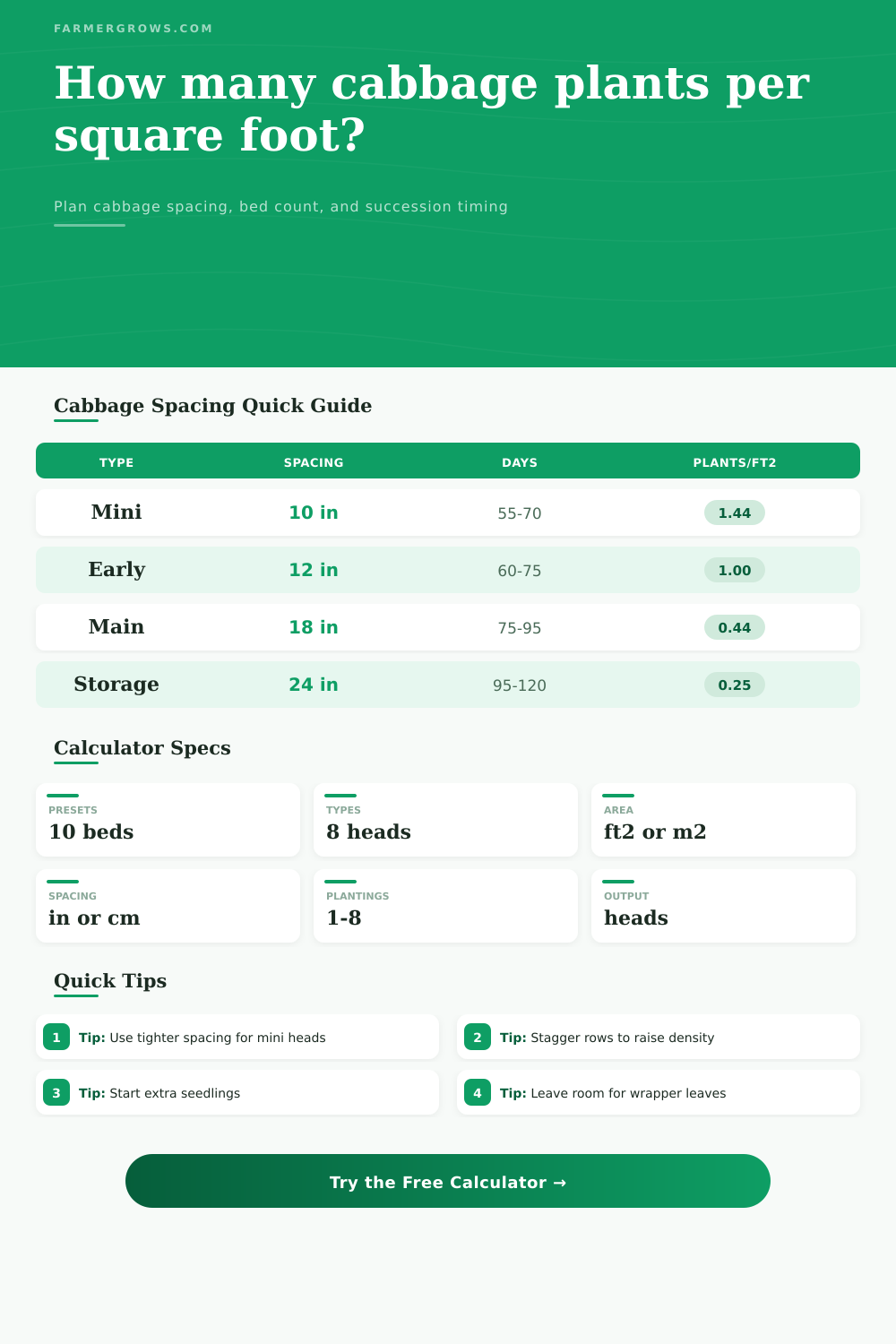
| Heading type | Typical spacing | Maturity range | Square-foot use |
|---|---|---|---|
| Mini or baby cabbage | 8 to 10 in each way | 50 to 70 days | 1.44 to 2.25 plants/sq ft for small heads |
| Early green cabbage | 12 to 15 in each way | 60 to 75 days | 0.64 to 1.00 plants/sq ft in spring beds |
| Maincrop round green | 18 in each way | 75 to 95 days | About 0.44 plants/sq ft for medium heads |
| Red cabbage | 18 to 24 in each way | 80 to 110 days | 0.25 to 0.44 plants/sq ft depending on head size |
| Savoy cabbage | 18 to 24 in each way | 75 to 105 days | Room for crinkled outer leaves improves airflow |
| Napa or Chinese cabbage | 10 to 15 in rows, 14 to 18 in apart | 50 to 75 days | Works well in staggered rows for tender heads |
| Spacing pattern | Plants/sq ft | Plants in 4x8 bed | Best cabbage fit |
|---|---|---|---|
| 8 x 8 in | 2.25 | 72 before edge buffer | Baby cabbage, trial greens, small napa |
| 10 x 10 in | 1.44 | 46 before edge buffer | Mini heads and compact pointed types |
| 12 x 12 in | 1.00 | 32 before edge buffer | Early green cabbage and tight square-foot beds |
| 15 x 15 in | 0.64 | 20 before edge buffer | Intermediate early and small red cabbage |
| 18 x 18 in | 0.44 | 14 before edge buffer | Maincrop, savoy, and medium storage heads |
| 24 x 24 in | 0.25 | 8 before edge buffer | Large storage cabbage or wide wrapper leaves |
| Succession plan | Interval | Useful season | What it does |
|---|---|---|---|
| Single planting | 0 days | Storage or one-time harvest | Maximizes one crop block and one harvest window |
| Two plantings | 10 to 14 days | Spring or fall main bed | Spreads mature heads over about three to four weeks |
| Three plantings | 14 days | Cool, steady weather | Works for fresh eating without filling the whole bed at once |
| Four or more plantings | 7 to 10 days | Baby cabbage or napa | Small repeated batches keep tender heads moving |
| Bed example | Usable area | 12 in spacing | 18 in spacing |
|---|---|---|---|
| 2 x 6 ft edge bed | 11 sq ft at 92% | 11 cabbage plants | 5 cabbage plants |
| 4 x 4 ft square bed | 15 sq ft at 92% | 15 cabbage plants | 7 cabbage plants |
| 4 x 8 ft raised bed | 29 sq ft at 92% | 29 cabbage plants | 13 cabbage plants |
| 30 in x 50 ft market bed | 115 sq ft at 92% | 115 cabbage plants | 51 cabbage plants |
Match spacing to head size. Mini and early cabbage can sit close, but storage cabbage needs air and wrapper-leaf room so heads size up without constant rubbing.
Plan seedlings above the exact count. A cabbage bed rarely transplants at 100 percent, so the calculator raises seedling starts when survival is below perfect.
How many cabbage plants fit? That’s what we all ask about a new raised bed. How many can I grow here without crowding?
We want a manageable home garden feel, but with the density of a commercial field. What’s the right answer to cabbage plant per square foot? It isn’t just about geometry; it is more like a negotiation between airflow, head size, and how patient you are with thinning baby cabbages.
How Many Cabbage Plants Fit in Your Garden?
Enter your bed dimension and your plant-to-plant spacing into the calculator; it’ll do the math for you. Stop guessing at conversions and other numbers. Knowing why matters help keep the heads firm and healthy.
One square-foot block, or perhaps a tidy 4×8 bed: that’s what most gardeners begin with. In their minds’ eye they see orderly grids, with each plant recieve its fair share of real estate. Fine on paper, but in the real world those cabbage leaves go and get all expansive. Particularly when the heads start to tighten up, they spread out like green umbrellas. If planted too closely, the foliage touches. When foliage touches, you’ve got trapped moisture and a recipe for mildew setting in. It is a small thing, but it matter.
See the reference table below for spacing. Mini varieties need 10 inches between plants, while storage cabbages need over a foot, at 24 inches. The point isn’t really fitting in more heads… But fitting in healthy ones.
The spacing depends a lot on the crop you’re planting. For example, mini cabbages will tolerate cramming into a 4×4 block and produce decent yields anyway. They don’t produce such a huge leafy structure as maincrop varieties, so they’re forgiving.
Early greens require about a foot of space in each direction to grow properly. They are slightly pickier, as too little room makes for a very unhappy early green. That’s when the heading-type selection has its impact.
A heavy red storage variety or some giant Savoys will push down the density requirement. And it will also force you to face reality: The plant is the size it must be, and there is no cheating nature by forcing three big heads in an area where only two fit. The outcome is three crappy, misshapen heads that go bad at the bottom.
Oh yeah, and then there’s the question of succession planting. A lot of folks grow all of their cabbages, say, on day one and then wait months, harvesting them all in a mad weekend rush. Then by the time you’ve even made a dent in half your heads, the remainder have begun to separate into bits, or go bolting.
Better to space your sowings, as this stretches that brief harvest moment into a stream of newly picked veggies. With the calculator you can specify how long to leave between sowings; I find about two weeks is ample to stagger maturing times. Plant a row in April; another in mid-April; perhaps one more in late May. Each batch will mature a week or two later than the last, and you’ll enjoy a constant supply rather than an onslaught. More work up front? Yes. But it pays back well in fresh food for many days longer.
People also ignore another number: transplant survival. You buy fifty seedlings and expect fifty plants, but don’t get fifty plants. Why? Because some get damaged by the roots; some burn their leaves in the sun; others just never establish themselves.
This tool has an input called survival percentage. If you’re a realist, say you enter 80 percent; if you’re a Pollyanna, call it 90. It will adjust the seedling count upward to allow for those losses, starting you with a few extras to make up the difference. Better a handful of spares than gaps in your rows.
How do you choose how many and where? Measure out what’s usable in your bed, then subtract drip lines, pathways, and edge space. Next, select the cabbage type that fits how you want to store them. Choose storage types for winter eating or mini heads for fast consumption. Based off that choice, set your spacing. Use this tool again to determine the density. Now stand back and assess your layout. Do the cabbages seems too close together in your mind? They will be in the soil.
The math will help; but even more so, believe your own eyes. A well-spaced bed will appear slightly empty initially; and that’s when you have it right.