Zucchini Plants Per Square Foot Calculator
Estimate zucchini plant count from actual usable bed area, bush habit, spacing, edge clearance, harvest load, succession rounds, and transplant buffer.
Choose a realistic garden setup, then tune the bed shape, bush size, harvest goal, and clearance for your own zucchini spacing plan.
Zucchini Planting Estimate
Results use usable growing area after clearance, then compare bed capacity with the plant count needed for your weekly harvest target.
Best for grow bags, half barrels, and small patios where one plant is often the whole zucchini crop.
Fits tight beds better than full-size bush types, but still needs open picking space around the crown.
The safest default for square-foot gardens: one plant per 9 ft² after edge clearance.
Can shrink the footprint, but needs staking, pruning, tying, and reliable watering to stay productive.
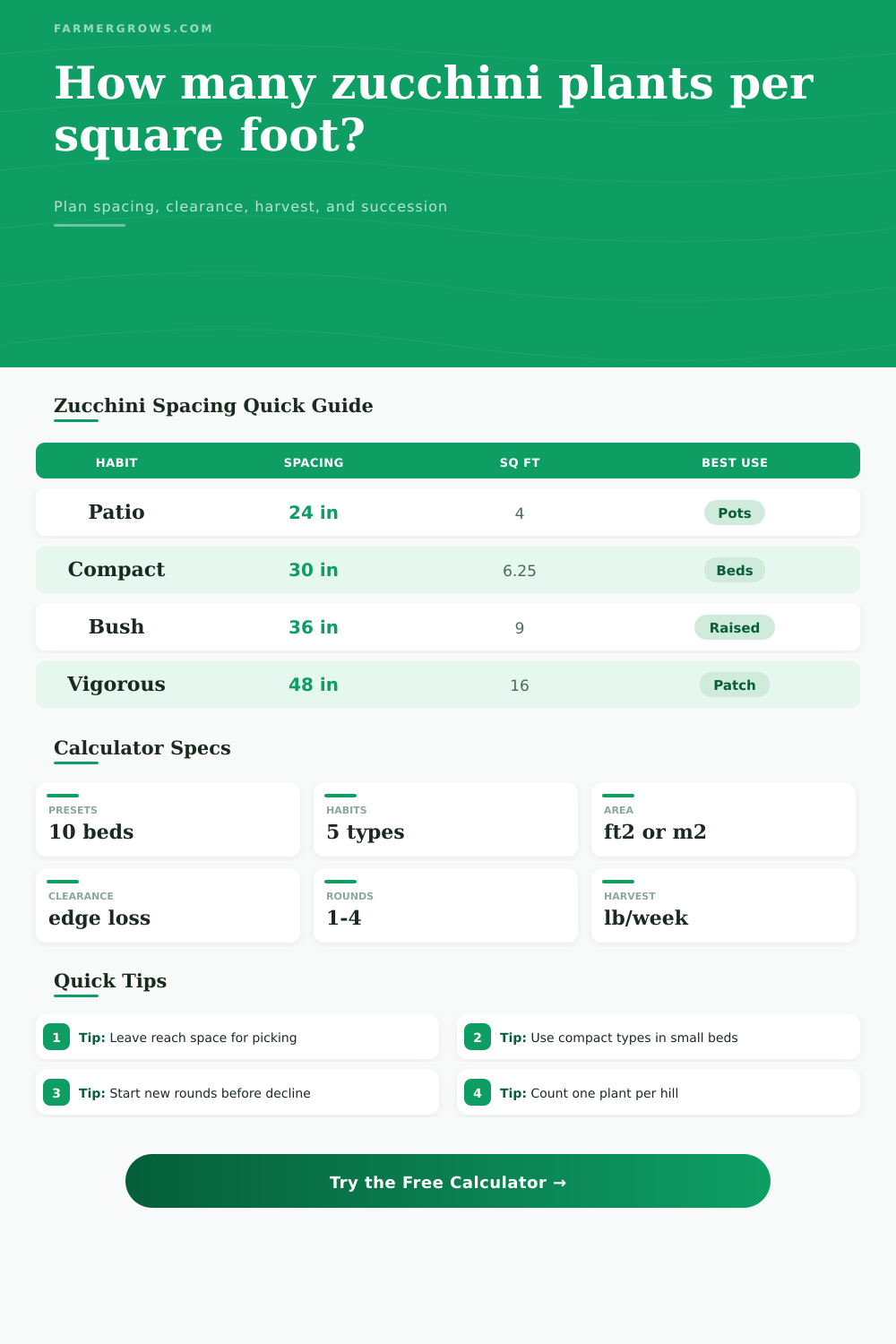
| Zucchini habit | Typical spacing | Sq ft per plant | Plants per ft² | Best fit |
|---|---|---|---|---|
| Patio or container bush | 24 in centers | 4.0 ft² | 0.25 | Large pots, grow bags, compact patios |
| Compact bush zucchini | 30 in centers | 6.25 ft² | 0.16 | Small raised beds and intensive gardens |
| Standard bush zucchini | 36 in centers | 9.0 ft² | 0.11 | Most backyard raised beds and block plantings |
| Large bush or semi-vining | 48 in centers | 16.0 ft² | 0.06 | Open patches, fertile soil, vigorous varieties |
| Trained upright or trellised | 24 to 30 in row spacing | 5.0 ft² | 0.20 | Supported vertical rows with frequent pruning |
| Usable area | Compact bush | Standard bush | Vigorous type | Trellised row |
|---|---|---|---|---|
| 16 ft² | 2 plants | 1 plant | 1 plant | 3 plants |
| 32 ft² | 5 plants | 3 plants | 2 plants | 6 plants |
| 64 ft² | 10 plants | 7 plants | 4 plants | 12 plants |
| 100 ft² | 16 plants | 11 plants | 6 plants | 20 plants |
| 200 ft² | 32 plants | 22 plants | 12 plants | 40 plants |
| Harvest goal | Typical plants | Peak weekly harvest | Round length | Succession note |
|---|---|---|---|---|
| Occasional meals | 1 to 2 plants | 2 to 5 lb | 5 to 7 weeks | One planting is usually enough for a small household |
| Steady family harvest | 3 to 5 plants | 6 to 12 lb | 6 to 8 weeks | Start a second round 4 to 5 weeks after the first |
| Sharing and freezing | 6 to 10 plants | 12 to 24 lb | 6 to 8 weeks | Split plantings to avoid one heavy flush |
| Farmstand picking | 12 or more plants | 25 lb or more | 4 to 7 weeks | Use staggered rows and retire declining plants |
| Clearance situation | Calculator treatment | Why it matters | Typical setting |
|---|---|---|---|
| Two-side raised bed | Subtracts edge clearance from all sides | Keeps leaves off paths and fruit reachable | 8 to 12 in edge clearance |
| Fence or wall side | Caps usable width near the reachable edge | Fruit hidden at the back is often missed | 24 to 30 in reachable width |
| Field patch rows | Subtracts service lanes at set intervals | Room for picking buckets and airflow | 18 to 24 in service paths |
| Containers | Uses container area with light rim clearance | One crown per large container is common | 24 in or larger diameter |
Plan the picking aisle first. Zucchini leaves get large fast, so a bed that fits plants on paper can still fail if you cannot see and harvest fruit every day or two.
Use succession to manage overload. Instead of planting every zucchini at once, split rounds by several weeks so old plants can be removed as newer plants begin producing.
Gardeners get a certain kind of panic in July. The packet promises: Two zucchini seeds are all it takes to feed a family of four. So in you go. The plants are planted, the hose is turned on, and seedlings are tended lovingly while you wait patiently for produce.
But what you got? You have a jungle of rampaging foliage and perhaps three usable squashes all summer long, making you wish you’d planted more. What you didn’t do wrong: Not enough work. What you did do wrong: Fail to adjust for reality.
How to Plan Your Zucchini Garden
To translate the number of feet in your bed into a reasonable plan of attack, there’s the zucchini plants per square foot calculator. It moves you from guessing wildly to having a real plan for everything from kitchen counters to ground beneath your feet.
We often forget about edge clearance as gardeners. When we measure how much room to give a plant, we’re thinking “square footage“… The width multiplied by the length across the bed, divided. But a raised bed isn’t an endless grid of squares; it’s a real place, bounded by edges, human arms that don’t go on forever.
Two inches of margin all around won’t be enough and the outermost plants will choke up against the fence. Their foliage won’t get air circulation, so their leaves will rot and the fruit will tuck into the shadows. Define that loss of space, and let the calculator do the rest (above). It also reminds you that a four by eight foot bed isn’t thirty-two usable square feet if you must leave edges free for access and health reasons. That makes all the difference. You’re only planting in more compact core than you originally figured.
The geometry of it all is important, but so is the habit: All zucchini are not created equal. Some are bred to be compact; so-called patio varieties that fit nicely into a snug corner or even a big pot. Standard bush types wants their own three by three foot square. Squeeze a rambunctious standard variety into what’s appropriate to a patio bush and you’ll have dinner (but more likely disease).
With the tool you can choose which sort of growth habit you’re dealing with. That’s key, because while yes, it’s about how you fit them in, it’s also about leaving them room to breathe. Zucchini foliage is big business. It casts long shadows. It traps moisture. When crowded, it invites mildew. And mildew, unlike pests, kills the crop fast. Avoiding that green fog of decay starts with choosing the proper habit for your space.
And it’s making you be honest with yourself about what (and how much) you actualy eat. I know we’d like endless summer squash. But seriously, how many loaves of zucchini bread can you really take before you start asking your neighbors for new recipes? A weekly harvest goal helps avoid the age-old problem of being overwhelmed by produce come fall.
How do you know if you’ve got too many plants to fit into your diet? Planting six plants of something you only eat two pounds of each week is a recipe for waste. The calculator will help you compare what you think you’ll eat versus what one plant will yield. It’ll show where you’re overdoing it for yourself to consume.
And it enables you to plant in stages. You don’t have to plant all at once; you can stagger some rounds so you don’t have a big drop-off in harvest as the earliest plants burn out here in our late summer heat. That way your harvest stays steady. A savvy gardener’s secret weapon is succession planting. A single planting makes heavy crops for six or eight weeks, then tapers off. When September arrives, there’s no more zucchini left. Start another round four weeks after the initial one and the fresh plants come into their own while the older ones die off. That levels the supply curve.
And it allows you to look at what’s happening mid-season, and amend plans accordingly. The calculator figures the overall footprint required for several rounds. That takes into account the need to wait until ground recovers so you don’t double-up on the same spot right away.
The last safety net is transplant buffers. Birds munch on seedlings. Heat and drought stress weaken the starts. And then there’s seed failure. The solution is this. A ten percent buffer in seed counts is inexpensive insurance that even with a loss of a couple of plants (either because they didn’t make it or were eaten by birds) you’ll still have sufficient stock to attain your harvest target. Better to have a few more seedlings to share than a patch of bare soil staring back at you wondering what went wrong.
Growing zucchini requires managing your expectations. The calculator eliminates all of the guesswork around how much space to leave between plants and how densely they can be planted. It transforms a chaotic patch into a managed system. The plant has a purpose. You can harvest consistently. You won’t panic in July anymore. That very first green fruit doesn’t come as a surprise. You’ll know exactly how many more will follow and when it is time for another round before the silence sets back in.