Squash Plants Per Square Foot Calculator
Estimate squash density from bed area, variety habit, hill or row layout, trellis training, spacing, walkway share, and seedling insurance.
Load a real squash layout, then adjust spacing, aisle share, germination buffer, and training method to match your garden.
Squash Spacing Results
Use the calculator to estimate squash density.
Zucchini, yellow squash, and many pattypans fit best with clear air around each crown.
Acorn and compact winter types need more room than zucchini but less than long runners.
Delicata and small-fruited vines can tighten spacing when pruned and supported early.
Large vines sprawl through alleys, so the true square-foot demand is much wider than the hill.
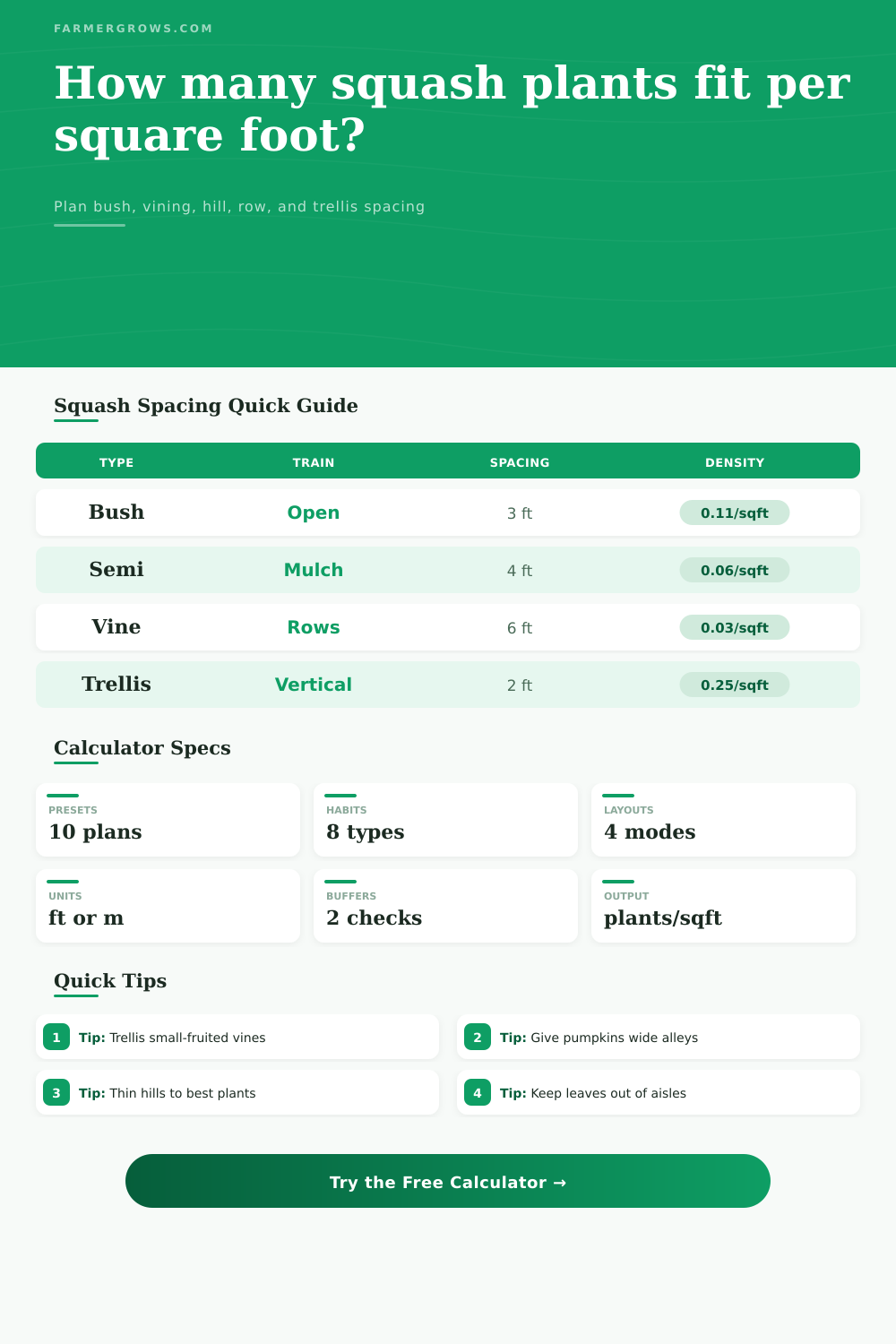
| Squash type | Typical plant spacing | Typical row spacing | Planning density |
|---|---|---|---|
| Bush zucchini | 24 to 36 inches | 36 to 48 inches | 0.06 to 0.17 plants per sq ft |
| Yellow summer squash | 30 to 36 inches | 36 to 48 inches | 0.06 to 0.13 plants per sq ft |
| Compact pattypan | 24 to 30 inches | 30 to 42 inches | 0.10 to 0.20 plants per sq ft |
| Acorn semi-bush | 36 to 48 inches | 48 to 60 inches | 0.03 to 0.08 plants per sq ft |
| Delicata trellis | 18 to 24 inches | 30 to 36 inches | 0.17 to 0.32 plants per sq ft |
| Butternut vine | 48 to 72 inches | 72 to 96 inches | 0.02 to 0.04 plants per sq ft |
| Spaghetti squash | 48 to 60 inches | 72 to 96 inches | 0.03 to 0.04 plants per sq ft |
| Pumpkin and large squash | 72 to 96 inches | 96 to 144 inches | 0.01 to 0.02 plants per sq ft |
| Layout method | Best fit | Count logic | Spacing caution |
|---|---|---|---|
| Square-foot grid | Bush and compact squash | Usable area divided by plant footprint | Leave room for leaf spread and harvest access |
| Single row | Garden edge or raised bed side | Row length divided by in-row spacing | Rows still need aisle width outside the bed |
| Double staggered row | Wide beds with bush squash | Two rows plus a modest stagger bonus | Not ideal for mildew-prone humid gardens |
| Hills or mounds | Pumpkins and long vines | Hill count times thinned plants per hill | Hill footprint must include runner space |
| Training method | Density effect | Works with | Support note |
|---|---|---|---|
| Open ground vines | Uses full spacing | All squash types | Simplest, but takes the most square footage |
| Mulched and guided runners | About 10% tighter | Bush, semi-bush, winter vines | Redirect runners before they root into paths |
| Light trellis | About 25% tighter | Delicata, small acorn, small gourds | Use netting and tie soft growth loosely |
| Strong trellis with slings | About 35% tighter | Small butternut and compact vines | Sling fruit before stems are stressed |
| Example garden area | Bush zucchini at 3 ft x 3 ft | Delicata trellis at 2 ft x 3 ft | Pumpkin hills at 8 ft x 10 ft |
|---|---|---|---|
| 24 sq ft bed | 2 to 3 plants | 4 plants | Usually too small |
| 48 sq ft bed | 5 plants | 8 plants | 1 hill if edges can sprawl |
| 100 sq ft patch | 10 to 11 plants | 16 plants | 1 to 2 hills |
| 250 sq ft patch | 25 to 28 plants | 40 plants | 3 hills |
Count the canopy, not just the stem. Squash leaves spread far beyond the transplant hole, so aisle share and edge loss prevent a neat bed plan from becoming an unharvestable thicket.
Match trellis density to fruit size. Small delicata and mini butternut types can go vertical; large pumpkins and heavy winter squash usually need open ground room.
Start with the seed. End with regret. You might mistake your zucchini transplant for one the size of a dinner plate. But it doesn’t stay that way.
Why? It is not because you love the crop too much. You underestimate just how aggressive its canopy can be in expanding to grab each and every inch of sun.
How to Space Your Zucchini Plants
So count before you plant, to avoid a tangle of missed harvests and mildewed messes. Counting is easier than you think once you stop looking at stems and start looking at the leaves. Once you know your variety’s growth habit and the shape of your planting bed, the calculator do all that work for you (above).
It’s as simple as choosing from one of their presets… Such as a typical zucchini bush bed… Or entering your own dimension data; the tool will factor in the growth habit.
Some squash-like plants is vining, so they need sturdy trellis support and wide aisles. Others are bush-type and require less space between them. However, these still needs plenty of airspace around the top of each plant to prevent rot.
It’s all laid out plainly in those reference tables on the page, and you don’t even have to remember it, the trick is to make your layout style match the way your plants naturaly grow, not try to wedge a square peg in a rectangle.
Few folks consider the losses in aisle shares and edges. Those are the percentages of what you can’t really plant, not when you must leave some empty space for walking, harvesting, and reaching in with your basket.
You’ll do better if you don’t cram things against the fence; then the inside foliage will get shaded out by those outermost leaves. You create a dark, moist environment where powdery mildew loves to party.
Losing even 10-20 percent of your potential growing area seems like such waste. In fact, it is insurance. That buffer mean the fruit is easy to get at, and the plants themselves stays happy and healthy.
Otherwise you’ll step all over their runners, or pull out the whole thing to finally uncover the elusive squash.
Right varieties: Trellising changes everything. You can grow some small-fruited varieties, such as early butternut or delicata, vertically, which frees up space in the ground for something else (or for more squash in the same footprint).
You can use a strong support system or a light trellis (the calculator will adjust the density to match).
Large winter squash and heavy pumpkins has their place; they don’t do well growing vertically. They want to sprawl on the ground. You’ll break stems and lose a harvest forcing a ten-pound pumpkin up a net.
Know your limit.
The bottom line: Germination rates also go into this math. And that’s where seeds are cheap insurance. Plant one or two or three per hill, then thin to the strongest seedling.
The tool uses your seed germination rate to tell you how many seeds to buy so you don’t run out midway through the season or order too many. It is a little thing, but it is important if you are trying to hit a particular harvest window.
But spacing isn’t only a matter of fit. Airflow matters, as does prevention of disease. Squash leaves is broad, and they catch moisture. If the plants are crowded, so is that moisture.
In that situation, the fungus travel quickly. By providing each plant with enough space (i.e., its square footage), you create a built-in ventilation system. Leaves will dry more quickly after watering or rain. Plants stays healthy for longer.
If you have a large bed, try putting two rows in it, but remember not to crowd them. That’s the silent killer for squash).
Double row saves space, but only if the variety is compact enough and the soil is fertile. Squash will get long and thin and viney, and the fruit will be misshapen, too, when they start competing for light and nutrients, overcrowded.
To an extent, it’s about knowing how much you’re realy measuring. It’s a living system. You aren’t trying to fill a box.
Get your base line by starting at the calculator. Take a tape measure and make your way around your garden area. Picture the future, not the baby seedling. Leave enough room to move around. If in doubt, go smaller.
Squash (and all plants) are more productive from fewer but well-placed plant than a half-dozen strangled specimens. We want quality, not quantity. Your back will thank you, and so will your dinner plate.
Count stems? Count canopies. That small change of perspective turns a wild patch into an efficient-looking garden.