Garlic Plants Per Square Foot Calculator
Estimate planting cloves, plants per square foot, row layout, seed garlic, and cured harvest weight from garlic type, clove size, spacing, bed dimensions, and stand survival.
Pick a real garlic layout, then adjust spacing, row count, clove size, and expected stand to match your field or raised bed.
Garlic Planting Estimate
Results update from your garlic type, clove size, row spacing, bed area, and harvest survival assumptions.
Often planted 6 inches apart in rows 8 to 12 inches apart. Bulbs commonly carry 4 to 8 large cloves and strong scapes.
Can fit slightly tighter spacing when airflow is good. Many bulbs carry 8 to 20 usable cloves and cure well for long storage.
Harvested immature, so spacing can tighten to 2 to 4 inches in-row with quick spring harvest before full bulb sizing.
Large plants need wider rows, often 10 to 12 inches in-row and 12 to 18 inches between rows for bulb expansion.
| Garlic use | In-row spacing | Row spacing | Plants per ft² | Best fit |
|---|---|---|---|---|
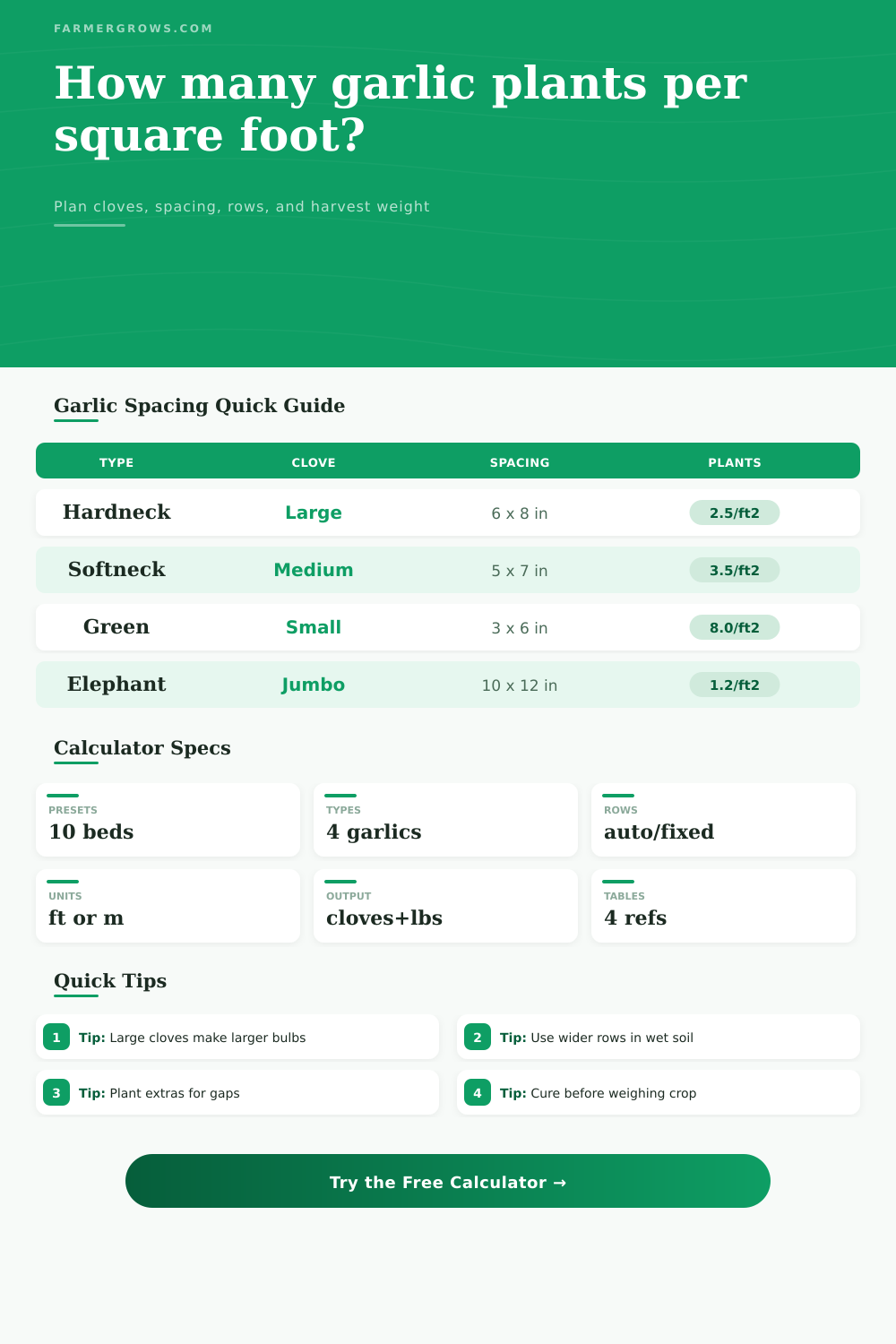
| Large hardneck bulbs | 6 to 8 in | 10 to 12 in | 1.5 to 2.4 | Big cloves, humid beds, premium bulbs |
| Standard hardneck | 6 in | 8 to 10 in | 2.4 to 3.0 | Raised beds and market rows |
| Softneck storage crop | 4 to 6 in | 7 to 10 in | 2.4 to 5.1 | Dry climates and good airflow |
| Green garlic | 2 to 4 in | 5 to 8 in | 4.5 to 14.4 | Immature spring harvest |
| Elephant garlic | 10 to 12 in | 12 to 18 in | 0.7 to 1.2 | Very large plants and bulbs |
| Clove size | Typical in-row spacing | Bulb weight assumption | Useable cloves per bulb | Planning note |
|---|---|---|---|---|
| Small cloves | 3 to 4 in | 0.8 to 1.4 oz | 8 to 14 | Best for green garlic or small bulb production. |
| Medium cloves | 4 to 5 in | 1.3 to 2.0 oz | 7 to 12 | Useful for softneck and home storage beds. |
| Large cloves | 5 to 6 in | 1.8 to 3.0 oz | 5 to 8 | Common choice for hardneck bulb production. |
| Jumbo cloves | 7 to 10 in | 3.0 to 6.0 oz | 3 to 6 | Give wide spacing for full bulb sizing. |
| Bed or row | Area | Spacing | Planting cloves | Harvest estimate |
|---|---|---|---|---|
| 4 x 8 raised bed | 32 ft² | 6 x 8 in | 96 cloves | 10 to 14 lb cured bulbs |
| 30 in x 100 ft market bed | 250 ft² | 6 in, 4 rows | 800 cloves | 85 to 120 lb cured bulbs |
| 3 x 10 kitchen bed | 30 ft² | 5 x 8 in | 108 cloves | 9 to 14 lb cured bulbs |
| 48 in x 50 ft wide bed | 200 ft² | 5 in, 6 rows | 720 cloves | 60 to 95 lb cured bulbs |
| Green garlic strip | 36 ft² | 3 x 6 in | 288 cloves | Harvest as fresh stems |
| Stand factor | Conservative | Typical | Strong crop | Calculator effect |
|---|---|---|---|---|
| Sprouting rate | 85% | 92% to 96% | 98% | Reduces planted cloves to emerged plants. |
| Harvest survival | 80% | 90% to 95% | 97% | Accounts for winterkill, rot, pests, and culls. |
| Bulb weight | 1.0 oz | 1.5 to 2.5 oz | 3.0 oz plus | Converts harvestable plants to cured weight. |
| Extra cloves | 5% | 10% | 15% to 20% | Adds seed garlic for gaps and sorting losses. |
For bulb garlic: big cloves generally produce bigger bulbs, but only when spacing, fertility, and drainage var the plant size up before curing.
For wet or humid beds: use the lower plants-per-square-foot result by widening row spacing; better airflow often beats squeezing in another row.
The dirt patch and garlic cloves sits before you in the garden. It is tempting to place them extra-close. More dense = more harvest, right? But no: Garlic, unlike annual veggies, doesn’t do well crowded. Each bulb must have elbow room. Each bulb must be able to reach moisture and nutrients.
Plant cloves too closely together, and what happens? You will get small bulbs all around. You gets quantity at the expense of quality.
Why Space Your Garlic Plants Correctly
Enter our calculator, above. Plug in your desired spacing, and the dimensions of your bed. Did it work? Will there be enough space? The calculator figure it out for you… No guesswork required.
What kind of garlic? Is it a hardneck variety with an intense flavor and unique scape? It’s strong; requires plenty of elbow room. It want plenty of air circulation among cloves, plus wide rows. That way it forms big bulbs.
Or is it a softneck type, more willing, that permits closer quarters? If your goal is storing garlic awhile, this comes in handy. The tool adapts its requirements based off your answer. A normal-sized softneck like slightly less space than elephant garlic. Failure to account for such differences results in disappointment, lots of bulbs, but not very good ones.
And then there’s the matter of size of the clove itself. That always seems like it should of been counterintuitive. Big cloves are reserved for eating, right? Small ones get planted. That is wrong. It’s the size of the planting clove that determine the eventual bulb size.
A big clove has stored up its energy, pushing up a strong shoot and a deep root into soil. A small one struggle to keep up from day one. It often ends up yielding an undersized harvest. When you’re making your seed inventory, plan accordingly. Get more seed bulbs if you only have a few large cloves. You’ll fill the same number of square of ground.
Space matter, too. You also need to know how to manage disease. In a humid climate, air circulation is key. You must avoid white rot and neck rot. Stagnant, moist air invite fungal problems.
When you space tightly, there are more bulbs per square foot. But more per bulb. Meaning higher yields. Also, less chance of death. The table make that clear as day. A little more room means better survival rates. More viable at the cost of less quantity. Viability tends to win out.
The real world is not perfect. Some cloves won’t sprout. Not all sprouts become bulb that produce for harvest. Pests get some; winterkill gets others. There are always gaps to fill in. A buffer of extras helps with that. If you don’t have a buffer, then your bed will be splotchy. All that space you’ve prepped? It is wasted.
Use the calculator to enter a percentage of what survives. Tack on a bit of safety. Account for the fact that not everything goes right, and you’ll order sufficient seed garlic. You are prepared.
Garlic must be planted with planning. Here’s how: In fall, you plant it. Then you wait, and wait, and wait… all winter long. In early summer, you get up, and your garlic come out. Plan where it goes. One well-planned bed of garlic yield uniformly spaced garlic plants, which cure properly and store well.
Better a little good garlic than a lot of mediocre stuff. Begin with proper spacing. Give the plant what it wants. Let the math do its thing. You’ll end up with perfectly formed bulbs. No more shrunken reminders left over.