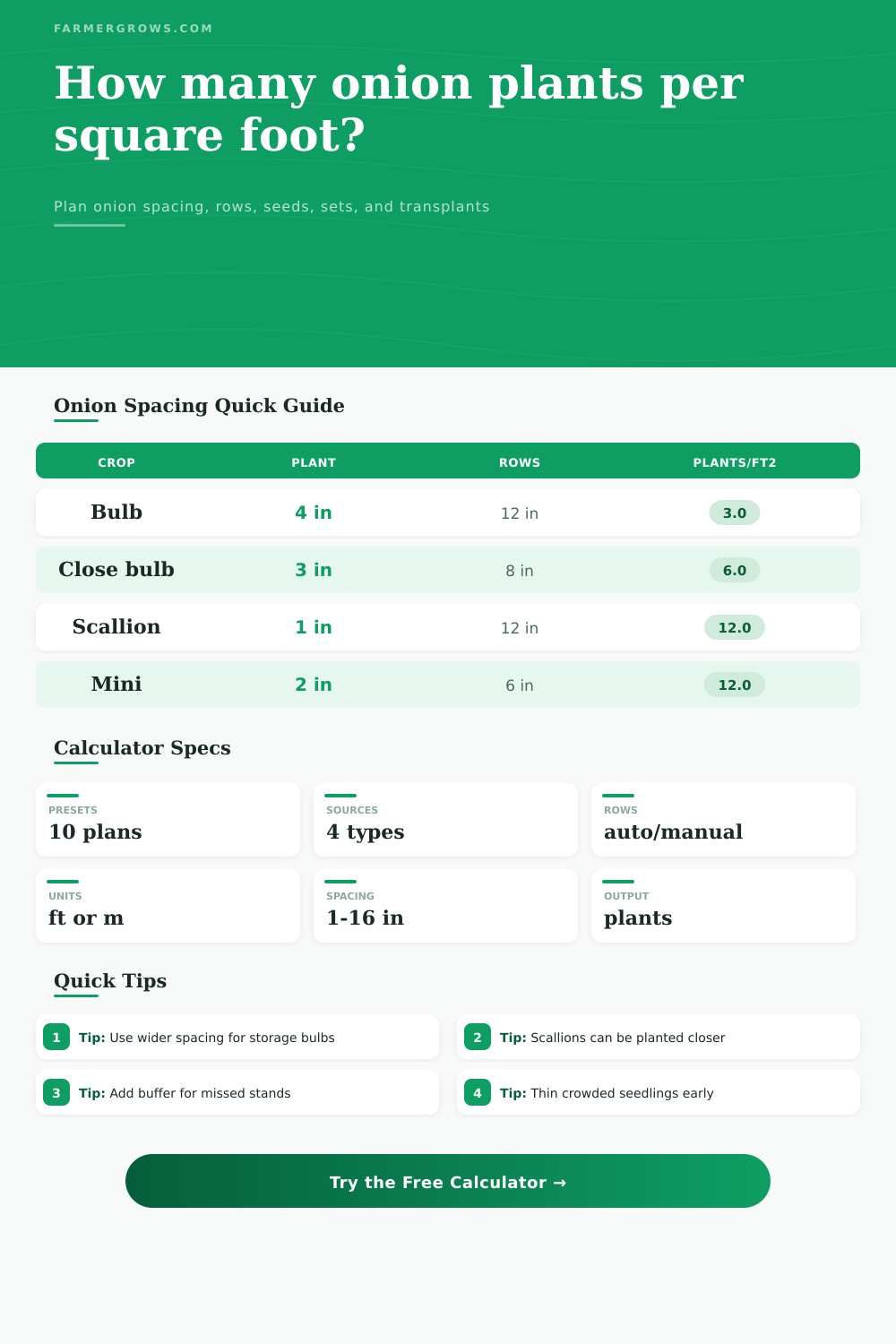
Onion Plants Per Square Foot Calculator
Plan bulb onion, scallion, set, transplant, or direct-seeded onion density from bed size, row spacing, plant spacing, edge clearance, stand survival, and planting buffer.
Choose a real onion scenario, then adjust the bed width, spacing, source, and stand buffer for your field bed, raised bed, high tunnel, or seed flat plan.
Onion Planting Results
These cards show common onion densities from spacing math. Plants per sq ft equals 144 divided by row spacing and in-row spacing, both in inches.
Use 4 inch in-row spacing and give rows enough air movement so necks dry well before curing.
Transplants can use 3 to 4 inch spacing; larger bulbs prefer the wider end of the range.
Closer spacing intentionally limits bulb size for pearl onions, picklers, or early bunches.
Green onions tolerate close spacing because they are harvested before full bulb expansion.
Use these tables to check spacing choices, row math, source planning, and bed examples before planting.
| Onion crop | In-row spacing | Row spacing | Plants per sq ft | Best use |
|---|---|---|---|---|
| Storage bulb onions | 4 inches | 12 to 16 inches | 2.25 to 3.00 | Full-size cured bulbs with better airflow. |
| Sweet onion transplants | 3 to 4 inches | 12 inches | 3.00 to 4.00 | Large fresh bulbs from vigorous starts. |
| Fresh market bulbs | 3 inches | 8 to 12 inches | 4.00 to 6.00 | Medium bulbs harvested before long storage. |
| Pearl or mini onions | 1.5 to 2 inches | 6 to 8 inches | 9.00 to 16.00 | Small bulbs where tight spacing is intentional. |
| Scallions | 1 inch | 6 to 12 inches | 12.00 to 24.00 | Green onions harvested young or in bunches. |
| Planting source | Calculator count | Typical allowance | What to watch | Best fit |
|---|---|---|---|---|
| Direct seed | Seeds to sow | 10 to 25% buffer plus germination rate | Thin early if seedlings crowd before bulbing. | Scallions, mini onions, and nursery rows. |
| Onion sets | Sets to plant | 5 to 15% buffer for misses | Large sets can bolt more often in spring. | Small gardens and quick spring planting. |
| Transplants | Starts to set out | 5 to 10% buffer for field loss | Plant shallow enough that the growing point is not buried. | Sweet onions and dependable bulb crops. |
| Plug trays | Cells or plugs | Tray count rounded up | Multi-sown plugs act like clumps, not single bulbs. | Bunching onions and greenhouse starts. |
| Bed example | Bed size | Spacing plan | Rows | Approx plants |
|---|---|---|---|---|
| Small raised bed | 4 ft × 8 ft | 4 in plants, 12 in rows | 4 rows | 96 bulb onions |
| Market bed | 30 in × 50 ft | 4 in plants, 10 in rows | 3 rows | 450 bulb onions |
| Wide garden row | 3 ft × 25 ft | 4 in plants, 15 in rows | 3 rows | 225 storage onions |
| Scallion strip | 2 ft × 10 ft | 1 in plants, 6 in rows | 4 rows | 480 scallions |
| Mini onion patch | 3 ft × 6 ft | 2 in plants, 6 in rows | 6 rows | 216 mini onions |
| Rows across bed width | Useful formula | Example | Result | Planning note |
|---|---|---|---|---|
| Auto row count | Floor usable width / row spacing + 1 | 48 in bed, 3 in edges, 12 in rows | 4 rows | Rows sit on centerlines inside the edges. |
| Plants per row | Floor usable length / plant spacing + 1 | 96 in bed, 3 in ends, 4 in plants | 23 plants | The edge clearance applies to both ends. |
| Density shortcut | 144 / row spacing / plant spacing | 12 in rows and 4 in plants | 3 per sq ft | Best for direct area estimates. |
| Seed count | Final plants / stand rate with buffer | 100 plants, 80% germ, 20% buffer | 150 seeds | Round up because partial seed counts are useless. |
Bulb size tip: Tight spacing makes more plants per square foot, but it usually shifts harvest toward smaller bulbs unless fertility, light, and water stay very consistent.
Scallion tip: Green onions can be planted much closer than storage onions because the crop is harvested before mature bulbs need shoulder room.
Space your onions correctly. For a good onion harvest, exact spacing make all the difference. Use the best soil and grow the right variety.
If they’re crowded, they’ll get small (or even rot). If they’re spaced too widely, it’s not efficient use of valuable garden space. It’s never clear exactly what spacing should be till a crop is a dud from wrong planning. Before you turn soil, find out how many onions will fits into a square foot.
How to Space Your Onions
Spacing is treated by most gardeners like a hard-and-fast rule; not something to vary with circumstance. Remember: “Four inches apart,” they say, and do it across the board to every onion type. That is not true. Onions don’t all require equal amounts of space. The storage ones must have some elbowroom so air can circulate between their neck while they dry, and they need time to fatten up. Ones you’ll harvest young (scallions) can be close together. Once you understand that, you’ll plot out your bed differntly.
For instance, it doesn’t just give generic guidance; it takes into account the dimensions of your own beds. Is it a row that’s several feet wide or a raised bed? How much clearance do you want around its edges? That reduces your usable width, which sounds like plenty if we’re talking about a typical 4-foot-wide bed, but turns out to be not so wide after all once you subtract that edge clearance.
Then there are the rows: How many can you fit within that usable area? Do not plan to put in six rows, when in fact only four would of have room without squashing the plants on either end.
How many will survive to the finish line? Well, that depends on how you’re growing the plant in the first place. If you sow them directly, they might not come up; the germination rate isn’t 100 percent. If set out as transplants, they could be damaged during transport. If started indoors as sets, they could go to seed prematurely if they are too big. Adjust the calculator accordingly to account for expected loss rates. Add a cushion for those inevitable mishaps. A cushion equals buying just a little more than the theoretical max number of sets or seeds. That excess provides a margin for gaps caused by poor germination or weeds getting at them to soon. You’ll still make it to whatever level of volume you want to harvest.
Competition and airflow also figure in density. Onions whose leaves becomes entangled when crowded develop a moist microclimate that invites fungal diseases such as downy mildew. Spacing farther apart lets more sun reach deeper into the row. Moving from 3 inches to 4 inches apart will cut your number of plants in half (see the table above). That makes quite a difference to the bulbs’ quality. Quantity or quality: Take your pick.
If you’re growing for slicing, give jumbo bulbs some space. Want to get a big volume of medium bulbs for cooking? Push it up a bit. And don’t forget: Your irrigation system is part of this picture. Bulbs planted under drip tape (which delivers consistent moisture to each plant) can be spaced a little closer together in the bed. Closer spacing results in more competition for moisture, which means a smaller bulb. Bulbs that are not being grown under drip but must compete for moisture in dry-farmed garden beds will gets smaller if they’re planted closer together.
The tool asks you to tell it how wide and long your beds are. Instead of displaying a density ratio, it tells you exactly how many plants you’ll have. That way you know exactly what size order of transplants, seeds, or sets to expect. You won’t run out halfway through planting and you won’t waste money buying more starts than you need.
Onion success depends not on chance but geometry. You are working with a grid of biological units with specific resource requirements. Planting day is free of guesswork when you calculate exactly what you need. How many plants to set? How many rows to lay them out in? What size harvest can you count on? All this make it an exercise in precision instead of chaos. As a result, the crop is healthier, cleaner, and more abundant.