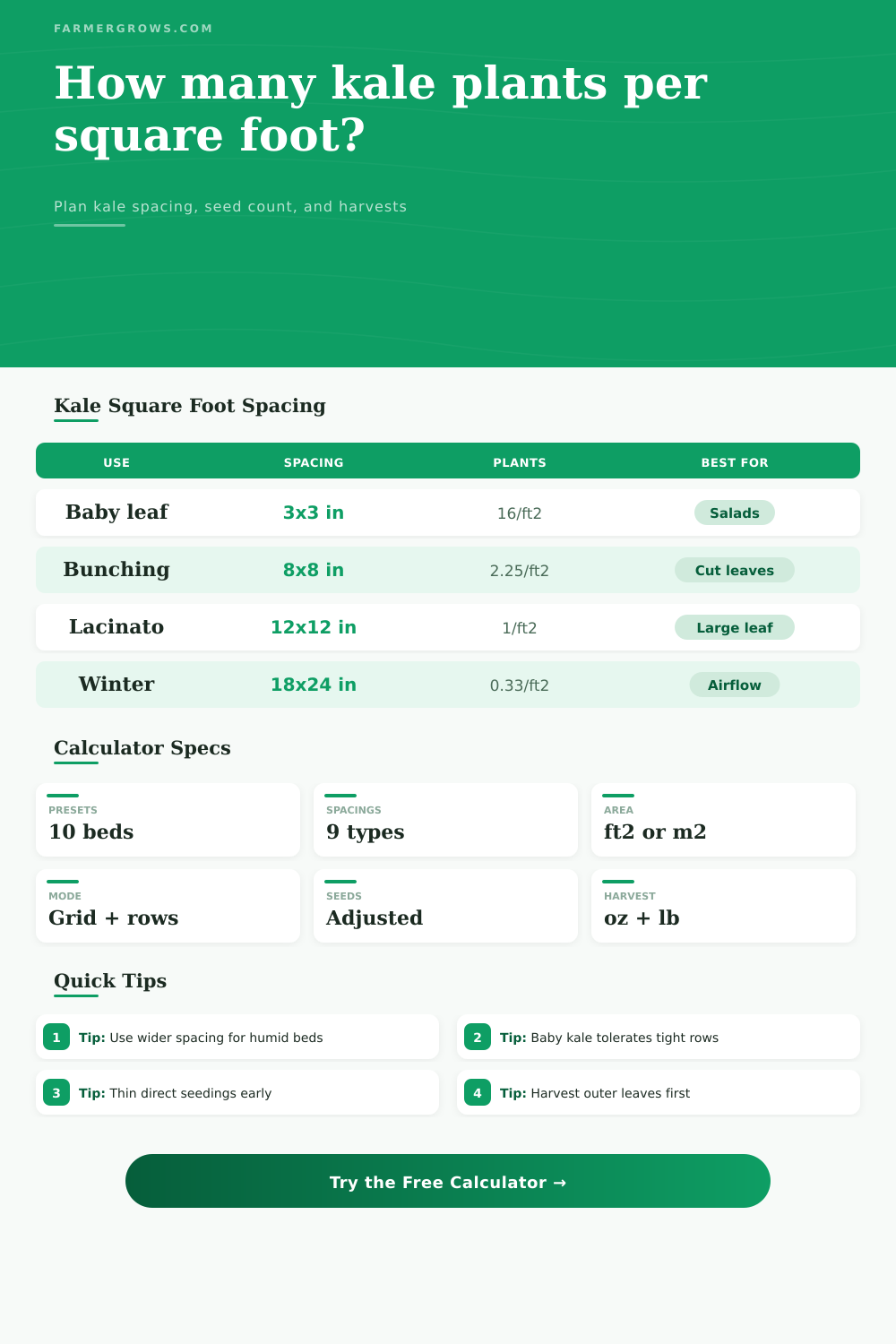
Kale Plants Per Square Foot Calculator
Size a small bed, raised bed, container run, or harvest block by kale spacing, row layout, survival rate, seed backup, and expected cut-and-come harvest rhythm.
Pick a preset, then tune the spacing and survival inputs for your garden. Dense baby kale and mature winter kale use very different square-foot math.
Kale bed capacity estimate
Your kale spacing result will appear here.
| Kale use | Typical spacing | Plants per ft² | Why it works |
|---|---|---|---|
| Baby leaf, repeated cuts | 3 by 3 in to 4 by 4 in | 9.0 to 16.0 | Tight spacing creates small tender leaves and quick canopy closure. |
| Baby bunching or young leaf | 6 by 6 in | 4.0 | Enough room for hand harvest while still using square-foot beds intensely. |
| Dwarf curly, compact Vates | 8 by 8 in | 2.25 | Good for small beds where leaves are harvested before plants become huge. |
| Red Russian and Siberian leaf kale | 9 by 9 in to 10 by 10 in | 1.44 to 1.78 | Loose leaves fill space quickly but need airflow in damp weather. |
| Lacinato, Toscano, dinosaur kale | 12 by 12 in to 15 by 15 in | 0.64 to 1.0 | Upright plants can fit one per square foot when harvested regularly. |
| Large mature or overwintered plants | 18 by 18 in to 18 by 24 in | 0.33 to 0.44 | Wider spacing improves airflow, light, and access for long-standing plants. |
Spacing ranges align with common extension guidance for kale: 8 to 12 inches after thinning for close rows, 12 to 18 inches for transplants, and wider 18 to 24 inch spacing for large mature plants.
| Bed area | 6×6 in young kale | 8×8 in compact kale | 12×12 in mature kale |
|---|---|---|---|
| 4 ft² patch | 16 plants | 9 plants | 4 plants |
| 16 ft² square bed | 64 plants | 36 plants | 16 plants |
| 24 ft² narrow bed | 96 plants | 54 plants | 24 plants |
| 32 ft² 4 by 8 raised bed | 128 plants | 72 plants | 32 plants |
| 48 ft² long bed | 192 plants | 108 plants | 48 plants |
| 100 ft² kitchen block | 400 plants | 225 plants | 100 plants |
| Planting method | Typical planning factor | Best input settings | Use case |
|---|---|---|---|
| Cell transplants | Plants divided by germination and survival | 80 to 95% germination, 85 to 98% survival | Best for exact square-foot placement and early spring starts. |
| Direct seeded rows | Base seeds plus 35% row thinning allowance | 70 to 90% germination, 75 to 95% stand survival | Useful for baby leaf or young leaf beds that are thinned in place. |
| Multi-sown cells | Base seeds plus 15% cell thinning allowance | 80 to 95% germination, 85 to 98% survival | Works when raising several seedlings per cell and clipping extras. |
| Backup seedlings | Add 5 to 20% after loss adjustment | 10% default backup | Covers gaps from poor cells, cutworms, heat, or transplant shock. |
| Kale style | Estimated usable leaves per cut | Typical cut interval | Calculator harvest basis |
|---|---|---|---|
| Baby leaf dense cut | 0.25 to 0.45 oz per plant equivalent | 10 to 18 days | 0.35 oz per plant per cut |
| Baby bunching kale | 0.4 to 0.8 oz per plant | 10 to 18 days | 0.6 oz per plant per cut |
| Dwarf curly or Vates | 0.7 to 1.1 oz per plant | 12 to 21 days | 0.9 oz per plant per cut |
| Red Russian or Siberian | 0.8 to 1.3 oz per plant | 12 to 21 days | 1.05 oz per plant per cut |
| Lacinato mature | 1.0 to 1.6 oz per plant | 14 to 24 days | 1.3 oz per plant per cut |
| Winterbor or overwintered | 1.2 to 2.0 oz per plant | 18 to 30 days | 1.55 oz per plant per cut |
Type spacing
- Fastest choice
- Uses kale-specific defaults
- Best for home beds
Square grid
- Same spacing both ways
- Easy square-foot layout
- Good for raised beds
Rows in bed
- Separate plant and row spacing
- Matches seed packets
- Good for drip lines
Offset rows
- Staggered plants
- About 15% denser
- Best for baby leaf beds
Want a family-sustaining crop of kale into winter, or a full square-foot of space packed with sixteen miniature kale plant (for salad)? That’s all in the timing, and the geometry. Enter the size of your bed, and how closely you like things spaced, and the calculator does arithmetic, saving you from having to do unit conversions yourself.
But what are these figures based off? What’s that about, exactly, and why should we care? Kale, after all, doesn’t grow in triangles or circles or fractions; it’s a plant, right? Spacing is usualy thought of as fixed: Read the seed packet, look up how many inches to space things apart, and go make each hole exactly twelve inches away from the last one. This method succeed with corn, and fails with kale.
How to Space Kale Plants
Kale, unlike corn, is forgiving. It can be crowded (for baby tender leaves) or spread out (for full-sized harvest). To allow for this flexibility, calculator includes two different modes.
If you pick a baby leaf preset, the program assume you’re in density mode, and will pack them in more tightly. Because the leaves don’t have room to grow big, they remains small, and the canopy forms fast. Shade inhibits weeds (plus), shade cools the soil.
The catch is that we aren’t measuring number of plants. We’re measuring air flow and light. But if left with all those close rows for any extended period, the middle of that bed are a swamp. It traps moisture and invites fungal problems. Suddenly your leaves aren’t dark and thick but are more stretched out and pale.
And this is where all those numbers we put into calculator really count, because such a densely planted bed require an earlier pick. You’ll be harvesting the outer leaves first, before they’re ever shaded out by inner ones. If you think about it, the calculator doesn’t presume that you’d uproot the entire plant at one time; it estimate harvest weight based off these repeated cuts.
This is a frequent error. Harvesting aggressively right from the start prompt the plant to continue pushing outward, producing new growth. To do otherwise, leaving the middle of the bed to rot, dooms the entire patch.
When we talk about mature kale, however, all bets are off. Big varieties such as Winterbor or Lacinato require elbow room for both the air and the leaves. Mildew and aphids can happen, especially on crowded kale in a humid summer. This is because you don’t notice the lack of airflow until it’s already gone.
To adjust for that the tool factor in the width of your chosen spacing, so if you go with wide, you’ll have fewer plant per square foot. There will be fewer plants, but each will be healthier. Each will yield cleaner leaves, a tradeoff between quality and quantity. You’ll be able to see both sides on the calculator, and decide how much of each matters in your kitchen.
There’s yet another level of complexity: Seed isn’t perfect, either. Germination rate. And then what happens when you transplant those little seedling? Not all survive. So the calculator has us enter a percentage of how many we think will make it (realism, rather than simply bookkeeping), and also enter a backup buffer.
If you direct seed kale, for instance, maybe eighty-five percent germinate, but oh my god, the thinning is cruel. Pulling out the weaklings; leaving room for the ones that made it, that means sowing more than you imagine is necessary, something that gets accounted for in this tool. It says to sow an extra amount, or you’ll have gaps in the bed. This wastes space. Weeds can creep into that space.
This is how it’s laid out in the reference table on the page, by type of kale: Baby kale can get away with being planted close together; mature kale likes a little space to breathe, and winter kale even more. Stage your kale growing like this: Plant some extra, then thin very carefully as needed, harvesting gradually.
Success at the end of all that will depend on how well you manage it, and don’t crowd those plants into the bed. Give them room to do their thing. Then sit back and watch them fill it in. You should of planted more.