Spinach Plants Per Square Foot Calculator
Estimate spinach density from bed area, plant spacing, row spacing, germination, thinning, baby leaf harvests, bunching targets, and overwintering survival.
Pick a real spinach planting style, then tune the spacing, stand loss, successions, and winter survival for your bed or market row.
Spinach Planting Estimate
Results update from your bed area, spacing, germination, thinning, and harvest mode.
Uses close rows or bands, higher seed counts, and an early cut before plants need mature spacing.
Needs enough room for usable stems and leaves, then converts total plants into estimated bunches.
Counts the spring target stand, then increases fall sowing for expected winter loss.
Uses wider spacing and lower seed waste when greenhouse plugs replace direct seeding.
These tables use spacing math based on square inches per plant. Local climate, seed age, variety, disease pressure, and harvest size can shift the best final stand.
| Spacing pattern | Plants per sq ft | Plants per sq m | Best spinach use |
|---|---|---|---|
| 2 in x 2 in | 36.0 | 387.5 | Very young baby leaf, fast harvest |
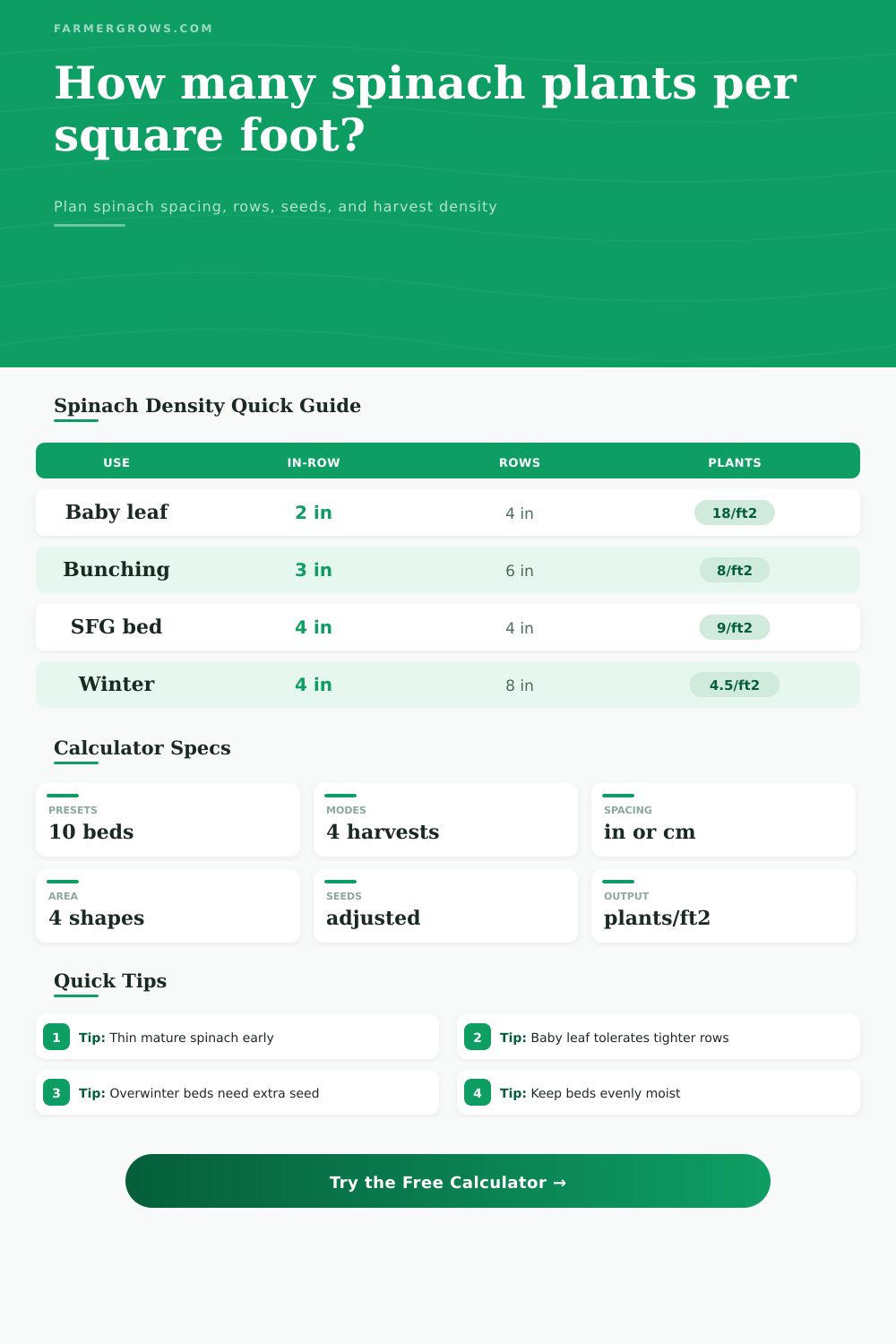
| 2 in x 4 in | 18.0 | 193.8 | Baby leaf rows or narrow bands |
| 3 in x 4 in | 12.0 | 129.2 | Cut-and-come-again leaf harvest |
| 3 in x 6 in | 8.0 | 86.1 | Bunching greens and small full plants |
| 4 in x 4 in | 9.0 | 96.9 | Square-foot mature spinach |
| 4 in x 8 in | 4.5 | 48.4 | Overwintered or humid-season spinach |
| 6 in x 6 in | 4.0 | 43.1 | Transplants and large savoy leaves |
| Planting system | Typical in-row spacing | Typical row spacing | Planning note |
|---|---|---|---|
| Baby leaf direct seed | 1.5 to 2.5 in | 2 to 4 in bands | Harvest small leaves before crowding reduces quality. |
| Standard garden rows | 2 to 4 in after thinning | 12 to 18 in rows | Useful where hoeing or wheel paths require wider rows. |
| Raised bed grid | 4 to 6 in | 4 to 6 in | Good for hand-weeded beds and mature leaves. |
| Bunching spinach | 3 to 4 in | 6 to 8 in rows | Balances leaf size with enough stems for bunch count. |
| Overwintered stand | 4 to 6 in | 6 to 10 in rows | Use extra seed to cover winter loss and spring gaps. |
| Bed width | 4 in row spacing | 6 in row spacing | 8 in row spacing | 12 in row spacing |
|---|---|---|---|---|
| 2 ft bed | 6 rows | 4 rows | 3 rows | 2 rows |
| 3 ft bed | 9 rows | 6 rows | 4 rows | 3 rows |
| 4 ft bed | 12 rows | 8 rows | 6 rows | 4 rows |
| 30 in bed | 7 rows | 5 rows | 3 rows | 2 rows |
| 48 in bed | 12 rows | 8 rows | 6 rows | 4 rows |
| Stand situation | Target plants | Field factor | Seeds before buffer | Use case |
|---|---|---|---|---|
| Fresh seed, spring | 100 | 85% | 118 | Normal direct seeding |
| Older seed, cool soil | 100 | 65% | 154 | Early spring sowing |
| Baby leaf dense bed | 100 | 75% | 134 | Higher cull and thinning loss |
| Overwintered bed | 100 | 60% | 167 | Winter survival included |
| Transplant plugs | 100 | 92% | 109 | Greenhouse plug planning |
Separate baby leaf from mature spacing. Baby spinach can start very dense because it is cut young. For full-size or bunching spinach, thin early so the plants have airflow and enough crown space.
Let overwintering math start with spring plants. Choose the stand you want after winter, then var the survival percentage increase fall seeding so bare spots are already accounted for.
Most gardeners toss a handful of seeds in ground and hope for the best. Maybe it works; maybe it doesn’t, maybe they end up with a tangled mess that bolts before their spinach leaves is even usable. Density (how close together they grow) seem to be the big difference-maker here.
There’s a spinach plants per square foot calculator to help you ditch the guesswork and embrace some good old-fashioned geometry. But how much space does each leaf need to breathe? And how much do you have? The calculator at top will do the math for you, but knowing what all of those inputs actualy mean makes all the difference in your harvest.
How to Space Your Spinach Seeds
How far apart? It all depends on what you’re growing for: If salad mix, you can grow spinach super-close, perhaps two inches apart, in rows that are only four inches wide. That’s like eighteen plants per square foot, too many for a mature plant to cope with. But remember: Because you will cut back baby spinach before its time (before it outgrows the space), it’s okay when crowded.
For full-sized bunching spinach with big leaves and substantial stems, however, you must be aggressive about thinning. Four-inch spacing between plants within a row is typical, as is four inches between rows. This means a semi-savoy type planted to full maturity may go at the standard nine plants per square foot. This easy-to-work-with grid allows each crown ample space to do its thing, free from competition from other plant for sunlight.
It’s all about knowing the difference between how many seeds you put in and how many plants grows from those seeds. Since seed density is not the same as plant density, those numbers can be dramatically different, so you sow thickly and then thin to your target spacing. (In other words: You don’t plant out exactly where the seed will go.)
This calculator takes that into account, and lets you factor in your thinning loss rate, plus your estimated germination rate. Only sixty percent of that packet came up because it was old seed or maybe cold soil. If you want ninety percent success but only get sixty, there will be gaps and crop yield will suffer. It is better to over-sow a little, especially if you want to eat the thinnings as microgreens. You have set the tool to calculate higher seed counts based on your expected germination. This ensures the final plant spacing reflect what you intend to harvest, rather than just how much you enjoy sowing.
There is one other aspect of overwintering that most gardeners don’t think about till spring: Will some of your spinach stand be lost to frost heave or wet feet as the cold weather arrives? Will some be lost to wet feet or frost heaving as the cold weather arrive? There’s an input for winter survival on the calculator because of all that.
Rather than guesstimate at what percentage of your stand won’t make it through the winter, you count back from the number of plants you wish to have alive come April. If you need fifty healthy plants for your March salads and expect twenty percent winter loss, you plant more in October. Expect 20 percent to perish? Plant double in October; it’s just basic math, but it saves you the heartbreak of heading outside in early spring to find half your bed empty.
How much soil moisture is involved? You’d be surprised how much. Spinach doesn’t like dryness at all. If the spacing isn’t right, the roots will have to struggle to reach around for moisture because the top layer of spinach-free soil bakes in the sun. By shading the space between them with proper density, they hold onto soil moisture better. Plants stressed from being in a bed that’s too thin (it heats up fast; dries out quickly) don’t do as well. Too-thick beds are humidity traps, inviting downy mildew.
The art of the crop: finding just enough. That’s all spelled out in the reference table on the page, which explains the shift: tighter banding when growing baby leaf versus wider grids for bigger bunches at maturity. Use that to get a feel for the tradeoffs. A tighter space requires more labor for thinning (and more seeds), but an earlier, faster harvest. Wider requires less weeds to compete with, fewer plants, but a longer wait for your full leaf. It’s not right or wrong; just different goals.
Know what kind of game you’re playing, and the math works itself out from there. Do you want a quick salad fix? Or something robust for winter? All in all, it’s just about space… Getting what you want and giving it to the plants they want.
If it’s market rows you’re after or some kind of square foot garden thing, it’s no different. Define the goal, adapt to the limits (or blessings) of your soil and seed, and then use geometry to point the way with your hand. With the calculator out of the equation, you’ll have nothing to fear but tangled clumps or empty patches, and therefore a plan that makes sense. No more guesswork; just get busy planting on purpose.