Broccoli Plants Per Square Foot Calculator
Estimate broccoli plant density, seedlings to start, harvest heads, row-foot needs, and expected yield from real plant and row spacing.
🥦Broccoli spacing presets
📏Planting inputs
Broccoli planting estimate
📊Spacing comparison grid
🌱Broccoli density reference
📘Reference tables
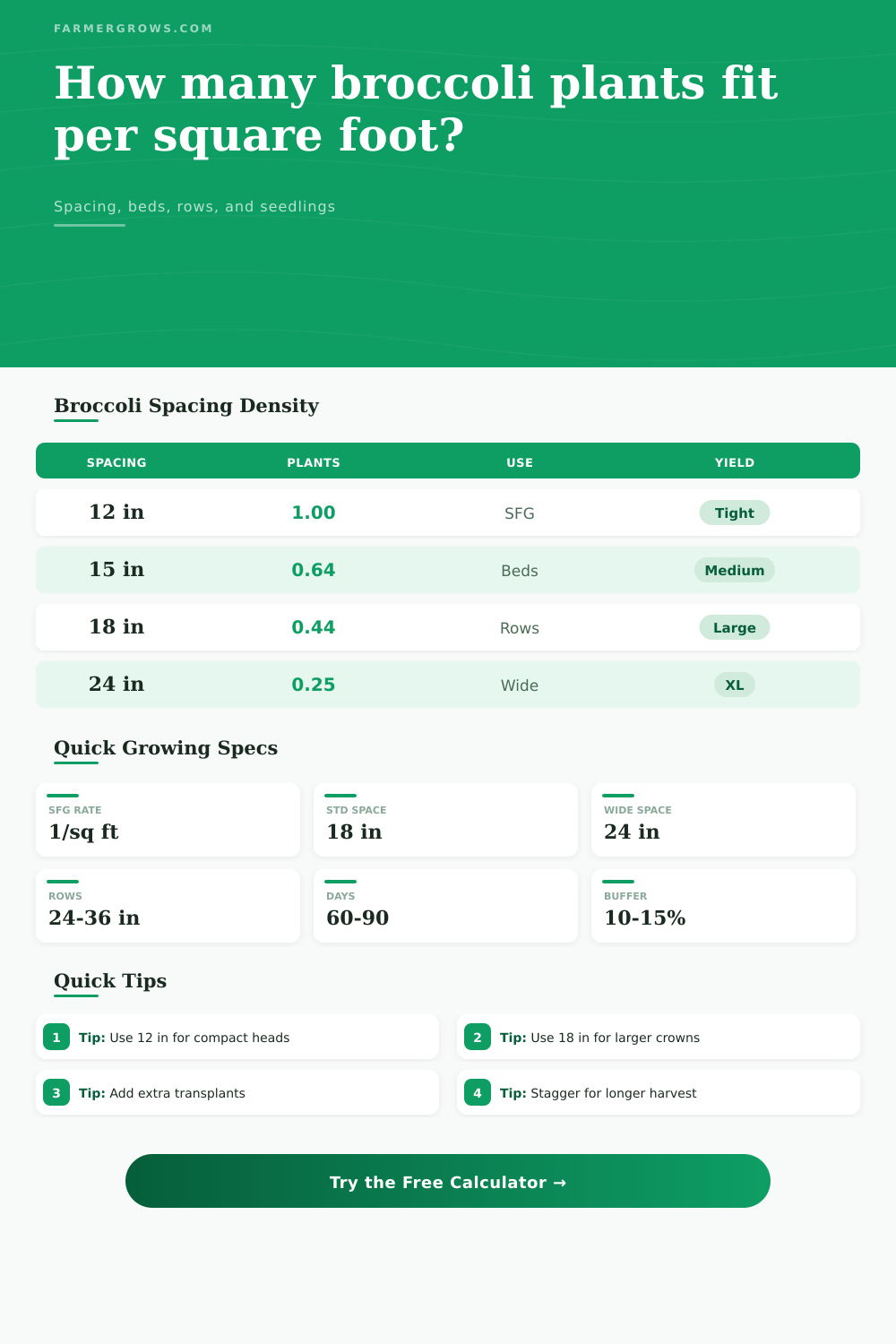
| Plant spacing | Plants per sq ft | Sq ft per plant | Best use |
|---|---|---|---|
| 10 in x 10 in | 1.44 | 0.69 | Baby broccoli, frequent cutting |
| 12 in x 12 in | 1.00 | 1.00 | Square foot beds, compact heads |
| 15 in x 15 in | 0.64 | 1.56 | Raised beds with better airflow |
| 18 in x 18 in | 0.44 | 2.25 | Standard crowns in fertile beds |
| 24 in x 24 in | 0.25 | 4.00 | Large plants and heavy side shoots |
| Row pattern | Density | Plants per 100 row ft | Notes |
|---|---|---|---|
| 12 in in-row, 18 in rows | 0.67 per sq ft | 100 | Tight row spacing for beds |
| 15 in in-row, 24 in rows | 0.40 per sq ft | 80 | Good compromise for crowns |
| 18 in in-row, 24 in rows | 0.33 per sq ft | 67 | Common garden row spacing |
| 18 in in-row, 30 in rows | 0.27 per sq ft | 67 | Better access and airflow |
| 24 in in-row, 36 in rows | 0.17 per sq ft | 50 | Large fall plants or equipment rows |
| Example bed | Area | 12 in grid | 18 in grid |
|---|---|---|---|
| 3 x 6 ft bed | 18 sq ft | 18 plants | 8 plants |
| 4 x 8 ft bed | 32 sq ft | 32 plants | 14 plants |
| 4 x 12 ft bed | 48 sq ft | 48 plants | 21 plants |
| 10 x 20 ft plot | 200 sq ft | 200 plants | 89 plants |
| 50 x 50 ft plot | 2,500 sq ft | 2,500 plants | 1,111 plants |
| Planning factor | Conservative | Typical | Intensive |
|---|---|---|---|
| Transplant survival | 80% | 90% | 95% |
| Extra seedlings | 5% | 10% | 15% |
| Main head weight | 0.5 lb | 0.75 lb | 1.25 lb |
| Side-shoot allowance | 0% | 15% | 30% |
| Harvest window | 60 days | 70 days | 90 days |
💡Spacing tips
How much room do you give broccoli? How do you grow this special food plant? Broccoli like attention. And if you don’t provide it, there will be no broccoli to pick.
Sowing broccoli seeds where you wish is one option. But those small, floppy-headed plants are common results of that technique. To get great broccoli, there’s an art to knowing how densely you must plant what and where.
How to Space Broccoli Plants
Most people want to know: how many seedlings will I have per square foot? Depends. On your variety; what kind of bed you’re growing in; and whether you plan to eat it fresh or freeze part. If you’re not sure how many inches to space things, or aren’t sure what your garden bed measurements are, just plug them into the calculator up top and it does math for you.
First select the type of plan you want to create: Do you want to go all-square-foot-garden-style (meaning there’s an exact number of squares… Say 12 inches wide, between each plant)? Some people like that kind of layout because everything’s nice and straight. It also works out nicely for smallish plants in a raised bed where space isn’t plentiful.
Broccoli, for instance, won’t do well twelve inches apart on such a strict grid. Its roots can’t stretch out enough. Besides, the leaves have no room to catch sunlight until heads gets going. This means the plants stunting from fighting each other for resources.
And then there’s issue of in-row spacing versus overall spacing of rows. You might put seedlings only eighteen inches apart within a row, but leave three feet between them in next row over. That’s more open. It allows air to flow through canopy better. Fewer fungal diseases will develop when air cannot get trapped on the leaf surface. This is bad news for brassicas, which are prone to downy mildews, powdery mildews, and more.
More space is good, even though it means less total plants, because now each plant has more room to breathe and thus be healthier. It is always a tradeoff between quality and quantity, balancing how many plants you have per square foot against how healthy they are.
Reality is never a perfect grid. Not everything will make it, and transplants are no exception. A heavy rain can drown them. Slugs and other nibblers may eat them. Or, perhaps the transplants simply won’t take root. So it makes sense to add a buffer percentage to your seeds-to-seedlings count: Start with 10-15 percent more then what you think you’ll need, as insurance against mishaps early on. This small investment now avoids gaps in your harvest later. By adjusting for expected survival rates in the tool, you ensure an accurate final number.
And don’t assume all your seed will become part of the harvest on harvest day. The whole equation changes with type of variety. Large crown types requires space. Intensive beds that use compact varieties can be spaced closer together. Crowd a large variety in a close grid and you will have small woody heads.
Another way to stretch out the harvest: stagger your planting times. Plant just a few rows at a time each week or two, rather than going all-in on seedling day. Rather than process a huge batch all at once, this approach keeps crop coming for several weeks. Eat fresh broccoli on a regular basis.
And then look at the reference tables on the page to see what various spacings would look like. The one I just posted is a density comparison so you will notice that even a change that might seem minor, say going from eighteen inches apart to twenty-four inches apart, means your number of plants goes down by dozens. That’s not nothing if you have a big bed.
Having dozens fewer plants means less competition for soil nutrients. Plus it allows you to harvest and weed more easily. You can also get in there to walk around and pick heads before they bolt. Access matters.
Consider what works for your beds: Big plants require bigger real estate if their soil is rich and loamy; tight spacing can make the most of meager nutrients in poorer soil. But don’t skimp on airflow for increased density. That’s an invitation for fungal diseases, especially when humidity is high.
Use the calculator as a starting point. From there, tweak according to your own expertise. Give that broccoli a little extra breathing room this year if it felt crowded last year. You’ll see the difference in plant vigor… And head size.
Planning now avoids headaches later. A properly spaced-out bed is also a productive one.