Basil Plants Per Square Foot Calculator
Estimate basil plant density for raised beds, rows, pots, window boxes, and trays using cultivar habit, pruning style, spacing pattern, container depth, and succession timing.
Choose a real basil growing plan, then adjust the cultivar, pruning, spacing, and season details to match your herb bed or container.
Basil Spacing and Harvest Estimate
Your basil density result will appear here.
Use 10 to 12 inch spacing for larger plants, easier picking, and better airflow in humid gardens.
Use 8 to 10 inch spacing, pinch early, and harvest whole stem tips before flower buds open.
Dwarf or compact cultivars can run tighter, but root depth and daily moisture matter more.
Leave access space around tomatoes and treat basil as an edge crop rather than a solid block.
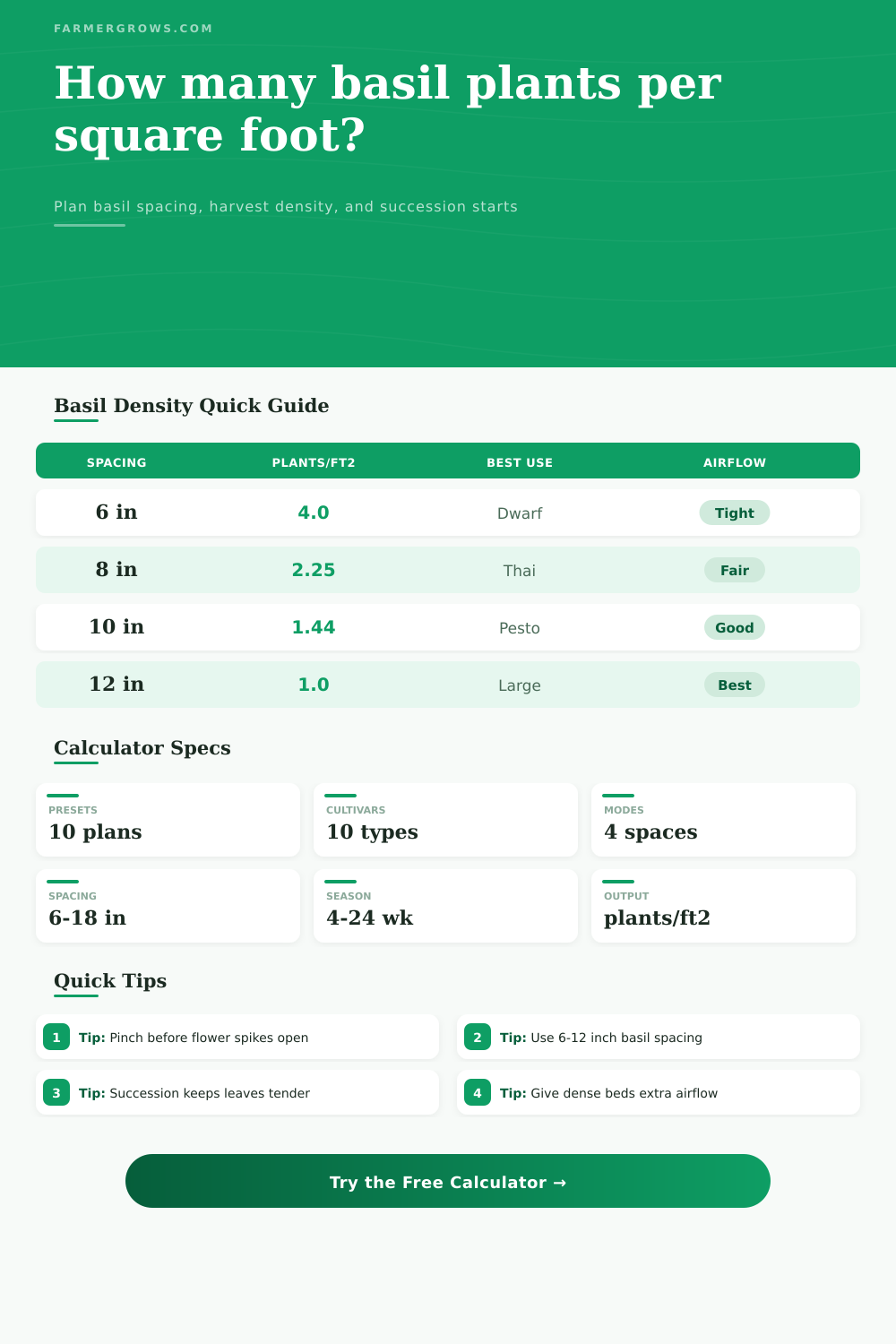
| Equal spacing | Plants per square foot | Typical basil use | Management note |
|---|---|---|---|
| 6 inches | 4.00 | Dwarf Greek, compact patio, young leaf harvest | Keep pinched and watered; airflow is tight |
| 8 inches | 2.25 | Thai, lemon, purple, intensive sweet basil | Good for frequent stem-tip cutting |
| 10 inches | 1.44 | Genovese and sweet basil pesto beds | Balanced density for cut-and-come-again plants |
| 12 inches | 1.00 | Large-leaf basil, humid climates, seed saving | Better airflow and larger individual plants |
| 18 inches | 0.44 | Specimen plants and flowering pollinator basil | Allows tall branching and bloom stalks |
| Cultivar group | Default spacing | First harvest from seed | Best density role |
|---|---|---|---|
| Genovese or sweet basil | 10 inches | 60 to 70 days | Pesto, sauces, steady kitchen cutting |
| Thai basil | 8 inches | 60 to 70 days | Frequent small bunches and heat-tolerant harvest |
| Lemon basil | 8 inches | 55 to 65 days | Small aromatic leaves, containers, tea blends |
| Greek globe or dwarf basil | 6 inches | 55 to 65 days | Patio pots, edging, dense ornamental herbs |
| Lettuce leaf or Napoletano basil | 12 inches | 65 to 75 days | Large leaves, big plants, wider airflow |
| Pot or bed size | Usable area | Suggested basil count | Best fit |
|---|---|---|---|
| 10 inch round pot | 0.55 sq ft before edge factor | 1 compact or 1 sweet basil | Single kitchen plant |
| 12 inch round pot | 0.79 sq ft before edge factor | 1 to 2 compact plants | Patio herb pot |
| 24 inch window box | About 1.3 sq ft at 8 inch width | 3 to 4 dwarf or lemon basil | Linear planter harvest |
| 2 x 4 ft bed section | 8 sq ft | 8 to 18 plants by spacing | Kitchen pesto patch |
| 4 x 4 ft square-foot bed | 16 sq ft | 16 to 36 plants by spacing | High-yield herb block |
| Succession choice | First useful cut | Replacement rhythm | When to use it |
|---|---|---|---|
| One planting | After plants branch well | Pinch continuously | Home kitchen use and decorative containers |
| Every 4 weeks | Seed about 8 weeks before needed | Replace 25% to 50% | Reliable tender leaves through summer |
| Every 2 to 3 weeks | Use transplants or plugs | Replace 50% or more | Market bunches, pesto batches, heavy cutting |
| Late-season backup | Start before nights cool | Replace flowering plants | Extending harvest when old plants get woody |
Pinch for density. Start pinching once plants have several pairs of true leaves, cutting just above a leaf pair so new side shoots form instead of one tall stem.
Give crowded basil air. Dense 6 to 8 inch plantings can work for quick harvests, but humid beds need wider spacing, drip watering, and regular harvest to reduce leaf disease pressure.
First it’s a piece of garden, a tiny corner where dreams run wild, and all the pesto I can make! Next thing you know, you have ten seedlings in the ground in one square foot; they was so adorable in that nursery tray. By July, they’re a damp, hot tangle. Almost everybody has this problem growing basil.
Basil needs space, it’s a branching plant that want room to do what it does, and it wants air, too. It wants to breathe. Taking care of the leaves gently is more important than the right fertilizer or even the best soil mix, and basil will tell you: Space makes all the difference.
How to Space Basil Plants
After determining what you want to achieve (and defining where it will fit), the tool handles heavy lifting for you. You don’t have to count each hole in the ground. There are three conflicting factors at play here.
One is the physical size of the particular kind of basil. A squat Greek globe require less space than a tower of Genovese.
Second, consider how you will harvest it. Will you pinch back the tops regularly? If so, you can plant more closely, since the plants remains small. Letting the plants grow lanky and tall means they will cast shade onto their neighbors, and also create an invitation to mildew.
Third is the length of the season. In a brief summer you may get away with a single sowing; in a lengthy, steamy one you can stagger seedings so that new foliage come right when the older stuff begins to fade.
Gardeners are guessing most of the time. They think one plant belongs in every square foot because that is what they did with tomatoes. They also think to base it based off pot size, like one plant for each four-inch cell. Nope, not basil. The habit of each cultivar counts, lemon basil spreads differently then Thai basil. How hard you pick it affects the plant’s canopy. Heavy cut-and-come-again harvests will be more densely planted than light picking. Light picking allows the plant to bush out as nature intended, which requires wider spacing to maintain air flow because dark centers invite fungal problems. It is a small detail, but it makes a difference.
So what about the succession variable? Why is there no basil come September when you planted it all one time in May? The plant died back, bolted, etc. Use the calculator to make several small plantings rather than one large planting. Set it to replenish twenty-five percent of your bed every four weeks. You can harvest continually. You won’t feel the shock of losing the whole crop all at once. You will have some tender younger ones to spare if a heatwave come. A lot of people are missing this step. They think of the basil as a one-and-done crop, not a rolling harvest.
But what about growing in containers? What about things like this (window boxes, anyone?) where depth is constrained? Because basil is a feeder, the tool look at the root zone‘s depth as well. Basil requires space for its roots to reach moisture and nutrients. Shallow containers will quickly run dry. Even more importantly: They restrict the plant’s eventual size. A big-leaf Napoletano won’t fit in a six-inch-deep tray and be happy. When roots get cramped, the calculator shows an effect on the yield; or on the density of your basil plants. It’s not lying. If you want lots of plants, be prepared to accept smaller ones. Want bigger ones? Fewer of them. Want both? Can’t do both in tight quarters.
Go back to the page with its reference tables, then test your hunch. Six inches apart? You get four plants per square foot. Tight. This is good for a dwarf variety, or if you’re planning on harvesting at the baby-leaf stage, when you take the leaves before they grow out. Twelve inches apart? One plant. Airy. Good in a humid climate, where airflow helps stave off powdery mildew. No good or bad here; just the right-for-you answer based off your climate and your kitchen schedule.
And last, consider the loss factor. In a garden, nothing goes exactly right. Some of your seedlings will die. Others will be consumed by slugs. Others will stretch out and weaken. A ten or fifteen percent buffer to account for those lost transplants isn’t being pessimistic; it’s being realistic. If nature throws you curve balls, it means you’ll still have a full number in the final harvest.
So here’s the math: How much space do you have? More than one row? Okay. Great. That means a basil garden where no plant ever dies of heat exhaustion and lack of air circulation, as happens in most other herb gardens.
This is called staggering your sowing, planting more than once so there is always another row coming up to replace the ones that are fading. And it’s called spacing things out, too, and pinching back, and pinching again, and again… Basil needs room. Plan accordingly.