Plants Per Acre Calculator
Estimate field population from row spacing, in-row spacing, bed systems, twin rows, skips, germination, stand loss, field area, and target plants per acre.
Load a named agronomic spacing pattern, then edit the stand, skips, bed layout, and acreage to match field measurements or planter settings.
Plant Population Estimate
Results update from your row geometry, bed rows, germination, skips, stand loss, and target population.
Population equals acre square inches divided by row spacing and in-row spacing, then adjusted for plants per station.
Use bed-center spacing as the main width, then multiply by the number of crop rows carried on each bed.
Twin rows usually share one bed center. The inside gap helps machinery setup, while both lines add crop-row length.
For squash, melon, or pumpkins, set plants per station to the expected surviving plants kept after thinning.
| Row spacing | Row feet per acre | Plants at 6 in | Plants at 12 in |
|---|---|---|---|
| 7.5 in drilled rows | 69,696 ft/ac | 139,392 plants/ac | 69,696 plants/ac |
| 15 in narrow rows | 34,848 ft/ac | 69,696 plants/ac | 34,848 plants/ac |
| 20 in rows | 26,136 ft/ac | 52,272 plants/ac | 26,136 plants/ac |
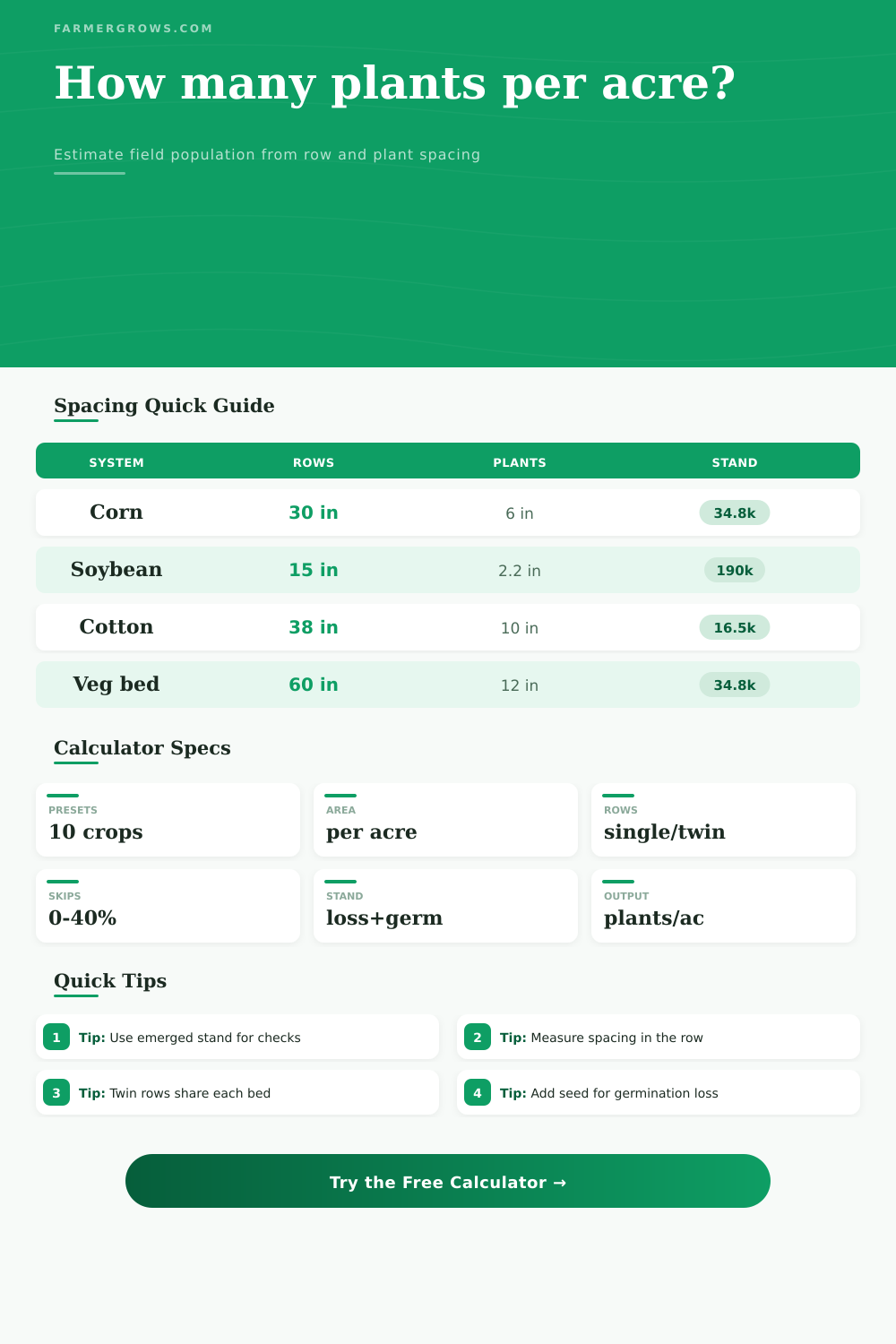
| 30 in rows | 17,424 ft/ac | 34,848 plants/ac | 17,424 plants/ac |
| 36 in rows | 14,520 ft/ac | 29,040 plants/ac | 14,520 plants/ac |
| 40 in rows | 13,068 ft/ac | 26,136 plants/ac | 13,068 plants/ac |
| 60 in bed centers | 8,712 ft/ac | 17,424 plants/ac | 8,712 plants/ac |
| 72 in bed centers | 7,260 ft/ac | 14,520 plants/ac | 7,260 plants/ac |
| Formula item | Exact value | Use in calculator | Field note |
|---|---|---|---|
| Square feet per acre | 43,560 ft² | Base acre area | International acre definition |
| Square inches per acre | 6,272,640 in² | Spacing formula numerator | 43,560 x 144 |
| Row feet per acre | 522,720 / row in | Planter travel check | 43,560 ft² divided by row width in feet |
| Plants per acre | 6,272,640 / spacing | Single-row population | Spacing means row inches times plant inches |
| Seed drop per acre | Target / survival | Seeding requirement | Survival includes germination, skips, and stand loss |
| Target plants/ac | 30 in rows | 36 in rows | 60 in bed, 2 rows |
|---|---|---|---|
| 15,000 plants/ac | 13.9 in | 11.6 in | 14.0 in per row |
| 25,000 plants/ac | 8.4 in | 7.0 in | 8.4 in per row |
| 32,000 plants/ac | 6.5 in | 5.4 in | 6.5 in per row |
| 60,000 plants/ac | 3.5 in | 2.9 in | 3.5 in per row |
| 120,000 plants/ac | 1.7 in | 1.5 in | 1.7 in per row |
| Crop or system | Typical row layout | Common spacing band | Population band |
|---|---|---|---|
| Field corn | 30 in single rows | 5.5 to 8 in in-row | 26,000 to 38,000 plants/ac |
| Soybean | 7.5 to 15 in rows | 1.5 to 3 in in-row | 120,000 to 200,000 plants/ac |
| Cotton | 30 to 40 in rows | 8 to 14 in in-row | 12,000 to 26,000 plants/ac |
| Potato | 34 to 36 in rows | 10 to 15 in in-row | 11,600 to 18,400 plants/ac |
| Tomato field bed | 5 to 6 ft centers | 18 to 30 in in-row | 2,900 to 5,800 plants/ac |
| Pumpkin or melon | 6 to 12 ft centers | 24 to 72 in in-row | 600 to 3,600 plants/ac |
Stand count tip: Count several 1/1000-acre row lengths after emergence, then compare the measured stand with this calculator instead of relying only on planter setting.
Bed layout tip: For twin rows and multi-row beds, measure bed centers across the field and count each planted line as a crop row inside that bed.
If you’re like most farmers, you think in terms of population but plant in terms of spacing and when you actualy count plants in a measured length of row, you might find youve planted short by almost 20 percent, enough to lose significant yield. Now if you look down the row, you’re confident it’s all right. The planter must be running well. And yes, you planted according to spacing; most farmers thinks population, but they plant for spacing.
To bridge this gap, we need to know how square inches translate into bushels. That’s where calculator comes in, after you input your row layout. That’s where the physical space comes in. An acre is 43,560 square feet. And this doesn’t alter different than what you’re growing there. It stays static. How you divide that space make a huge difference.
How to Plant the Right Amount of Seed
What if you want to grow things in thirty inch wide rows? That means you’ve got X number of row feet to play with. Switching to narrow rows greatly change the calculation. With the tool, you can select among twin rows, beds or even single rows. Why? Because a bed system isn’t treated like a conventional row crop. If you go to multi-row beds, then you aren’t simply divvying up the bed center by row width. Now you multiplies the number of crop rows in the bed center. A little bit of a structural tweak, but it completely changes density.
Reality check number two: Zero skips and perfect germination are imaginary groups. In real world fields don’t behave that way. Seed quality, planter maintenance issues and soil compaction all introduces losses, and they add up fast. That’s where stand loss and skip inputs comes into play. If you assume five percent post emergence loss and three percent skips, your final stand is far less then your geometric capacity. When most folks set their seed drop, they forget to account for losses. They shoot for 32 thousand plants per acre, but they just put in enough seed to get 32 thousand. But they fail to consider not every seed will make it.
By adjusting the seed requirement based off expected losses and germination rate, the calculator provides a realistic target for what goes in the planter box. Germination rates are particularly tricky, however. You’ve heard that a 92 percent germination rate is great. It’s not. That’s saying that out of every dozen seeds, one doesn’t sprout. Add this to the mechanics skipping and you has quite an adjustment factor.
Also consider having some sort of buffer to handle loss. The seed doesn’t jump flawlessly from bag into hopper. Some calibrate different, and some spill. Adding a couple percent more will cover poor field conditions and still hit target.
There is another constraint for vegetable producers. Uniform density is crucial for field crops. Individual plant vigor matter for hill-plants such as pumpkins and transplants. So here’s where the number of plants per station input comes into play. With a hill crop, for example, you may have four-foot spacing between the hills. Thin to three per hill? Your population skyrockets in comparison to thinning to one. Your population rockets different than thinning to three. That’s what the tool’s layout comparison section illustrates. How do hill planting (or twins) changes that basic math? It is not about all plants; it is more then just counting heads. It’s knowing how those heads relate to the resources they has.
Precision planting isn’t perfect; it’s about eliminating uncertainty. There are things you have no control over such as soil microbes or the weather. But there are things you do have control over such as how much seed you want to emerge and how much seed you put in ground. Setting the planter the right way the first time mean using these tools to work backward from the stand you want to see. That translates into a plan instead of a guess.
And guess what? When it comes time to harvest, that difference shows up on the truck scale. Long before you ever cut down an ear of corn, that is evidence that taking care with those details around spacing matter.