🍵 Tea Plants Per Acre Calculator
Estimate tea bush population, nursery order quantity, row length, and mature green leaf yield from tea field spacing.
5.0 ft x 2.5 ft
4.0 ft x 2.0 ft
3.5 ft x 1.8 ft
5.0 ft bed x 2.0 ft
Comparison cards show live bushes per acre after the same roads, drains, and headland deduction used in your inputs.
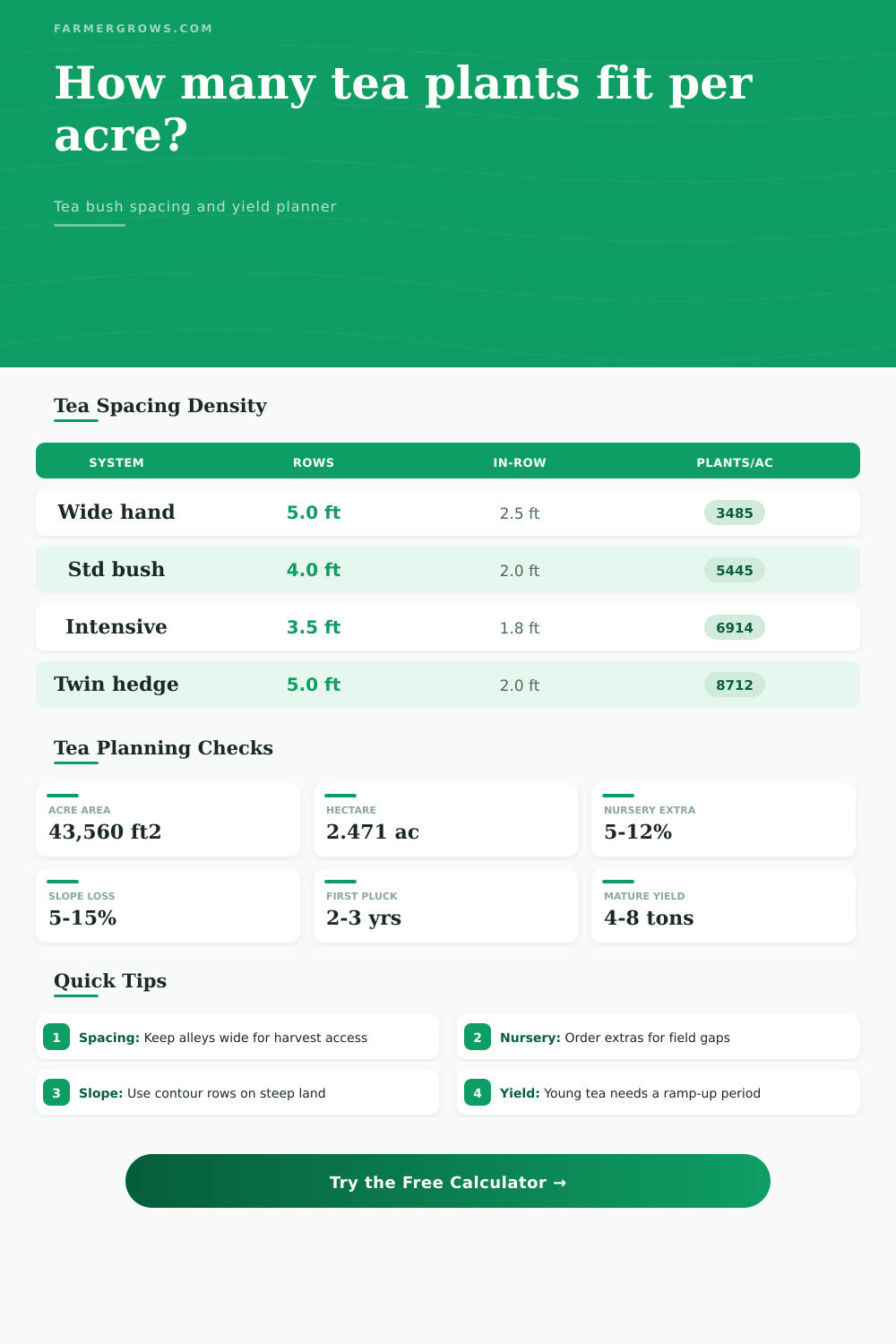
| Spacing system | Row or bed spacing | Plant spacing | Approx. plants/acre |
|---|---|---|---|
| Wide hand-plucked tea | 5.0 ft rows | 2.5 ft in row | 3,485 |
| Standard smallholder tea | 4.0 ft rows | 2.0 ft in row | 5,445 |
| Intensive close-planted tea | 3.5 ft rows | 1.8 ft in row | 6,914 |
| Twin hedge bed | 5.0 ft bed pitch | 2.0 ft in row | 8,712 |
| Field condition | Typical deduction | What it covers | Planning use |
|---|---|---|---|
| Square, flat block | 3% to 6% | Main path and small drains | High plantable share |
| Rolling tea land | 7% to 12% | Contour access and water control | Common planning range |
| Steep slope contour | 12% to 18% | Terraces, grassed drains, turns | Use conservative density |
| Mechanical harvest block | 8% to 15% | Machine turns and wider alleys | Protect access width |
| Allowance item | Typical range | Why it matters | Calculator input |
|---|---|---|---|
| Nursery culls | 3% to 5% | Weak plants removed before field set-out | Nursery reserve |
| First season gaps | 5% to 10% | Drought, waterlogging, handling shock | Survival percent |
| Clone replacement stock | 2% to 5% | Keep same clone in each block | Nursery reserve |
| Replanting old tea | 8% to 15% | Uneven stumps and soil variation | Both allowances |
| Tea stage | Yield factor | Green leaf expectation | Planning note |
|---|---|---|---|
| Year 2 tipping crop | 25% | Very light crop | Train frame first |
| Year 3 young bushes | 45% | Partial plucking table | Fill gaps early |
| Year 4 canopy building | 70% | Approaching commercial crop | Manage bush height |
| Mature tea | 100% | Full expected yield | Depends on clone and care |
When you’re growing tea, each inch of ground matters; this is no longer just a garden, its a business. You might wonder how many tea plant to plant per acre.
It’s an economic equation: How close do you plant? That determines leaf tonnage, ease of harvest and how quickly the canopy close. Planting too tight creates density but lacks airflow. This invite disease and makes hand plucking hard. Plant too far apart and you’re leaving money on the table. Less leaf means less yield. There’s unused photosynthetic capacity.
How Many Tea Plants to Plant Per Acre
So what’s the right balance? They is far enough to thrive, but close enough that they’re competing with one another for light. To help with the arithmetic, there’s this calculator which take into account your land conditions and desired spacing.
First, however, you must define your planting system. Geometry makes all difference. Smallholders commonly grow a standard single hedge row. That’s a good compromise between plant density and bush size.
On steep slopes, by contrast, you’ll probably opt for contour rows, following the land different than a strict grid. This helps reduce soil erosion, but it means your row lengths will be more complicated. For even greater yield potential, you may want twin hedge planting, again, making sure enough light reaches the inner bush and using wider beds.
Once you’ve selected the system, remember that not all of your farm will yield crops, so plan for lost production in the field. Don’t count on your entire deed acres; farmers don’t plant each square foot. There are roads, drains, headlands, etc. Deduct the percentage these non-cultivatable zones occupy. For example, it may be five percent if you’re farming flat ground. It could be as high as 15 or even more. This happens if your terrain is hilly and drains cover much of land surface.
Failing to do this leads to overordering plant or, worse, underestimating the labor required. It is a little thing, but it has a big impact on your bottom line.
Optimism distinguishes the novice grower from the experienced one: not all young tea bushes survives, no matter how well planted and cared for. Even in a nursery, drought, flooding, or the shock of being handled can kill some of your crop. Your calculator requires an expected survival rate; typically, nine-tenths.
Then there’s the nursery reserve, for fill-in plants. Have these plants at the ready to plug holes as they occurs. Better to buy an extra few at planting time then chase them down piece-by-piece over time. Some clones might be out-of-season when you’re needing more.
Besides the number of plants to purchase, the output also tell you the estimated yield and row length. To understand what this means for the estimated yield: you need to know what stage your tea’s at. If it’s only been growing for two years, it won’t be yielding like a mature bush. That thing hasn’t had time to build up its frame yet. The tool uses estimates to account for the age of the plants.
In tea, revenue is back loaded; you’re making an investment in slow paying infrastructur. Reference tables shows the relative density of different spacing systems. And bear in mind: density ≠ productive.
To plan a tea estate, one must balance practicality with ambition. On the one hand, you want as many plants as possible to get the most from every acre of land. On the other, you need adequate space between them so they can stay healthy while harvesting remains efficient. The provided tools show these trade-offs and help you visualize things before you plant.
By adjusting the inputs to suit your terrain, you’ll be able to avoid some of the more common pitfalls: over-planting just as much as wasting land. The numbers will point you where to go; your judgement has to confirm.
When you put plants into the ground, you’re stuck with their spacing. Get it right the first time, because it’s the only strategy that works.