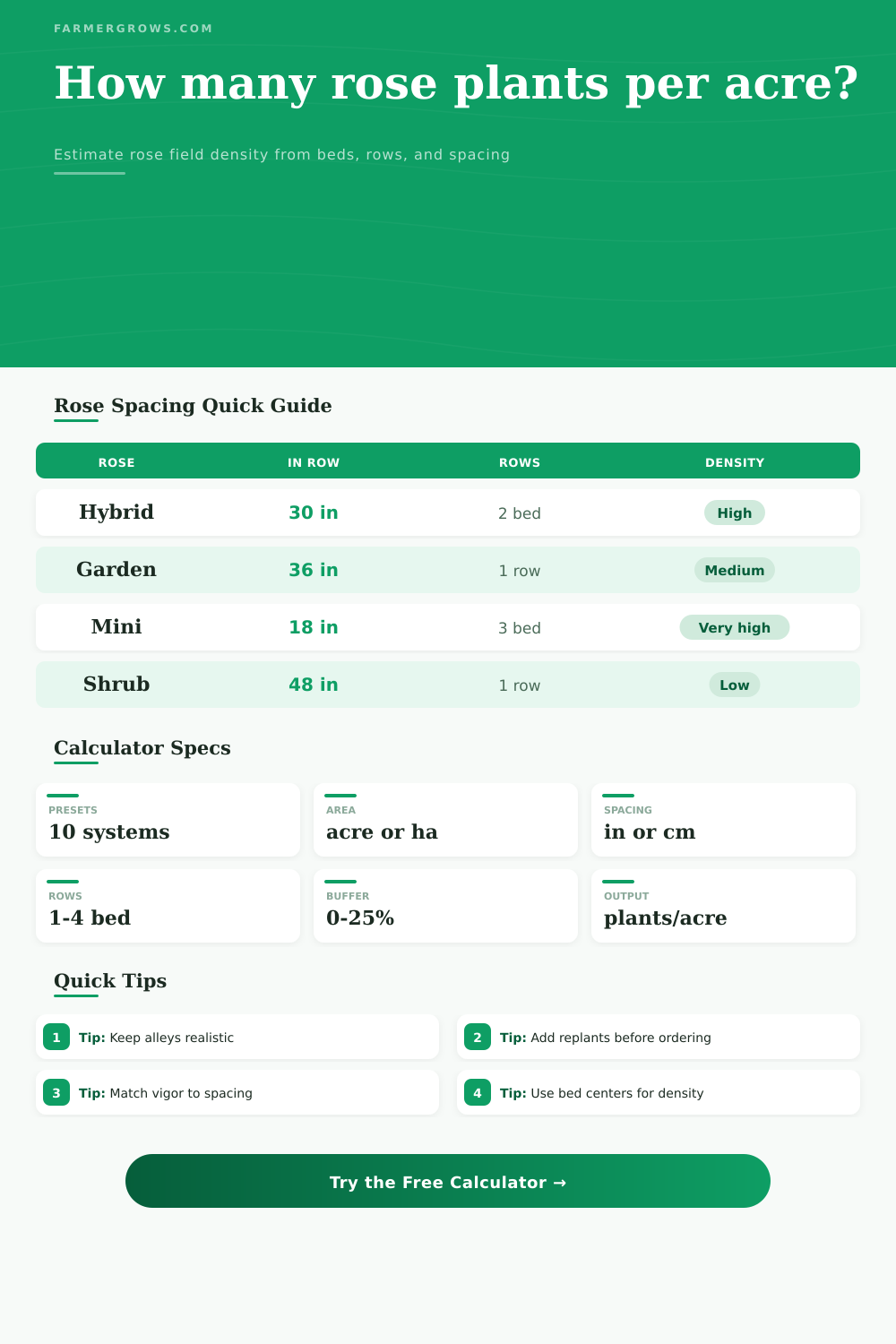
Rose Plants Per Acre Calculator
Plan rose field, nursery, or cut-flower bed density from usable acres, bed width, rows per bed, plant spacing, alleys, end losses, and replant buffer.
Choose a realistic rose production layout, then adjust the bed, alley, spacing, and field-use assumptions for your own block.
Rose Planting Density Results
Density estimate for the selected rose block.
One row on 7 to 9 ft centers with 42 to 60 in in-row spacing commonly falls near 1,200 to 2,200 roses per acre before buffers.
Two rows per 6.5 to 8 ft bed module with 24 to 36 in in-row spacing often lands near 3,500 to 5,800 plants per acre.
Three or four rows per bed with tight spacing can exceed 8,000 plants per acre, but irrigation and disease scouting must be strong.
Climbers need stronger posts, wider alleys, and 6 to 10 ft in-row spacing, so plant counts are much lower than cut rose beds.
| Rose class or crop | Common in-row spacing | Typical row or bed system | Planning note |
|---|---|---|---|
| Hybrid tea cut roses | 24 to 36 in between plants | Two rows per 4 ft bed, 2 to 4 ft alleys | Closer spacing improves stem count but raises pruning and disease pressure. |
| Spray roses and floribundas | 24 to 30 in between plants | Double rows or narrow triple rows | Useful where plants are renewed or pruned hard for production. |
| English garden roses | 36 to 48 in between plants | Single rows or roomy double rows | Allow more canopy room for arching or vase-shaped shrubs. |
| Landscape shrub roses | 42 to 60 in between plants | Single-row blocks on wide centers | Air movement and equipment access matter more than maximum count. |
| Miniature roses and liners | 12 to 24 in between plants | Three or four rows per nursery bed | Best for short production cycles with close irrigation control. |
| Climbing roses on trellis | 72 to 120 in between plants | Single trellis rows, wide alleys | Spacing follows post strength, training style, and harvest access. |
| Layout | Bed module width | Rows per bed | What it usually fits |
|---|---|---|---|
| 4 ft bed plus 2.5 ft alley | 6.5 ft module | 2 rows | Dense cut roses where carts or foot traffic are light. |
| 4 ft bed plus 3 ft alley | 7 ft module | 2 rows | Common hand-harvested rose blocks with drip and mulch. |
| 5 ft bed plus 3 ft alley | 8 ft module | 2 to 3 rows | Nursery rows, better aisle comfort, easier spray coverage. |
| Single row on 8 ft centers | 8 ft module | 1 row | Shrub roses, landscape stock, or machine mowing alleys. |
| Trellis row on 10 ft centers | 10 ft module | 1 row | Climbers, rose hips, and permanent support systems. |
| Row center or bed module | In-row spacing | Rows per module | Plants per gross acre |
|---|---|---|---|
| 6.5 ft module | 24 in | 2 rows | About 6,702 plants before field-use losses |
| 7 ft module | 30 in | 2 rows | About 4,978 plants before field-use losses |
| 8 ft module | 36 in | 2 rows | About 3,630 plants before field-use losses |
| 8 ft module | 48 in | 1 row | About 1,361 plants before field-use losses |
| 10 ft module | 96 in | 1 row | About 545 plants before field-use losses |
| Planning factor | Conservative value | Intensive value | How to use it |
|---|---|---|---|
| Usable planted area | 70% to 78% of gross acre | 82% to 90% of gross acre | Lower the value when blocks have broad turnarounds, windbreaks, or uneven shapes. |
| Headland and row-end loss | 8% to 12% | 3% to 6% | Use this for non-planted row ends, gates, irrigation headers, and turning space. |
| Replant buffer | 8% to 15% | 3% to 7% | Add more when liners are small, bare-root quality varies, or wildlife damage is likely. |
| First-year survival | 85% to 92% | 94% to 98% | Lower survival for hot planting windows, weak irrigation, or delayed planting. |
Check the bed fit before ordering. Multi-row rose beds need enough shoulder room between the outside rose rows and the bed edge. If the calculator warns that rows are too tight, widen the bed or reduce rows per bed.
Do not ignore non-planted acres. A rose acre with headlands, water lines, loading lanes, and turning space may plant far fewer roses than a simple square-foot spacing formula suggests.
When you have a set amount of money, a limited plot of land, and particular plant requirements, it’s time to plant your acre of roses. Before committing to space, determine how many square feet is acceptable as wasted area. While growers tend to begin by considering how their land are shaped, the real effort comes in figuring out what won’t work: disease, dead plants, and the kind of soil.
The density calculator is there to keep you from getting ahead of yourself. The second issue comes from changes in usable area. Sure it sounds easy: take the perimeter and divide by number of plants per square foot. But fields are never ideal rectangles, there are areas with irregular edges. There are also headlands for turning equipment and water lines. All of these cut down on space you have to work with.
How to Plan Your Rose Garden
Assuming you can plant a square inch on gross acre puts you behind before you even start. Once you enter your field configuration into the calculator, it do the math for you. It forces you to face the truth, that maybe only eighty percent of your land can actualy support a rose bush. Overcrowd and ignore those margins, and you gets disease and a bad year.
Now that you know what’s on the ground, it’s time to think about how the beds themselves will be laid out. Raised beds allow for double rows or single rows. Two rows per bed is common with hybrid tea cut roses; a space of thirty inches per plant work well here. That makes the best use off the stems. But it also create high humidity. You could go even tighter (sometimes three or four row per bed) with miniature roses, which require careful attention to irrigation.
On the other extreme, shrub roses is larger and more likely to have fungal problems when squished together. They also needs some air circulation. Switch back and forth between those configurations with the tool. Adjust the alley width between beds so that harvest carts or spray rigs can moves through them. You may be able to squeeze slightly more plants into each bed by narrowing the alleys, but you’ll spend extra money maintaining them.
Life finds ways. That’s biology.
You don’t plant every rose that you sell, you plant multiples. First-year survival and a replant buffer aren’t optional inputs. They’re what make the difference between a patchy field and a full one. Bare root liners are fragile. They’ll succumb to bad luck, wildlife, or drought. Eight to fifteen percent is a good buffer adder to account for this naturaly loss. It’s better to buy extra plants now than to scramble for replacements later when they’re in short supply. This calculator adds those extras into your final order count. The number at the bottom is the number you should of put on your purchase order.
This is the reference table of classes of roses. Compare that 10-foot row of climbers between plants with the nursery block of intensive planting. Not only do you want to fit your plants in, but match size of the plant to the space you have for it. An English garden rose grown in tight hybrid tea spacing won’t be happy. It’ll gets weaker canes and smaller blooms. Give a compact shrub too much space and it will look sparse and cost you precious land.
Maximizing density is not the objective. The goal is optimal density. You want enough plants in the soil to do their job, cover it and yield well; but not so many that they competes for resources. Balancing row spacing, bed width, and survival rate gives you a clear-eyed view of what harvest you can expect from this piece of ground. And that translates a guess into a plan.
In agriculture, having a plan is the only thing that keeps you from crop failure. Begin with the land. Respect its biology. Let the numbers tell your hand where to go.