Chilli Plants Per Acre Calculator
Estimate chilli and pepper plant population from in-row spacing, row or bed centers, rows per bed, field losses, survival, gap filling, and nursery buffer.
Pick a realistic pepper production system, then adjust spacing and stand assumptions for your variety, trellis, drip line, and headland layout.
Chilli Plant Population Estimate
Spacing and stand summary will appear here.
Best for small farms, hand weeding, and mixed chilli blocks where 30 to 42 inch centers keep harvest paths open.
Two rows per bed increase plants per acre, but drip tape placement and disease airflow become more important.
Works when plants are pruned or supported and humidity is managed; otherwise crowding can reduce usable fruit.
Lower plant count may be correct when cultivators, sprayers, or mechanical harvesters need consistent row spacing.
| Pepper type | Common in-row spacing | Common row or bed centers | Typical final plants per acre |
|---|---|---|---|
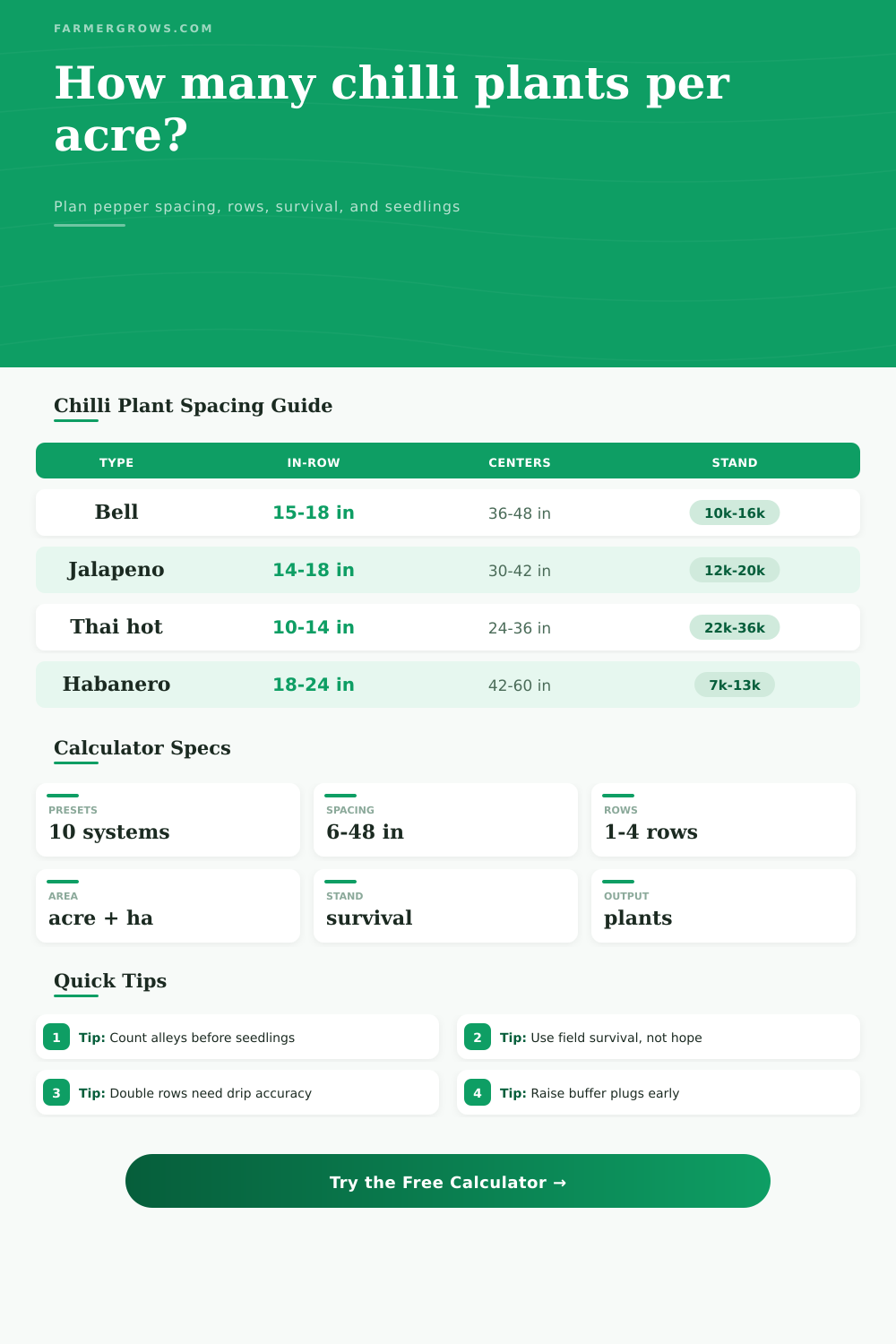
| Bell or blocky sweet pepper | 15 to 18 in | 36 to 48 in single rows | 10,000 to 16,000 |
| Jalapeno or fresh green chilli | 14 to 18 in | 30 to 42 in single rows | 12,000 to 20,000 |
| Cayenne or long dry chilli | 12 to 18 in | 30 to 40 in rows | 18,000 to 30,000 |
| Thai hot or bird eye chilli | 10 to 14 in | 24 to 36 in rows | 22,000 to 36,000 |
| Habanero or Scotch bonnet | 18 to 24 in | 42 to 60 in rows | 7,000 to 13,000 |
| Layout example before losses | Planting holes per acre | Metric equivalent | Best fit |
|---|---|---|---|
| 48 in rows x 24 in plants, 1 row | 5,445 holes | 13,454 holes/ha | Very vigorous or wide harvest access |
| 36 in rows x 18 in plants, 1 row | 9,680 holes | 23,920 holes/ha | Bell, jalapeno, staked fresh pepper |
| 30 in rows x 15 in plants, 1 row | 13,939 holes | 34,444 holes/ha | Cayenne, serrano, moderate canopy |
| 60 in beds x 18 in plants, 2 rows | 23,232 holes | 57,407 holes/ha | Double-row plasticulture |
| 24 in rows x 12 in plants, 1 row | 21,780 holes | 53,820 holes/ha | Small hot chilli, intensive hand harvest |
| Field survival before gap fill | Final stand with no gap fill | Final stand with 50% gap fill | Seedling planning note |
|---|---|---|---|
| 98% | 98% of holes | 99% of holes | Small buffer is usually enough |
| 95% | 95% of holes | 97.5% of holes | Raise a normal spare tray block |
| 90% | 90% of holes | 95% of holes | Plan replacements before transplant day |
| 85% | 85% of holes | 92.5% of holes | Stress, heat, or pests are likely issues |
| Plants needed | 72-cell trays | 128-cell trays | 200-cell trays |
|---|---|---|---|
| 5,000 seedlings | 70 trays | 40 trays | 25 trays |
| 10,000 seedlings | 139 trays | 79 trays | 50 trays |
| 15,000 seedlings | 209 trays | 118 trays | 75 trays |
| 25,000 seedlings | 348 trays | 196 trays | 125 trays |
Measure the center-to-center distance that equipment actually uses. If beds are 5 ft apart from drip line to drip line, use 60 inches even when the planted row pair is much narrower.
Base nursery numbers on field survival, not tray germination alone. Heat, wind, cutworms, and transplant shock can remove plants after perfect-looking trays leave the nursery.
Sowing peppers sounds straightforward enough… Just dig a hole and drop in a seedling (but when you’re planting acres of them), things get complicated fast. How much room do you leave between rows? Between plants within each row? And how many will die from transplant shock (or worse)?
If you guess wrong on your spacing, you end up with field of weeds or a crop of stunted plants fighting for sunlight. No, you don’t want that in your field. The tool above takes care of all that math after you enter in your assumptions about survival rates and spacing. It spares you having to convert units and fiddle with coefficients.
Planning Your Pepper Field
First of all, there’s space. And that’s what you’re working with: Spacing. No, this isn’t a question of cramming as many plants into the soil as possible. This is providing individual plant some breathing room.
Bulky, it is: Bell peppers need their shoulders. Squeeze them together in a row, and lower foliage will rot (and so will the fruit be ugly). Thai chilies are different: they are small, upright, and happy to be crowded. You can get away with really packing them in tight.
Row centers range from 36 inches for sweet peppers to just 24 inches for the hotter ones, and that difference makes all the difference (see table of references at right). It affects how many seedlings you set out in a tray, and it even determine whether your tractor can turn around. Space is something you work with; not the other way round. Match spacing to how the plant grows.
And then there’s the matter of loss. Don’t assume everything will live. Do not allow any hope. Before you plug your gaps, the calculator wants to know how many of those transplants you expect will survive into maturity. Experience beats optimism. A row of young plants may die from root rot in a wet spring before they get established. Transplants may dry out in hot, dry wind if you don’t water them immediately.
If you set your expected survival rate at 92 rather than 100 percent, that seems like no big deal, right? But that difference in number of transplants requires that you raise more seedlings in the nursery. That means you have to order more trays. That comes with a price tag up front, yes… But it spares you a patchy yield down the line. You’re paying now to prevent failure later.
But there’s one more wrinkle: Gap filling. Yes, it is the law of agriculture: You’ll lose plants. And with the tool, you can plug in how many of the holes you can expect to reasonably fill. Fill 60 percent of the gaps and you’re better off than if you didn’t. But now you’d still like your stand to be buffered with seedlings.
That’s why the calculator has a nursery buffer setting. Raise a little extra; that’s cheap insurance for replacements. For the ones that get nibbled by cutworms overnight. Some cells in some trays won’t germinate very wellly. This is a classic mistake among farmers: They raise exactly as many plants as they need for the map…then scramble when the field cries out for help. Raise a little extra; that’s cheap insurance.
Also, don’t forget about the headlands. Not every square foot of the field gets planted. There are pump lanes, shed strips, drainage ditches, and turn rows for machines. Those get ignored if you aren’t careful and will inflate your plant count. To account for this, the calculator subtracts the headland loss from what it calculates as usable area so that your final numbers represent reality, not some idealized grid. That’s key for budgeting.
How many actual plants do you have producing? How many holes did you dig in theory? Here is some context for these numbers: habaneros grow outward quickly and need plenty of space. Bell pepper is in between. Thai hot goes high density. So understanding this range puts your inputs in perspective. If your plan is for 30,000 bell peppers on an acre, you’re doing it wrong. Those things will strangle each other. You’ll end up with low yields because though there are a lot of them, it’s not the best quality. Having too many plants do not mean better quality. It is about finding a balance between space, light, and airflow to get a good yield.
Planning a pepper field means taking care of risks. That’s where this spreadsheet comes in. You get to pick the space between plants. You guess at what will go wrong and account for that guess. You leave wiggle room. And then you put it all together using the tool, which spits out some numbers, and your own judgement.
Begin with the variety. Choose the space. Tweak it based off your equipment. Raise as many seedlings as the math says to raise. Sounds like administration, but it could of been the groundwork for a good harvest. Dig the hole. Drop the plant. But first plan the acre.