Black Pepper Plants Per Acre Calculator
Estimate black pepper vines, support standards, row length, spacing density, and nursery reserves from real field spacing and plantable-acre assumptions.
Choose a planting style, then adjust row spacing, vine spacing, support type, alleys, and nursery reserve to match your farm block.
Black Pepper Planting Estimate
Spacing and support summary will appear after calculation.
Gliricidia, erythrina, or similar standards are planted before pepper and need extra replacements for failed standards.
Use the palm grid as the first density limit, then count pepper vines per usable palm instead of forcing a square pepper block.
Post spacing is easier to keep uniform, so density is usually close to the calculated footprint after headlands are removed.
Contour planting often loses extra area to drains, turning bays, and uneven row length; use a larger plantable-area deduction.
| Support spacing | Area per support | Support points per acre | Support points per hectare |
|---|---|---|---|
| 1.8 m x 1.8 m | 3.24 m² / 34.9 ft² | 1,249 | 3,086 |
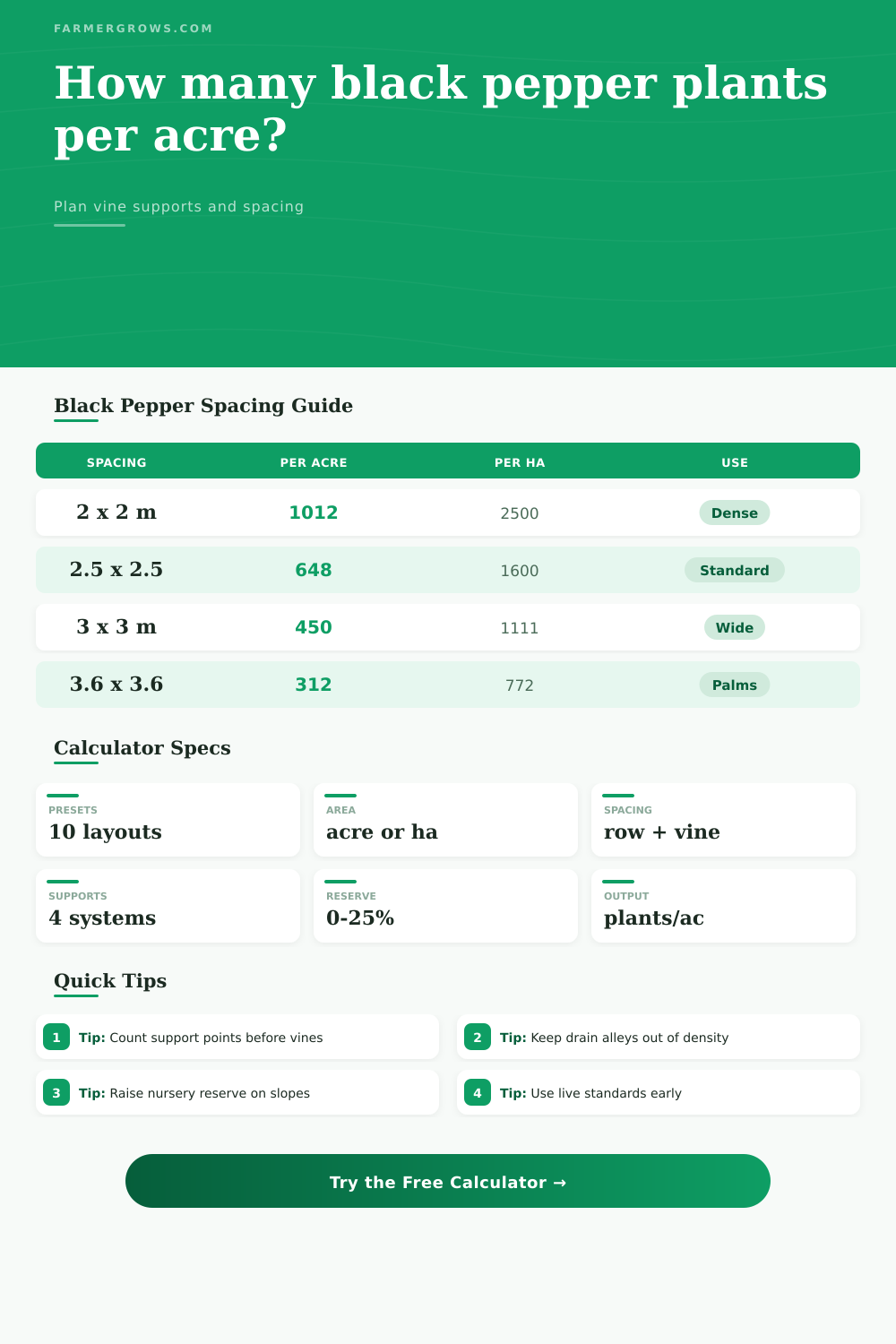
| 2.0 m x 2.0 m | 4.00 m² / 43.1 ft² | 1,012 | 2,500 |
| 2.5 m x 2.5 m | 6.25 m² / 67.3 ft² | 648 | 1,600 |
| 2.7 m x 2.7 m | 7.29 m² / 78.5 ft² | 555 | 1,372 |
| 3.0 m x 3.0 m | 9.00 m² / 96.9 ft² | 450 | 1,111 |
| 3.6 m x 3.6 m | 12.96 m² / 139.5 ft² | 312 | 772 |
| Support system | Typical planning use | Reserve to consider | Counting note |
|---|---|---|---|
| Live standard | Dedicated pepper gardens | 5% to 12% supports | Count one standard for each support point. |
| Arecanut support | Intercrop in palm rows | 0% to 5% supports | Density follows usable palms, not ideal pepper spacing. |
| Coconut garden | Wide mixed garden | 0% to 5% supports | Only count palms selected for pepper training. |
| Concrete or stone post | Uniform commercial blocks | 2% to 5% supports | Add corner, end, and breakage reserve separately. |
| Trellis trial rows | Research or nursery blocks | 3% to 8% posts | Use actual post or standard count, then vines per point. |
| Field planning factor | Light deduction | Moderate deduction | Heavy deduction |
|---|---|---|---|
| Boundary headlands | 2% to 4% | 5% to 8% | 9% to 12% |
| Drainage channels | 2% to 3% | 4% to 7% | 8% to 15% |
| Contour and slope breaks | 3% to 5% | 6% to 10% | 11% to 18% |
| Mixed shade trees | 5% to 8% | 9% to 15% | 16% to 25% |
| Area unit | Square feet | Square meters | Black pepper planning use |
|---|---|---|---|
| 1 acre | 43,560 ft² | 4,046.86 m² | Main density unit for plants per acre. |
| 1 hectare | 107,639 ft² | 10,000 m² | Multiply per-hectare support counts by 0.4047 for acres. |
| 1 cent | 435.6 ft² | 40.47 m² | Useful for small home-garden pepper plots. |
| 1 guntha | 1,089 ft² | 101.17 m² | About one-fortieth acre in many farm records. |
Separate support count from vine count. A one-acre pepper block may need fewer support standards than planted vines when two rooted cuttings are trained on the same standard.
Deduct unusable land before comparing density. Drains, shade-tree gaps, contour paths, and headlands can reduce real plants per acre even when spacing is measured accurately.
Moving from theory into the field turns your spreadsheet into something of a liability. The spreadsheet becomes a physical liability, you have land, rooted cuttings, and a budget that refuses to stretch further.
How many plants can you grow on this? That’s not the right question. How many vines will live, climb, and bear fruit, while still allowing each other enough light? The black pepper plants per acre calculator help close that gap between ideal geometry and the realities of the field, forcing you to consider unplanted space.
Why Spacing Matters More Than Density
Spacing is where most growers begin, as if it’s important. It sounds good on paper. Two by two meters is an efficient-looking grid, promising more than a thousand support points per acre. However, what is efficient on paper can turn into misery in the field. Narrow rows are hard to prune and invite fungal disease because they trap heat.
With the tool you can modify spacing to three by three meters or even wider. That will reduce the number of plant but perhaps improve health of each vine. Is your preference for a densely planted plantation or something more manageable like a garden?
Where it becomes complicated is with the support system. With living supports such as Gliricidia, you’re planting support trees, not poles. Some will die, some won’t take hold, some break. How many? The calculator wants you to put in a percentage of reserves on support trees. This is the single most common error that novice farmers commit; they ignore this number.
They come up with calculations for 500 vines, then only forty percent of their support trees survives the first monsoon. No reserve means lower density, which translates into crumpled yield estimates. Plug in your loss rate and the tool does the math for you.
Drainage channels and service alleys limit useable acres. A ditch is no place for a vine. Narrow gaps between tree are too small for a sprayer. The plantable area input removes the idea of covering every single inch. Contour breaks are necessary on any sloping ground. Wider drains for flood control are needed if your land is rainfed.
Before calculating plant density, the calculator subtracts unusable strips from total area. That way you can’t design some high-density layout on land you cannot possibly maintain. It makes you realize the acre as it is, not as it looks on a survey map.
Another essential layer is nursery reserves. Cuttings (rooted ones) are delicate creatures and can be lost in transit, left too long in hot sunlight, or even refuse to take when planted in the field. Ten to fifteen percent reserves will give you a backup nursery for replacement stock if things go awry. It helps manage risk.
Nature doesn’t work according to a perfect grid. There is also a set of reference tables so you can get a quick answer on popular configurations (like intercropped with coconut or arecanut). It doesn’t start from scratch and acts as an extension of palm grid systems, but it also doesn’t use theoretical support points. Instead, it counts the actual number of usable palms.
This number varies depending on whether you’re in a pure garden system or a mixed-garden system, and it adjust to match. That’s where the change in reasoning comes into play, avoiding overplanting in the mixed-garden systems.
“Don’t think about how many vines you can squeeze onto an acre. Think about how many healthy, productive vines you can have. Density isn’t a trophy. It’s a tool. Entering those numbers in the calculator is stress-testing your plan. It asks how much the slope, soil, and odds of survival will affect each change in reserve and spacing.
Its resulting numbers are a guideline, but its true value lies in what you discover as you enter them. You learn to view the field as a livig system with management to do. That shift in perspective makes a planting schedule into a successful harvest. You should of planned better.