Papaya Plants Per Acre Calculator
Estimate papaya planting density from row spacing, in-row spacing, paired-row layouts, usable land, seedling survival, fruiting stand percentage, and expected yield per bearing plant.
Choose a real papaya spacing style, then adjust the usable acreage, hill thinning, survival, and yield assumptions for your cultivar and field.
Papaya Planting Estimate
Spacing and production summary for the selected papaya block.
Best where individual plants need air flow, easy harvest access, and clearance from structures or other trees.
Balances density and canopy movement for many solo, red lady, and local market plantings.
Gives about 2,500 plants per hectare before field losses, a common high-output planning figure.
Only fits compact cultivars and careful management because shade, disease pressure, and nutrition demand rise fast.
| Spacing system | Spacing used | Plants per acre | Plants per hectare |
|---|---|---|---|
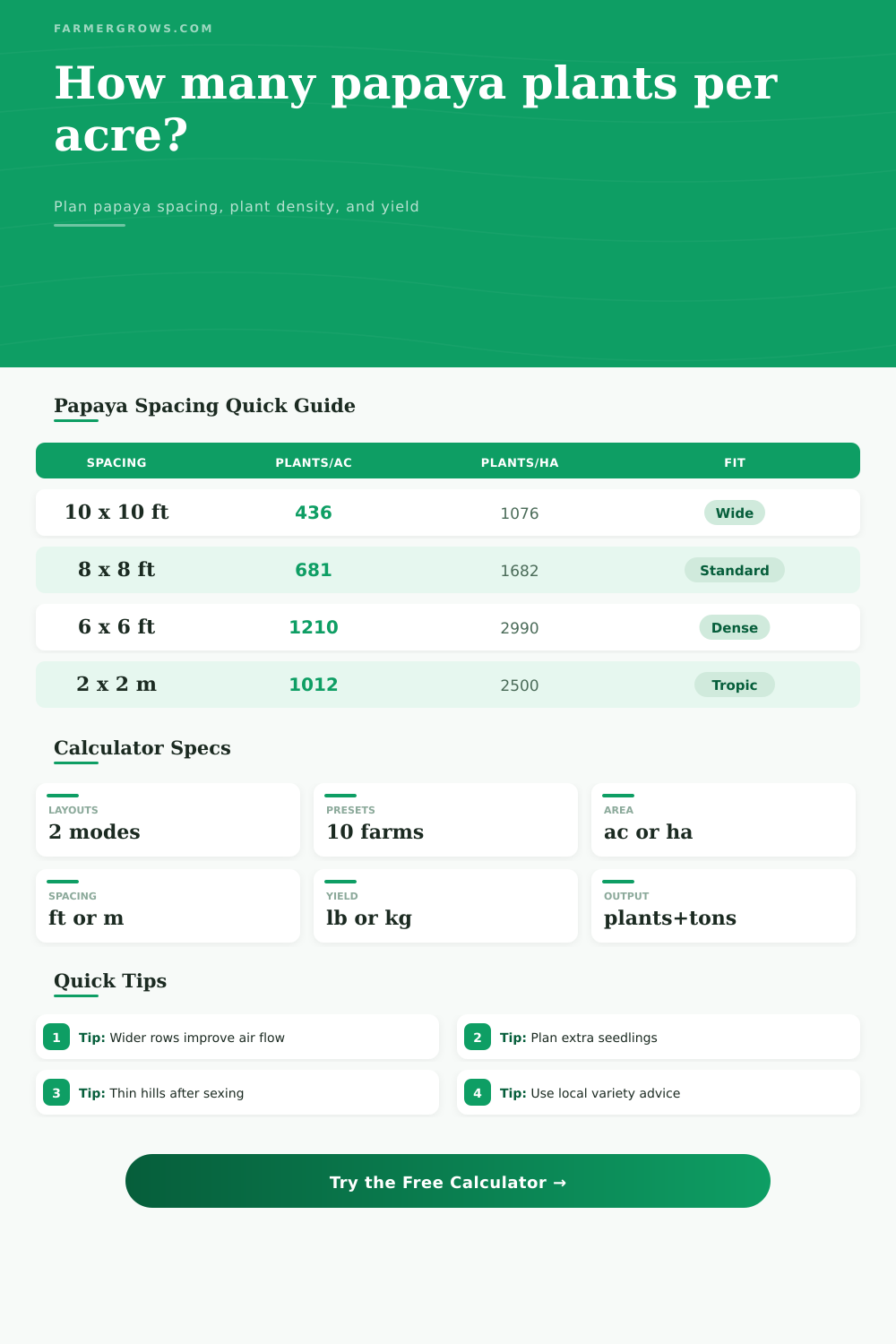
| Wide home orchard | 10 ft x 10 ft | 436 | 1,076 |
| Home or windier sites | 9 ft x 9 ft | 538 | 1,329 |
| Island standard | 8 ft x 8 ft | 681 | 1,682 |
| Close commercial row | 7 ft x 8 ft | 778 | 1,922 |
| Dense square block | 6 ft x 6 ft | 1,210 | 2,990 |
| Metric wide orchard | 2.5 m x 2.5 m | 648 | 1,600 |
| Metric tropical block | 2 m x 2 m | 1,012 | 2,500 |
| NHB normal spacing | 1.8 m x 1.8 m | 1,249 | 3,086 |
| High density block | 1.5 m x 1.5 m | 1,799 | 4,444 |
| Dwarf close planting | 1.2 m x 1.2 m | 2,810 | 6,944 |
| Paired-row layout | Plant gap in row | Effective row spacing | Plants per acre |
|---|---|---|---|
| 2 m close row plus 4 m alley | 2 m | 3.0 m | 675 |
| 2 m close row plus 3 m alley | 2 m | 2.5 m | 810 |
| 6 ft close row plus 12 ft alley | 7 ft | 9 ft | 691 |
| 6 ft close row plus 10 ft alley | 6 ft | 8 ft | 908 |
| 5 ft close row plus 9 ft alley | 6 ft | 7 ft | 1,037 |
| Seedling plan | Use when | Starting seedlings | Planning note |
|---|---|---|---|
| 1 per spot | Known sex transplants | Spots x 1.05-1.15 | Good for reliable nursery plants or grafted stock |
| 2 per spot | Some sex uncertainty | Spots x 2.1-2.3 | Thin after flowering and replace weak hills early |
| 3 per spot | Dioecious seedlings | Spots x 3.1-3.5 | Useful where female or hermaphrodite selection is needed |
| Gap filling | Rain or heat stress | Add 10-20% | Keep uniform age by replanting quickly |
| Yield assumption | lb per bearing plant | kg per bearing plant | Best use in calculator |
|---|---|---|---|
| Low first-cycle estimate | 35-50 lb | 16-23 kg | Young fields, stress, limited fertility, or conservative planning |
| Moderate managed field | 60-90 lb | 27-41 kg | Irrigated blocks with good nutrition and harvest access |
| Strong commercial stand | 100-140 lb | 45-64 kg | Healthy trees, strong variety, long harvest window |
| High-output trial | 150+ lb | 68+ kg | Use only with local records or variety-specific guidance |
Separate plant density from seedling count. Papaya growers may plant multiple seedlings per spot for sex selection, but final plant population should reflect the bearing plants left after thinning.
Do not chase density without management. Tight papaya spacing raises fertilizer, irrigation, pruning, and disease pressure; widen rows when air flow or harvest access is limiting.
If you’re planning an orchard of papayas, you’ve got some things to consider. What area do you want to use? Which variety are you interested in growing? How much fruit do you want to harvest each year?
Trees don’t fit neatly on every acre, and it’s more complicated than punching holes in the ground. How can you make the most of your property? When will fruit need to be harvested and how will tree be accessed? Will there be enough airflow and sunlight to avoid disease pressure? There are many possibilities.
How to Plan Your Papaya Orchard
Most gardeners begin with a vague plan for how far apart to plant their trees and just hope they don’t have to buy irrigation systems or fertilizer.
That’s where this calculator (above) comes in: With a few clicks, entering the size of the area you want to grow on, choosing how many rows wide you plan to make it, and what spacing within each row (single, double?); it translates your preference into numbers, calculating exactly how many plant you will get based off those dimensions, given a realistic approach to gardening and to raising crops: It assumes that not all seedling survive. Even with establishment rates and the loss of male plants if you are growing a dioecious variety, you should of have an extra set of seedlings ready in case some fail to fill out the field.
The first big decision is choosing a spacing system, which will establish the tone of the rest of the crop cycle. The easiest is wide spacing. A ten feet by ten feet layout is comfortabley. You can walk around with ease and get good airflow, which reduces fungal problems. You also have fewer trees competing for nutrient. But fewer trees per acre translates into a smaller number of total tree, unless each tree’s fruit production is huge, limiting potential revenue. This is the low-stress option, suitable for low-input systems with limited labor (or even in home orchards).
At the other end of the spectrum are high-density plantings, which go as low as six feet by six feet, or even closer with dwarf varieties. The idea here is to get as much ground covered as soon as possible, shading out weeds while getting as many fruits as possible on each acre. And then there’s this: Dense plantings need aggressive pruning (to maintain open canopies), precise irrigation (many roots to feed) and thorough disease management (moisture traps). Without your ability to tend to such a dense canopy, all those additional plants are going to simply compete and die back, creating a mess instead of a crop.
To illustrate: The calculator shows you what you’re going to end up with, like a fruiting stand. This is super important because it shows the difference between the plants you planted and the ones that will bear fruit. Those fruits will bring you money. You might plant a thousand seedlings, but after you account for the failure rate and subtract any sterile males found in the first year, you will end up with a very different number of trees that actualy bear fruit. Adjust those percentages depending on the reliability of your variety and your nursery quality. Known-hermie transplants will mean better survival and fruit set than seedling production. Selecting for sex means you should plan on needing to plant more, and that there will be some thinning.
The value lies in planning: predicting yield. You enter how much produce each bearing plant will yield and it calculates the total tons per acre. It helps you determine whether you have enough volume for your market channel. With local sales, perhaps a lower yield is more manageable. For wholesale sales, you want the higher density yield to make logistics worth your while. The system takes into account recoveries at harvest, because not all of the fruit you pick gets sold. Weather, damage and culls result in a loss, plan for those losses so that your optimistic revenue predictions don’t crumble once the fruit lands on the table.
The bottom line: It’s not the papaya tree count-per-acre that makes the best papaya farm; it’s the number of good productive trees that can be well managed by available resources. Consult the tables of reference spacings to see what is normal. However, rely on the inputs that fit your land and labor capabilities and your market objectives. The calculations are only there to sharpen your intuition.
Begin with where you’re constrained, crunch some numbers, then tweak again and again till you have a plan that feels sound. And off you’ll go, planting all those trees.