Dragon Fruit Plants Per Acre Calculator
Estimate dragon fruit plant density from trellis system, row spacing, support spacing, plants per post, usable acre percentage, reserve cuttings, pollinizer rows, and drip emitters.
Choose a realistic orchard layout, then tune the block area, support spacing, plants per post, reserve percentage, pollinizer share, and irrigation points.
Dragon Fruit Planting Layout Results
Use the calculator to estimate plants, trellis posts, row length, and nursery reserve.
Full layout breakdown
Simple concrete posts with a top tire, cross, or frame. Easy to count, prune, and replace one station at a time.
Fewer heavy vertical stations with continuous arms or wire. Useful where rows are long and straight.
Wider row spacing and a split canopy can improve access and airflow in humid or high-rainfall blocks.
Lower density, easier mowing, spraying, harvesting carts, shade management, and turning at row ends.
| Row spacing | Post spacing | Plants per post | Posts per acre | Plants per acre |
|---|---|---|---|---|
| 8 ft rows | 6 ft supports | 1 plant | 908 posts | 908 plants |
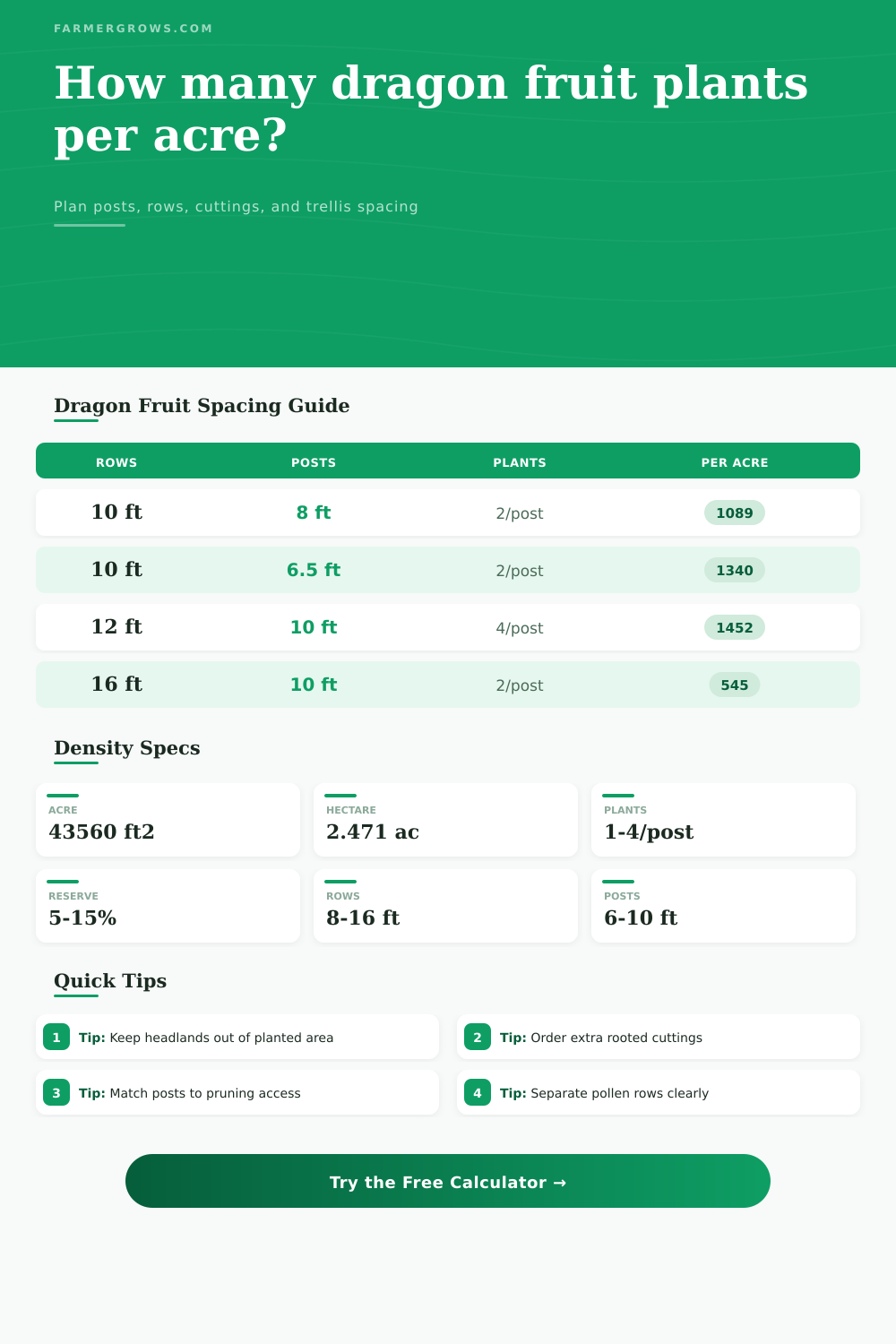
| 10 ft rows | 8 ft supports | 2 plants | 544 posts | 1,089 plants |
| 10 ft rows | 6.5 ft supports | 2 plants | 670 posts | 1,340 plants |
| 12 ft rows | 8 ft supports | 2 plants | 454 posts | 908 plants |
| 12 ft rows | 10 ft supports | 4 plants | 363 posts | 1,452 plants |
| 14 ft rows | 8 ft supports | 2 plants | 389 posts | 778 plants |
| 16 ft rows | 10 ft supports | 2 plants | 272 posts | 545 plants |
| Plants per support | Best use | Canopy effect | Planning caution |
|---|---|---|---|
| 1 plant | Variety trial, weak starts, mother plants | Slow fill, easiest tracing | Lower early production per support |
| 2 plants | Most commercial single-post layouts | Balanced fill and access | Needs a reserve for failed cuttings |
| 3 plants | Faster canopy on moderate posts | Quick fill, more pruning | Watch crowding near post head |
| 4 plants | Strong concrete posts with wide crowns | High plant count per support | Requires stronger post and top frame |
| Reserve level | When to use it | Added cuttings for 1,000 plants | Reason |
|---|---|---|---|
| 5% | Rooted nursery plants, mild site | 50 extra | Minor culls and labeling errors |
| 10% | Typical new acre planting | 100 extra | Early losses and weak rooting |
| 15% | Windy, hot, or dry establishment | 150 extra | Replant gaps before canopy forms |
| 20% | Unrooted cuttings or risky timing | 200 extra | Nursery shrink plus field misses |
| Usable acre share | Planted area | Why acres shrink | Layout note |
|---|---|---|---|
| 95% | 41,382 ft² | Narrow headlands only | Compact square block with little service space |
| 90% | 39,204 ft² | Normal turns and drainage | Good default for a practical acre estimate |
| 85% | 37,026 ft² | Windbreaks or wider turns | Often fits farms using carts or sprayers |
| 80% | 34,848 ft² | Roads, shed pads, setbacks | Use for irregular or service-heavy blocks |
| Row run length | Rows at 10 ft spacing | Rows at 12 ft spacing | When it helps |
|---|---|---|---|
| 200 ft | 22 rows per full acre | 18 rows per full acre | Short fields and mixed varieties |
| 300 ft | 15 rows per full acre | 12 rows per full acre | Common compact orchard blocks |
| 400 ft | 11 rows per full acre | 9 rows per full acre | Long straight rows with fewer turns |
| 500 ft | 9 rows per full acre | 7 rows per full acre | Long-row farms and drip zones |
| Planning item | Low density acre | Medium density acre | High density acre |
|---|---|---|---|
| Field plant count | 545 to 780 plants | 900 to 1,100 plants | 1,300 to 1,450 plants |
| Two emitters per plant | 1,090 to 1,560 emitters | 1,800 to 2,200 emitters | 2,600 to 2,900 emitters |
| 15% pollinizer share | 82 to 117 plants | 135 to 165 plants | 195 to 218 plants |
| 10% rooted reserve | 55 to 78 extras | 90 to 110 extras | 130 to 145 extras |
Count usable acreage, not deed acreage. Dragon fruit density changes fast when you remove headlands, drainage alleys, windbreak setbacks, and loading space. A practical one-acre block often plants closer to 80% to 95% of the gross acre.
Match density to pruning and harvest access. A closer post grid can raise plants per acre, but dense dragon fruit canopies need more pruning, stronger tops, clearer variety labels, and enough aisle width for night flowering checks and fruit harvest.
On the ground, all those concrete posts and tidy rows makes dragon fruit farming seem like child’s play. But that ordered surface conceals a complex problem involving logistics, weight, and space. The key to whether it becomes a tangle or a thriving orchard is often answered with this one question: Just how many plants is there per acre?
It is not stem counts. No, that’s how many vines there may be. It’s how much labor you’re willing to spend on pruning. It’s how much weight your posts will support, and how much room each vine have to breathe.
How to Count Dragon Fruit Plants Per Acre
The problem most novices face is that they overestimate what their structure can hold and so pack it full of plant. “Oh man I could fit X number on this acre,” you say, “but my structure only holds Y.” A regular old concrete post can only holds so much weight. Cramming four strong vines on top of a post meant for two is asking for trouble in high wind or under a heavy fruit load.
Once you draw out your trellis, the calculator will do the rest. You won’t have to guess how many plants you think you can get away with versus how many you realy have room for. It’ll force you to come to terms with engineering limits of the farm and biological needs of cactus.
And then there’s land that you can use. The acreage on a paper title is a nice figure, but that rarely translates into usable ground. There are road setbacks and shade structure setback. You need headlands for turning equipment and drainage ditches for rain management. Treat that whole acre as space where something grows. Before long, you won’t have any space to get a harvester in, and the vines will be choking the perimeter of your property. Ten to twenty percent off the gross area makes sense; call it a safety margin if you like, but it’s also a practical adjustment. It’s the difference between an idealized layout and one that works.
The table on the page lays it all out clearly… How a simple five percent shrink of the planted footprint translate into a significant difference in your post count.
There’s another dimension to consider: Pollination. Some of the most popular types is self-incompatible, meaning they require a partner and won’t work if you only have a single variety. Plan accordingly, leaving room in your plot for pollinizers; typically a smaller percentage of your total block. No biggie, right? Actualy, you cannot have a crop without it. That’s not an option; that’s a prerequisite for a harvest. Without planning for that portion from the start, you may find yourself with a gorgeous-looking canopy; but no fruit except for flowers.
Density also scales irrigation plans: Every plant need water, and every water source requires an emitter. More plants = more emitters = more complicated drip lines that has more places to clog up. That’s just a little bit of logistics, but if you’re standing in July troubleshooting a dry spot, you’ll be glad to know exactly how many emitters you need to order rather than having to improvise with spares later on.
Experience matters more then optimism when looking at the reserve cutting percentage. Even a good plant sold by a nursery isn’t necessarily one you’ll recieve home with, or one that survives initial dry spell, or transplant shock. Seasoned growers sets aside ten to fifteen percent of what they plant as reserves; plants just in case some don’t make it (and even if they do, some may be damaged). That should of seemed wasteful, but is really insurance against bare spots in the rows. If left unfilled, those gaps can grow wider and create wind tunnels that damage nearby vines. A uniform canopy, maintained by filling these gaps promptly, maintains a consistent microclimate.
At the end of the day, though, planting is less about the initial count and more about how you manage that count over the long term. These are the tools we use to see our blocks ahead of time, to turn the idea of “spaced out” into real terms: rows, posts, and reserved areas.
In three years, you’ll be walking around your fields, and either cursing yourself for making things so tight that there’s no room to prune, or thanking your lucky stars that you left some elbow room. It’s one thing to make the most of an acre; it’s another to do so in a manner where the fruit itself can flourish. That’s what differentiates a piece of property from an orchard.