Aloe Vera Plants Per Acre Calculator
Estimate aloe vera plants per acre, total crowns or offsets, nursery order quantity, replacement reserve, plant row length, leaf harvest, and gel yield from spacing, layout pattern, usable field area, and stand assumptions.
Use net planted area for aloe vera blocks by excluding lanes, drains, pump pads, headlands, windbreaks, and wide harvest alleys. The calculator counts one rooted crown, plug, offset, or tissue-culture plantlet as one planting station.
Aloe Plant Population Results
Your aloe vera plant count will appear here.
| Spacing system | Footprint | Plants per acre | Use case |
|---|---|---|---|
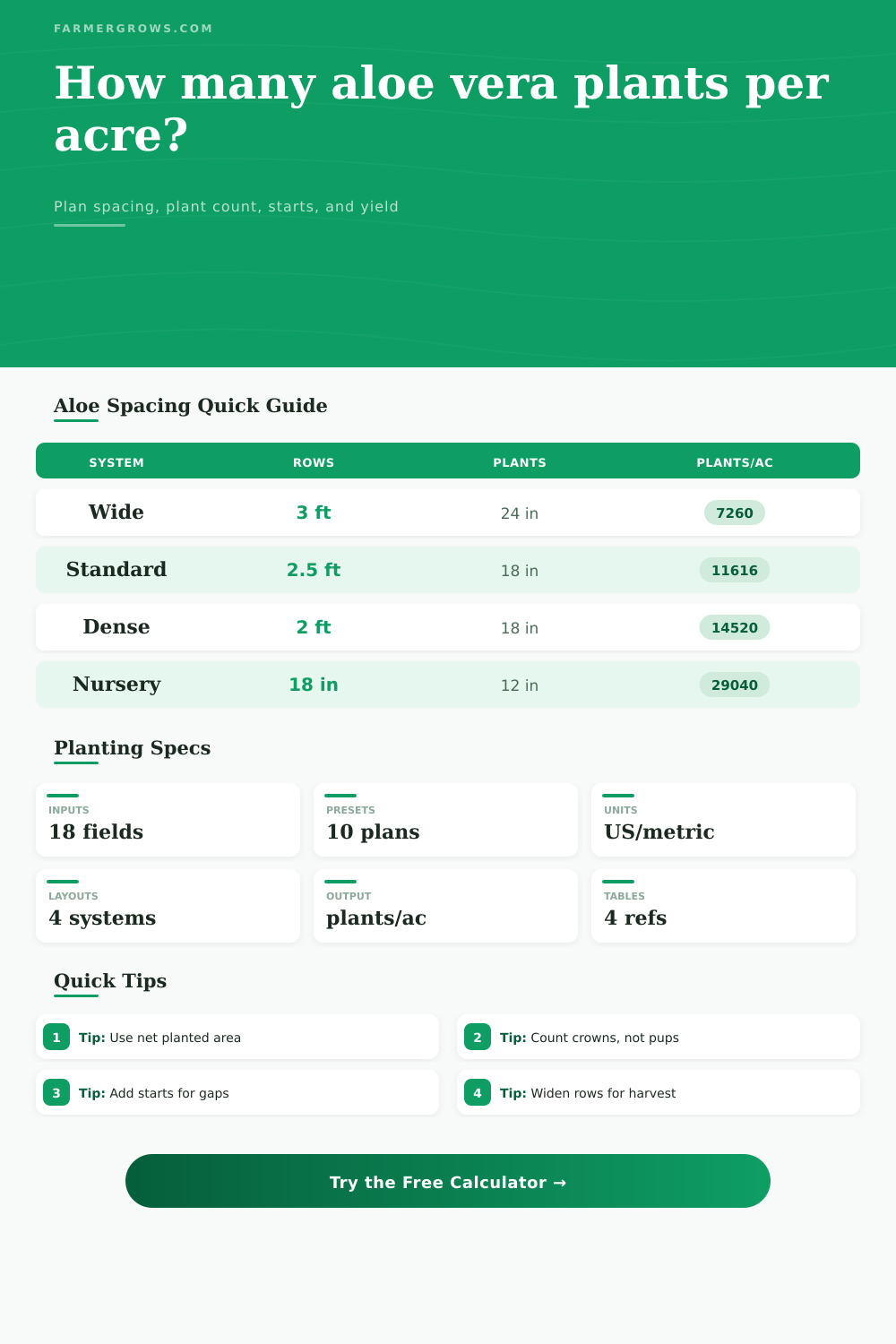
| 3 ft rows x 24 in plants | 6.00 sq ft | 7,260 | Wide dryland rows, large crowns, easier harvest access |
| 2.5 ft rows x 18 in plants | 3.75 sq ft | 11,616 | Standard irrigated leaf production with moderate access |
| 2 ft rows x 18 in plants | 3.00 sq ft | 14,520 | Dense fresh leaf blocks with careful fertility and scouting |
| 18 in rows x 12 in plants | 1.50 sq ft | 29,040 | Nursery increase beds or short-term offset production |
| 4 ft rows x 30 in plants | 10.00 sq ft | 4,356 | Very wide organic rows, arid sites, or equipment alleys |
| Material type | Typical culls | Buffer range | Planning note |
|---|---|---|---|
| Rooted offsets or pups | 4-10% | 8-15% | Sort by crown diameter so smaller pups do not weaken the first stand. |
| Nursery plugs | 2-6% | 5-10% | Tray uniformity reduces culls, but hardened plugs still need a field reserve. |
| Bare-root crowns | 8-16% | 12-20% | Increase reserves when shipping, storage, or dry roots are expected. |
| Tissue-culture plantlets | 3-8% | 8-12% | Use after acclimatization; weak plantlets should remain in nursery rows. |
| Large field divisions | 5-12% | 10-15% | Heavier starts handle stress well but can be inconsistent in size. |
| Stand density | Harvest assumption | Fresh leaf lb/ac | Gel at 52% |
|---|---|---|---|
| 7,260 plants/ac | 2 leaves x 2 cuts x 0.65 lb | 18,876 lb | 9,816 lb |
| 11,616 plants/ac | 3 leaves x 3 cuts x 0.55 lb | 57,499 lb | 29,899 lb |
| 14,520 plants/ac | 3 leaves x 3 cuts x 0.50 lb | 65,340 lb | 33,977 lb |
| 20,000 plants/ac | 2.5 leaves x 4 cuts x 0.45 lb | 90,000 lb | 46,800 lb |
| 29,040 plants/ac | Nursery leaves not counted | Population only | Use for starts |
| Field size | Net planted area | Plants at 2.5 ft x 18 in | 72-cell trays |
|---|---|---|---|
| 0.10 acre trial | 88% | 1,022 plants | 16 trays with buffer |
| 0.25 acre patch | 88% | 2,556 plants | 40 trays with buffer |
| 1 acre block | 88% | 10,222 plants | 158 trays with buffer |
| 5 acre field | 85% | 49,368 plants | 762 trays with buffer |
| 0.5 hectare block | 87% | 50,007 plants/ha | Use metric inputs |
For plant counts: Count each planted crown once. Later pups that arise around the crown are stand expansion, not extra original acre population unless the block is intentionally used as a nursery increase bed.
For harvest planning: Leaf yield changes sharply with plant age, water, fertility, leaf size, and cutting interval. Recheck the plan with field sample weights before scheduling labor or processing capacity.
It starts as an abstraction when buying aloe vera land. It is math problem you don’t want to face. And then you see the acres and you picture rows of green spikes. And you understand that yield isn’t something magic about the soil. It’s a simple calculation of how many living plants will actualy fit inside.
The calculator does density math for you so you never need to break out your spreadsheet. But the hard part comes well before touching the calculator: deciding on the correct spacing.
How to Plan Your Aloe Farm
Most people begin their journey by asking the wrong question. How much aloe will I grow on this acre? Instead, they should of ask, how many plants will survive on this acre? That’s two different answers. The difference between them is where profits go.
What about the planting material? A tissue culture plantlet is equivalent to a rooted offset, right? No; at least not in the eyes of the field, which treats both quite differently: Tissue cultures is uniform in size, while offsets are tough but irregular. Therefore, you’ll have more culls when transplanting.
To include this in your calculations, the calculator allow you to tinker with the establishment survival rate. This is a fancy way of saying how many plants dies before you harvest them. This little detail has big impact on your order size. If you forget to account for your culling percentage and order based off solely on how many plants you believe you require, you’ll end up with gaps (which look great in the springtime), but hurt your wallet come autumn.
And then there’s spacing, where farming gets real. On one hand, wide rows is easily accessible for both equipment and harvest crews. On the other hand, dense rows packs as many plants into an area as possible. This can push up to fifteen thousand or more plants per acre. And because they’re tightly packed together, any spread of disease move quickly. Densely spaced rows requires careful scouting and precise irrigation.
The trade-offs are laid out simply in the tool’s reference tables. Do you want a field that is easy to traverse or do you want to get every last ounce of productivity out of it? There isn’t a single correct answer. It should reflect your irrigation infrastructure and labor availability.
Next, there’s the harvest. More guesswork. Another sheet of caution and hope. It calculates how many leaves you’ll have by assuming the number of plants you put in, multiplied by assumed weight of each leaf. Nature defies assumptions. If it’s a heavy rain year, that will increase the leaf size. But maybe the drainage is bad, and it will rot the crowns instead. Maybe it was drought, which shrink the leaves. You get more cuts, but they’re lighter weight per cut.
That’s why the calculator has a yield range. To reflect the volatility.
Perhaps the best thing about it is how it helps with planning. Because it makes you think about the low end, so you can be covered if the weather fail.
So how do I plan my aloe crop? That’s the question, and it has nothing to do with farming, realy. It’s logistics. It’s inventory management. You are managing a living inventory of plants. Plants requires space to live. They require water to live. And they require room for harvesting.
From the moment you place your first tray order to the time you recover the last drop of gel, the tool help you visualize that inventory. It translates your vague hopes into specific numbers. These specific numbers comes in handy when you’re hiring harvest crews or negotiating with suppliers.
When you know that each percentage point difference in survival rate impacts your bottom line, then the calculator is no longer just a gadget. It becomes your safety net.
Now you have the confidence to plant, because you have already simulated the harvest in your mind.