Tobacco Plants Per Acre Calculator
Estimate tobacco plant population, row feet, usable acres, transplant order size, float tray count, stand gaps, and cured leaf range from field spacing and establishment assumptions.
Use the distance between row centers and the actual in-row plant spacing after setting. The usable area factor removes turning space, barn lanes, irrigation headers, contour breaks, and field edges before population and tray quantities are calculated.
Moderate plant counts balance stalk size, leaf count, barn capacity, and curing uniformity.
Spacing often gives more canopy room for stalk strength, leaf expansion, and housing labor.
Dark-fired and dark air-cured fields commonly use lower density for heavy leaf and stalk handling.
Wrapper and shade systems can run tighter spacing when irrigation, shade, and picking lanes are planned.
Tobacco Population Results
The layout estimate will appear after calculation.
| Row spacing | Plant spacing | Plants per acre | Best fit |
|---|---|---|---|
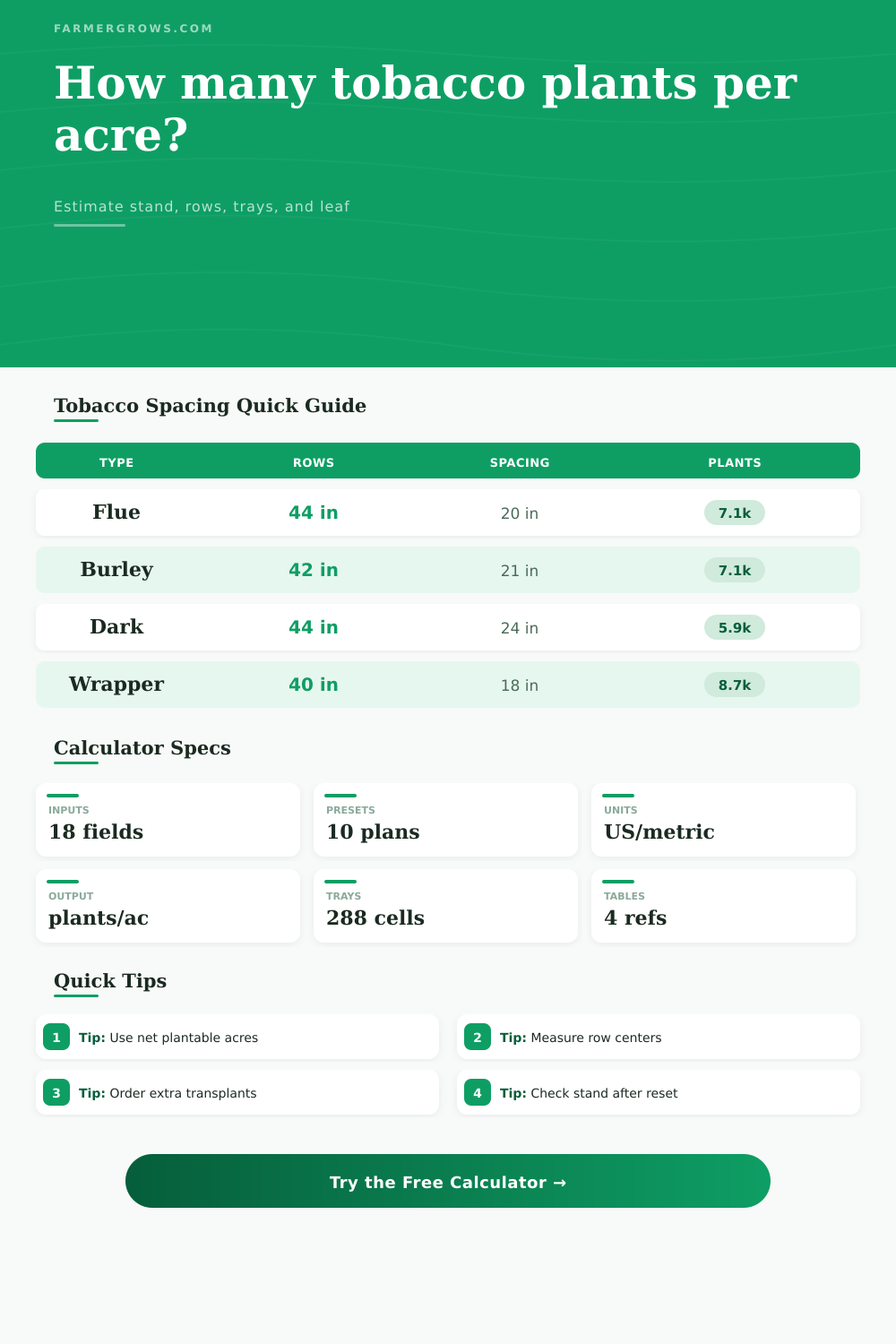
| 40 in | 18 in | 8,712 | Wrapper, shade, or intensive small leaf |
| 42 in | 20 in | 7,467 | High flue-cured or burley density |
| 44 in | 20 in | 7,128 | Common flue-cured planning setup |
| 44 in | 22 in | 6,480 | Moderate flue-cured or burley stand |
| 48 in | 24 in | 5,445 | Dark tobacco or wide hillside rows |
| Planned plants | Extra order at 10% | 288-cell trays | 338-cell trays |
|---|---|---|---|
| 5,500 | 6,050 | 22 trays | 18 trays |
| 6,500 | 7,150 | 25 trays | 22 trays |
| 7,200 | 7,920 | 28 trays | 24 trays |
| 8,500 | 9,350 | 33 trays | 28 trays |
| 10,000 | 11,000 | 39 trays | 33 trays |
| Row spacing | Plants in 20 ft | Plants per acre | Plants per row ft |
|---|---|---|---|
| 40 in | 11 | 7,187 | 0.55 |
| 42 in | 12 | 7,467 | 0.60 |
| 44 in | 11 | 6,534 | 0.55 |
| 44 in | 12 | 7,128 | 0.60 |
| 48 in | 11 | 5,990 | 0.55 |
| Factor | Conservative | Typical | High confidence |
|---|---|---|---|
| Transplant field survival | 88% | 94% | 98% |
| Reset or gap-fill allowance | 2% | 4% | 8% |
| Order buffer | 5% | 10% | 20% |
| Harvestable leaves per plant | 14 | 18 | 24 |
| Sort and field loss | 5% | 8% | 18% |
Spacing note: Use the row center spacing from planter, setter, or ridger setup. Bed tops alone will overstate tobacco population because alleys are part of the field.
Reset note: Count stand after the first reset pass when possible. Early counts can miss plants that recover, while late counts can miss weak skips.
A single row is the beginning: That’s when the math begins. Each inch you leave between each seedling along that initial row will affect the square footage of harvested leaf. It will affect the number of trays of transplant required. And it will determine whether curing barns is running at max capacity or whether they’re irritatingly sparse.
The math of planting isn’t exactly rocket science; most growers understand the principles of spacing well enough. But the details of usable acreage are another story, the kind that can make difference between a great year and a merely good one.
The Math of Planting Spacing
Gross field area is a vanity metric unless you factor in headlands (the area around the perimeter), irrigation headers, and the muddy areas where planter won’t reach. The calculator above does this math for you. All you have to do is enter dimensions, and it will save you from guessing on the usual conversions and coefficients that tend to trip up field planners.
The plant architecture determine how close together plants are; so first it’s got to be about tobacco type. For flue-cured, there has to be enough space for the plant to bear a full leaf load but not so much as to buckle under its own weight. Too few plants per acre and stalks becomes spindly. The leaves gets smaller and the tobacco will cure in fits and starts, nightmare stuff.
Growers of burley tend to leave a bit of extra room. Canopy strength. Go farther out still with dark-fried and dark air-cured types, which are grown for their huge, meaty leaves that can takes all the heat they’re going to get from curing fire.
Wrapper leaf growers go the other direction. To do that wrapper leaf growers gets the plants spaced tightly in field, even covering them with shade cloth. That makes it necessary for plant to stretch up to make its leaves long and skinny with the desired texture. If you look at their reference table on the page, you see what I mean.
A change from rows spaced every forty-four inches to every forty inches add thousands of plants to your stand. Then comes the messiness of reality: no transplant operation is perfect. Every row will have skips on ends. Some will die within first week after being set out. Gaps will open up and require filling. That’s what the reset allowance and survival rate inputs is for. Most growers believe their survival rate is about ninety-four percent. If you’re an inexperienced transplant crew or if soil isn’t good, adjust downward. The reset allowance accounts for those plants you’ll need to hand-plant once machine makes its run. It’s a tiny percentage in the spreadsheet, but it equals hours of field labor.
That’s also where some folks get burned… On ordering their transplants. Running out in middle of season is disastrous. Do not use float trays (they are pricey) unless you have a backup plan. A good buffer is 10 percent. That will cover you for the ones you break off as they float around. It covers the ones that don’t make it out of the float system alive. It also covers plants you’ll need for that last pass to reset things. Don’t scrimp on the buffer. Better to dump out an extra ten trays than drive into town in the dead of night looking for more thousand plants because you didn’t order enough.
With a little help from the calculator, you’ll know exactly how many trays to order (typically 288 cells per tray), so that when you phone the supplier, you can sound like you know what you’re talking about.
And lastly, consider the leaf. Keep in mind: You don’t grow just a plant. You’re growing a pound (or more) of cured tobacco. How many leaves do you expect from each plant? The calculator gives an idea of range of cured leaf you can get. This allows you to calculate how much barn you’ll need. If the calculator tell you the yield will be too high for your curing capacity, maybe make the spacing even wider, a little less dense, and lessen load on your infrastructure.
And weeks from now when you’re standing out there in that field and counting the live plants in a given twenty-foot section, you’ll have a good sense of where you stand. The math was simply the map. The harvest is territory.