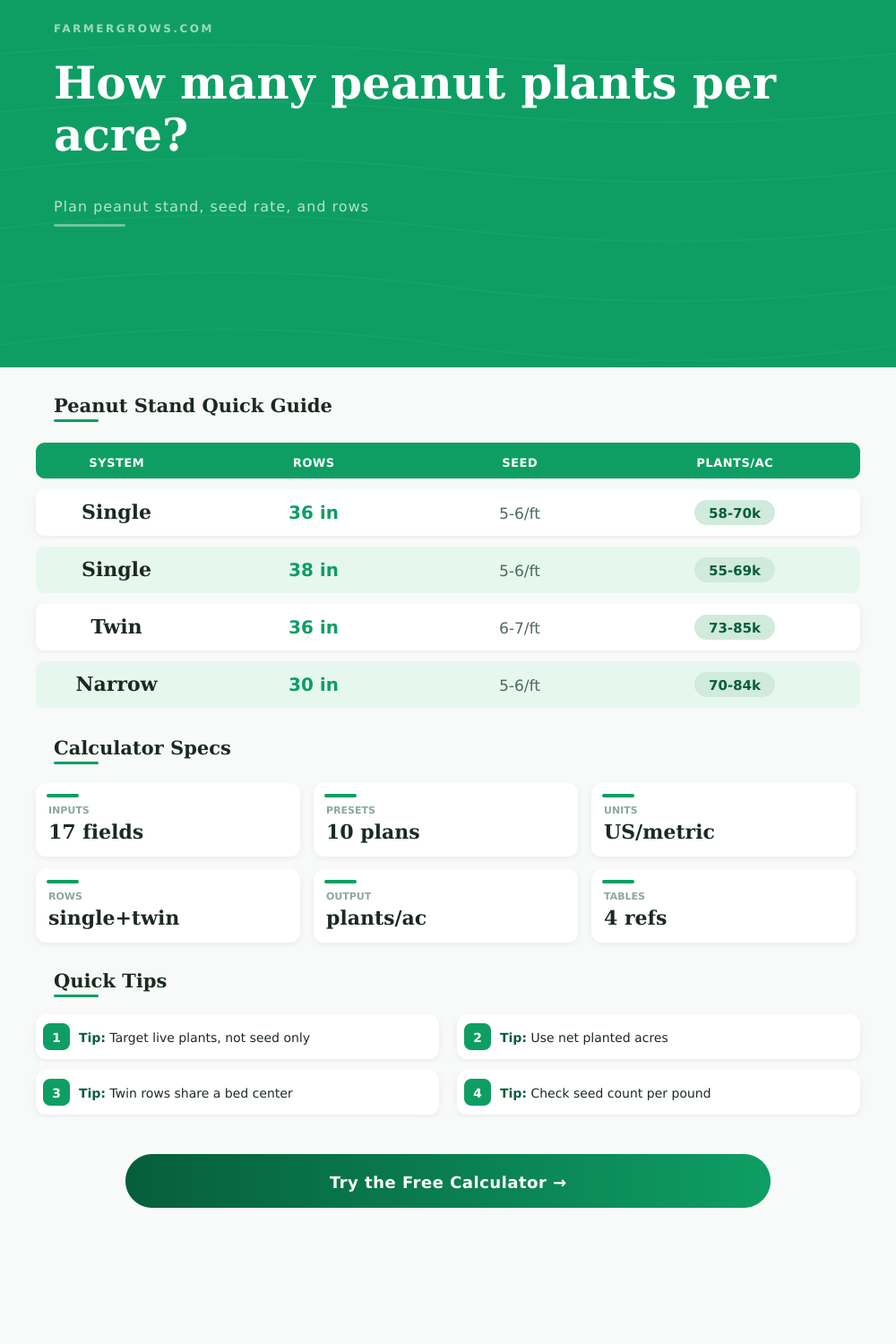
Peanut Plants Per Acre Calculator
Estimate peanut plants per acre, row feet, live stand from field counts, planter drop spacing, seed pounds, bag totals, and rough pod yield range from spacing and emergence assumptions.
Use net planted acres and actual center-to-center row or bed spacing. For twin-row peanuts, enter the bed center spacing and two rows per bed; the calculator handles total plant row feet per acre.
Peanut Population Results
Enter your field and row assumptions to calculate peanut stand.
| Row or bed spacing | Rows per bed | Plant row feet per acre | 4 plants/ft | 5 plants/ft |
|---|---|---|---|---|
| 30 inches single | 1 | 17,424 ft | 69,696 plants/ac | 87,120 plants/ac |
| 36 inches single | 1 | 14,520 ft | 58,080 plants/ac | 72,600 plants/ac |
| 38 inches single | 1 | 13,755 ft | 55,021 plants/ac | 68,777 plants/ac |
| 40 inches single | 1 | 13,068 ft | 52,272 plants/ac | 65,340 plants/ac |
| 36 inches twin bed | 2 | 29,040 ft | 116,160 plants/ac | 145,200 plants/ac |
| Seed per row foot | 36 in single seed/ac | 38 in single seed/ac | 36 in twin seed/ac | Drop spacing |
|---|---|---|---|---|
| 4.5 seed/ft | 65,340 | 61,899 | 130,680 | 2.67 inches |
| 5.0 seed/ft | 72,600 | 68,777 | 145,200 | 2.40 inches |
| 5.5 seed/ft | 79,860 | 75,655 | 159,720 | 2.18 inches |
| 6.0 seed/ft | 87,120 | 82,532 | 174,240 | 2.00 inches |
| 7.0 seed/ft | 101,640 | 96,287 | 203,280 | 1.71 inches |
| Seed count size | Seed/ac at 5 per ft, 36 in | Seed lb/ac | 50 lb bags per 100 ac | Use case |
|---|---|---|---|---|
| 450 seed/lb | 72,600 seed | 161 lb/ac | 323 bags | Large Virginia seed |
| 550 seed/lb | 72,600 seed | 132 lb/ac | 264 bags | Large runner seed |
| 650 seed/lb | 72,600 seed | 112 lb/ac | 223 bags | Medium runner seed |
| 750 seed/lb | 72,600 seed | 97 lb/ac | 194 bags | Small runner seed |
| 850 seed/lb | 72,600 seed | 85 lb/ac | 171 bags | Small Spanish seed |
| Stand count method | Measured sample | Area represented | Fast use |
|---|---|---|---|
| Single row count | Plants in measured row length | Row spacing x length | Most flexible field scouting |
| 36 in shortcut | 10 row ft | 30 sq ft | Plants x 1,452 for plants/ac |
| 38 in shortcut | 10 row ft | 31.7 sq ft | Plants x 1,376 for plants/ac |
| Twin-row bed count | Count both twin rows evenly | Bed spacing and two rows | Compare per planted row foot |
| Metric count | Plants in row meters | Spacing meters x length | Convert plants/ha to acre |
| Measured stand | General reading | What to check next | Calculator cue |
|---|---|---|---|
| Below 3 plants/ft | Thin or uneven stand | Skips, disease, crusting, replant date | Review |
| 3 to 3.5 plants/ft | Marginal but sometimes workable | Uniformity and vine closure potential | Borderline |
| 3.5 to 5 plants/ft | Common target band | Canopy, row pattern, soil moisture | Near target |
| Above 5.5 plants/ft | Dense peanut stand | Seed rate, competition, variety growth | Dense |
Stand count note: Count live, healthy plants after emergence is mostly complete. Separate weak patches from normal areas before averaging the whole field.
Seed planning note: Peanut seed size shifts pounds per acre quickly. Recalculate whenever seed count per pound, germination, planter calibration, or row layout changes.
A peanut plant doesn’t behave like a soybean or corn plant. It grows horizontally by pushing its peg into the ground to set pods below surface. So when planning your plant population, it’s not just two dimensions, it’s three.
You’re not merely taking up space, but also accommodating the root system which will spreaded. Keeping the canopy tight enough to block sunlight from weeds is critical. Most growers don’t get their plant population right and lose margin prior to ever seeing one pod.
How to Calculate Peanuts for Your Field
It’s a fine line between yield potential and seed cost. It’s a mathematical equation that doesn’t forgives guessing.
To use the calculator (above) simply enter your seed specs and how many rows wide you plan to make. The machine do the rest of the work. Then it converts that abstraction into some real numbers: a concrete amount of bags.
But entering all that data means nothing if you don’t understand what it represents. That’s where it gets interesting.
First, there is the nature of your row layout itself. Are you running narrow twin rows on beds? Or wide ones (thirty-six inches)? More rows equals more plants, sure, but it also mean more competition for resources like nutrients and moisture.
Twin rows on wider bed centers are popular because they support high populations, but you must count each planted row separately to get an accurate seed count. The tool distinguishes between row spacing and bed spacing, which will prevent the usual mistake of double-counting planters.
The other variable that gets people tripped up is the size of the seed. A pound of Virginia peanuts contains many fewer seeds than a pound of smaller sized Spanish peanuts. If you don’t look at the number of seeds per pound when ordering seed by pounds per acre, you’ll either underperform or overplant based off the math. The calculator requires seeds per pound because it needs to make adjustments for weight. It may sound like a small detail but it saves you from running out of seed mid-field or having to buy too much seed.
Germination rates are important here, too. Field emergence isn’t the same thing as lab germination. Disease pressure, soil temperature, and moisture conditions will all knocks your numbers down. This occurs well before the plants reaches knee-high. Building in a buffer for loss in the field isn’t being pessimistic, it’s being realistic.
The change from planning to verification happens when you go from planting to scouting. From a measured section of row, count how many plant are present and compare that to what you wanted. What do you realy have?
Row width is in the reference tables on the page, with conversion factors for common row widths, so no need to bring along a spreadsheet in your pocket. So, if it’s thin. Less than three plants per foot, for example, dig into the why. Was it a germination failure? Was there poor seed-to-soil contact? Was the soil crusting? Whatever caused it is tougher to get at then the math, but the math will tell you whether there’s something to investigate.
The last piece is the yield estimate. Based off presumed pod weight for each plant and stand density, the tool provides an estimated range of yields. Not a promise, just a signal: If you have a good uniform, dense stand, that generally will mean a consistent yield; if you have a patchy stand, it may average out the same weight as well, but with higher risk and lower quality.
That signal helps you determine whether to adjust irrigation or fertilizer timing to help out the plants you’ve got. Align these inputs with what your biological assets actualy are.
Planting peanuts is a precise exercise in patience. And while there are months involved in waiting for those pods to fill, there’s only a small window where getting it right matters. The critical work occurs at the time of planting.
With the proper respect of the relationship between seed size, emergence, and row feet, you’ll be taking the guesswork out of the process. Even if the weather does not, the numbers do. You should of believe in the data that you can control. Let the soil do the rest.