Cauliflower Plants Per Acre Calculator
Estimate cauliflower plant population from in-row spacing, row or bed spacing, rows per bed, head size class, transplant survival, field efficiency, marketable recovery, succession blocks, and seedling buffer.
Choose a named cauliflower planting pattern, then adjust the spacing, bed system, survival, marketable percentage, and succession count for your field.
Cauliflower Planting Estimate
Spacing and stand plan will appear here.
About 7,260 plants per acre before field efficiency. Works for big curds, strong airflow, and tractor cultivation.
About 11,616 plants per acre before efficiency. Common for fresh-market heads with moderate size.
About 11,616 plants per acre before efficiency, using bed centers instead of individual row spacing.
About 21,780 plants per acre before efficiency. Best for smaller heads and tight harvest windows.
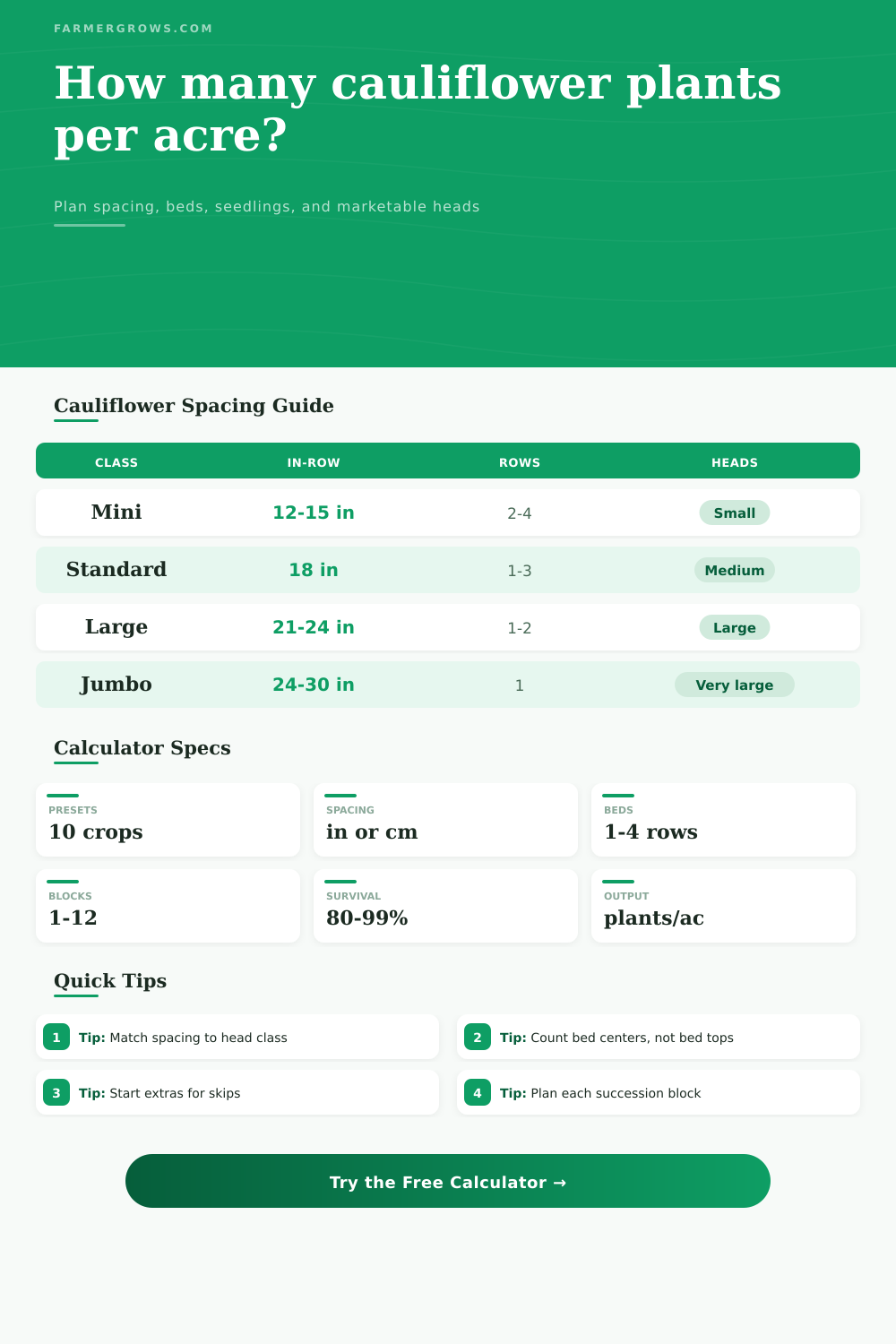
| Head size class | Typical in-row spacing | Common row or bed layout | Planning note |
|---|---|---|---|
| Mini or dense florets | 12 to 15 inches | 2 to 4 rows per bed | Higher population, smaller curds, tighter harvest window |
| Standard fresh market | 16 to 20 inches | 18 to 36 inch rows or 2-row beds | Balanced head size and plants per acre |
| Large curd or 12-count pack | 21 to 24 inches | 30 to 40 inch rows or 2-row beds | More canopy room for large leaves and white curds |
| Jumbo wide-row heads | 24 to 30 inches | 36 to 48 inch single rows | Lowest density, easiest cultivation, largest head target |
| Layout example | Formula basis | Gross plants per acre | At 88% field efficiency |
|---|---|---|---|
| 18 in in-row, 30 in single rows | 43,560 sq ft / 3.75 sq ft | 11,616 | 10,222 set plants |
| 18 in in-row, 2 rows on 60 in beds | 17,424 row ft/ac x 0.667 | 11,616 | 10,222 set plants |
| 15 in in-row, 3 rows on 72 in beds | 21,780 row ft/ac x 0.800 | 17,424 | 15,333 set plants |
| 24 in in-row, 36 in single rows | 14,520 row ft/ac x 0.500 | 7,260 | 6,389 set plants |
| Stand factor | Conservative value | Strong value | How to use it |
|---|---|---|---|
| Transplant survival | 88 to 92 percent | 94 to 98 percent | Use lower values for hot, windy, or dry setting windows |
| Marketable percentage | 75 to 82 percent | 85 to 92 percent | Use lower values for uneven curd, insect pressure, or missed cuts |
| Seedling buffer | 10 to 15 percent | 5 to 8 percent | Start extra plants for weak plugs, border skips, and resets |
| Field efficiency | 78 to 85 percent | 88 to 94 percent | High values fit rectangular fields with few alleys |
| Succession plan | Block size | Why it matters | Planning note |
|---|---|---|---|
| Weekly CSA cuts | 0.05 to 0.25 acre | Small steady harvests | Use extra buffer if block timing overlaps heat |
| Farmers market blocks | 0.25 to 0.75 acre | Predictable table volume | Stagger varieties by days to maturity |
| Wholesale carton run | 1 to 5 acres | Uniform pack-out matters | Use realistic marketable percentages |
| Fall storage or processing | 2 acres or more | Large harvest crew demand | Keep row spacing wide enough for airflow |
Use bed centers for multi-row cauliflower beds. If two rows sit on a 60-inch bed, the acre calculation uses 60-inch bed centers and two rows per bed, not 30-inch row spacing plus a separate alley.
Let head size set the spacing first. Tight spacing can raise plants per acre, but large cauliflower curds need leaf area, airflow, water, and fertility to finish cleanly.
You plant the field, and then you realize you packed them in too tight, so you’re watching your cauliflower turn from tight white heads to loose green buttons. Harvest day comes, and what do you see? The plants was planted too closely together. Rot set in because there wasn’t enough airflow to prevent it, or because the leaves didn’t open wide enough to shade the curds. They’re there, but the crop isn’t.
Planting density is not simply a matter of math; it is a biological negotiation of market expectations versus space and light. That’s where the calculator comes in. It does all the math for you: Your desired head size? It turns into an actual plant station-per-acre equation.
How to Space Your Plants for a Good Harvest
A grower typically begins with a head size goal. For example, a wholesale buyer might want big jumbos. Get out the wide rows and big in-row gaps. A local CSA wants minis. Tighten ’em up. With the tool, you set the geometry exactly.
And you’ll notice another key point: bed centers. When many first-time growers calculate their acres, they measure row-to-row distance within a bed. But that doesn’t account for bed width, which is crucial when making acre calculations. Why? Even though your bed contains living soil, its gap between beds (which may be full of weeds) is dead space for planting. So not accounting for bed width vs. Row width result in grossly overestimating your plant count, by thousands… Resulting in crowding from day one.
Now you’ve got the geometry, but there’s one more thing: reality. Things don’t grow on a perfect grid. Because of this, the calculator includes a field efficiency factor. Space gets eaten up by headlands, irrigation lanes, and unplanted edges. Eighty-eight percent is a conservative starting place for this efficiency rate.
And now we get into survival. Transplanting brassicas is hard work. Some of the plugs will be transplanted in less-than-perfect conditions. Even then, they can wilt and sometimes die from transplant shock, even in good weather. Ninety-five percent sounds like an optimistic assumption unless you have a seasoned crew and automated irrigation. Most growers assume lower. The tool takes your assumed survival rate and adjusts the final set plant count accordingly.
You are not buying the number of plants you plan to see standing in the field. You’re buying the number of plants you think will need to replace the ones that won’t survive. Which brings us back to the seedling buffer.
Don’t make the mistake of starting only as many plugs as you think you’ll need for the eventual stand. Make more. Count on some failing in the nursery bed. Expect damaged trays on transport day. Plan for skipped spaces in the field. Twelve percent is a conservative buffer. On a blustery transplant day or a hot spring day, you’ll thank yourself for each additional plug in that tray.
Based off what cell count you choose, the calculator figures out how many trays to order. Your nursery logistics are directly linked to your field plan.
The last filter is marketability. Not all of the survivors make it into the marketplace as a saleable head. Some get infested with insects. Some bolt. Some just don’t look good. Enter the marketable percentage. Your surviving stand gets put through the tool again. You end up with a realistic estimate of how much you’ll have to harvest. And that matters if you’re hoping to sell at a farmer’s market, right? You want to know how many heads are going to sit on your table, not just how many went into the ground.
Multiplying this by planting in stages makes things even more complex. Over the course of a season, you might have three blocks of cauliflower growing. You want to figure out the density and buffer of each block separately. You can input those numbers into the calculator to expand them across different blocks. That way you won’t accidentally average your density over the entire season. Each block comes with its own harvest window, and also its own risks from weather.
To help get those numbers into perspective there are some reference tables in the tool. These give a sense of what sort of densities is considered standard for various head classes. Treat this as a benchmark but not a rule. Depending on how good your irrigation is, or how rich your soil is, you could bump up the density on either side of that scale. Poor airflow? Back off. Perfect air flow? Push it.
Remember, we’re not trying to grow plants/acre. We’re trying to grow marketable heads/acre. It’s a difference. Two thousand rotted, buttoned heads will fill up an acre. But they aren’t worth jack. Plant less, so that each plant has space to breathe, create good canopy, and produce clean, white curds. Now you’ve got a profitable acre.
First, define the size of your heads. Use that as the starting point for how far apart to space things. Adjust from there based off the messiness of real life. It’s simple math. It’s the judgment that makes the crop succeed or fail. And no, this isn’t seed-planting; this is microclimate design for each plant. Get the space right, and the rest falls into place. Get it wrong, and you’re harvesting dissapears.