Turmeric Plants Per Acre Calculator
Estimate turmeric plant population, bed footage, seed rhizome pieces, seed weight, sprouted stand, nursery reserve, and fresh rhizome yield from field area, spacing, row layout, and stand assumptions.
Use net planted area for turmeric. Headlands, wash lanes, canals, shade-house aisles, and wide tractor turns should be excluded or entered as a lower usable percentage so the rhizome order is not overstated.
Turmeric Planting Results
Enter field area and spacing to estimate turmeric plant population.
| Bed or row center | Rows per bed | In-row spacing | Approx. plants per planted acre |
|---|---|---|---|
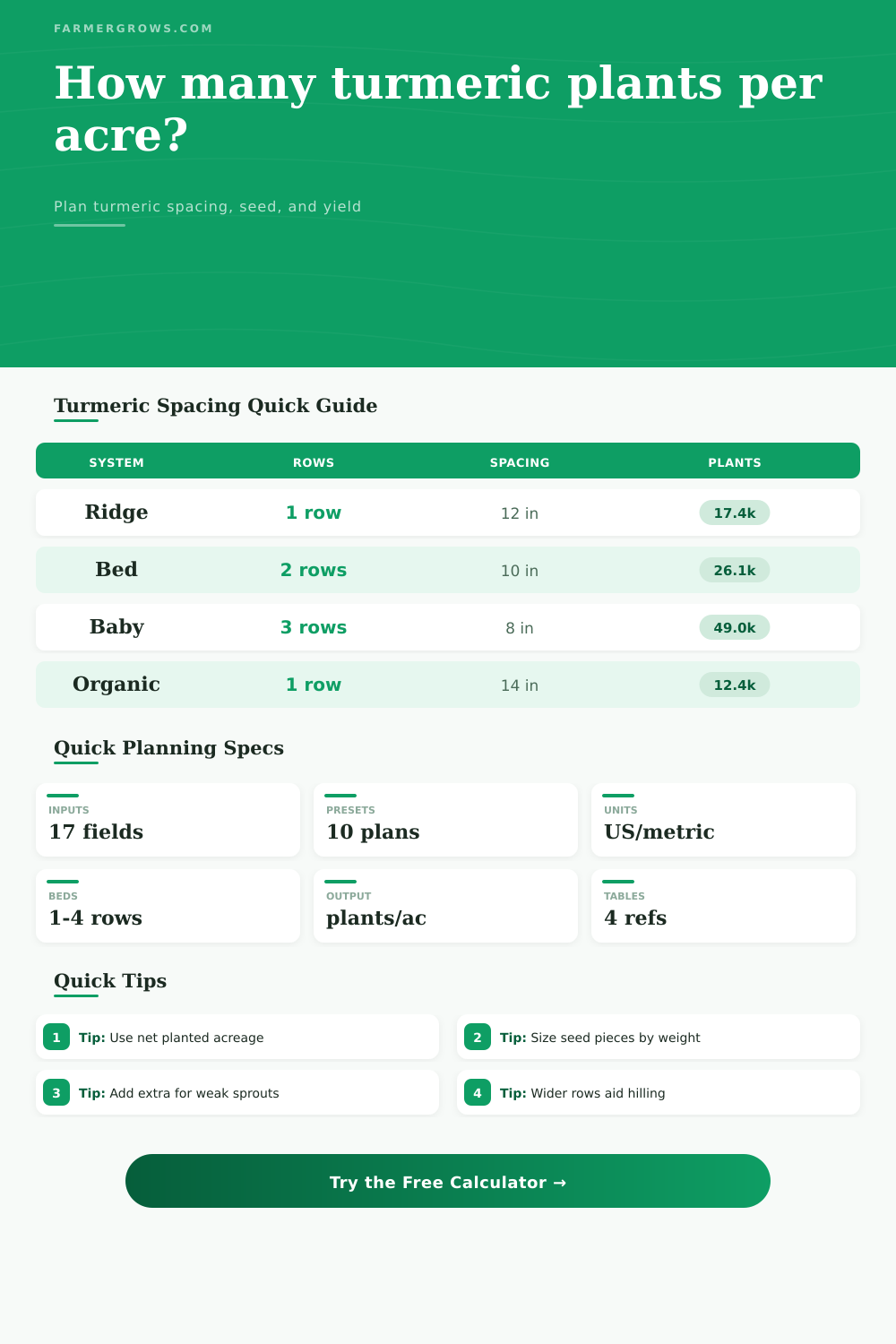
| 30 in ridge | 1 row | 12 in | 17,424 plants/ac |
| 36 in ridge | 1 row | 12 in | 14,520 plants/ac |
| 42 in ridge | 1 row | 14 in | 10,669 plants/ac |
| 48 in bed | 2 rows | 10 in | 26,136 plants/ac |
| 60 in bed | 2 rows | 12 in | 17,424 plants/ac |
| 48 in bed | 3 rows | 8 in | 49,005 plants/ac |
| Plan | Typical layout | Best use | Planning note |
|---|---|---|---|
| Single ridge crop | 30-36 in row, 12 in spacing | Fresh rhizome harvest | Simple hilling and digging. |
| Raised bed twin row | 48-60 in bed, 2 rows | Mulch or drip fields | Good balance of count and access. |
| Baby turmeric | 3 rows, 8-10 in spacing | Early tender harvest | High count, smaller rhizomes. |
| Seed increase block | 2 rows, 12 in spacing | Next-season seed | Track sprout rate carefully. |
| Organic wide rows | 36-42 in row, 14-16 in spacing | Cultivation and airflow | Lower count, easier weed control. |
| Shade-house beds | 3-4 rows, 8-10 in spacing | Protected small plots | Use known bed length mode. |
| Seed piece size | Pieces per pound | 50 lb bag count | Useful planning note |
|---|---|---|---|
| 1.0 oz | 16 pieces/lb | 800 pieces/bag | Small pieces need strong buds. |
| 1.5 oz | 10.7 pieces/lb | 533 pieces/bag | Common counted seed size. |
| 2.0 oz | 8 pieces/lb | 400 pieces/bag | Safer for weak lots. |
| 2.5 oz | 6.4 pieces/lb | 320 pieces/bag | Heavy seed, fewer pieces. |
| 3.0 oz | 5.3 pieces/lb | 267 pieces/bag | Often used for nursery starts. |
| Crop goal | Practical stand | Fresh yield per plant | Use in calculator |
|---|---|---|---|
| Fresh turmeric | 14k-22k plants/ac | 1.0-1.8 lb | Balanced default range. |
| Baby turmeric | 30k-50k plants/ac | 0.35-0.8 lb | Higher count, early harvest. |
| Seed rhizomes | 18k-28k plants/ac | 0.8-1.4 lb | Reserve clean mother pieces. |
| Wide organic | 10k-16k plants/ac | 1.4-2.4 lb | Lower count, larger clumps. |
Count hills, then seed pieces. Most plans use one turmeric seed piece per station. If pieces are tiny or irregular, increase pieces per hill and seed weight together.
Keep planted area honest. Turmeric often loses area to drains, shade edges, curing space, and alleys. Enter gross area and usable percent separately for better acre density.
How much turmeric do you want? How much space does each plant need? What are you planning to grow, and what spacing and size are appropriate? Turns out this isn’t so straightforward.
There’s math involved, but only after some thought (and then more math…). You have a turmeric rhizome in hand, a truck load, and an acre of soil. You know approximately how many plants you’d like to grow. The trick: turmeric behave differently depending on whether you’re going for big fresh roots or a very dense baby crop, and there’s no one-size-fits-all plan.
How to Plan Your Turmeric Farm
Use the calculator to input variables like sprout rate and field shape, and it will give you a practical number to use for planting.
An acre isn’t square: An acre is what growers think of as a uniform square, but that’s not true for your planting area. There are access lanes, ditches, and headlands. They all count toward the size of your growing area, but you will order too much or to little seed if you calculate based off total area. The tool allows you to set a percentage of what counts as usable. It’s a tiny tweak that avoids expensive overbuying.
Consider the spacing. What are you growing? If it’s baby turmeric, you want a lot of plants in there; if it’s big rhizomes that will expand, space them out. How do you know? Switch row types (twin-row beds vs. Single ridges) on the calculator and see the change in number of plant per acre. The right system for your desired outcome is what matters most. Not necessarily how many plants that equates to.
Then there’s the matter of seed quality. Weight doesn’t match up with the number of pieces. One big rhizome isn’t the same as several small ones. And rhizomes varies in size. A bag of a certain weight might contain far more plants if the pieces are small, while a bag of large mother rhizomes will contain fewer.
The calculator adjusts based on an average seed weight and how many seeds is expected to sprout from each piece. That’s important because not everything sprouts. Order accordingly. If you don’t adjust for the sprout rate, by mid-season your field will be dotted with holes.
How many will it yield? We don’t know exactly, but we have a place to start. It offers a pound estimate based on how densely the plants is growing, telling you roughly how much to expect when you go digging. Pests and weather affect things; this isn’t a promise. But it’s a ballpark figure. Ten thousand pounds or twenty thousand? That will help you plan for storage space and how much time you’ll need to put in.
So what’s the practical advantage of presets? All but the most experienced growers begin with a preset. There are established patterns for wide organic rows or for raised beds. A preset lets you begin quickly and accurately. From there, tweak it to suit your setup or land contours.
Save a little for the seeds. Set aside some of the harvest for next year’s crop. The calculator has a function that lets you set how much of the crop to save as seed. This closes the loop on your own production cycle and eliminates the need to purchase from someone else. It saves money and is smart.
“Uncertainty goes down when you plan.” There are things that you cannot control, like market prices or rain. You can control how much seed to order. How many plants go into the ground? Get the population density correct early; it sets the stage for everything.
If you have exactly what you planned for come harvest time, that’s a big deal. It should of taken some time to do the calculations; and that clarity is worth it.