Lavender Plants Per Acre Calculator
Estimate lavender plant population, row footage, plug or liner order size, replacement reserve, plants per acre, plants per hectare, and mature stem range from field area, row spacing, in-row spacing, survival, and harvest goals.
Use the area actually planted to lavender for the best order count. Row spacing should include the alley used for harvest, weeding, mower traffic, drip lines, and airflow around the mature mound.
Commonly fits closer rows and tighter in-row spacing where plants stay small and harvest is mostly by hand.
Hybrid lavandin grows wider and often needs more alley room for airflow, harvest carts, and mature canopy width.
Closer in-row spacing can make a continuous harvest hedge, but pruning and disease scouting must stay practical.
Wider spacing reduces competition for moisture and gives each mound more root zone in low-irrigation fields.
Lavender Planting Estimate
Your lavender stand estimate will appear here.
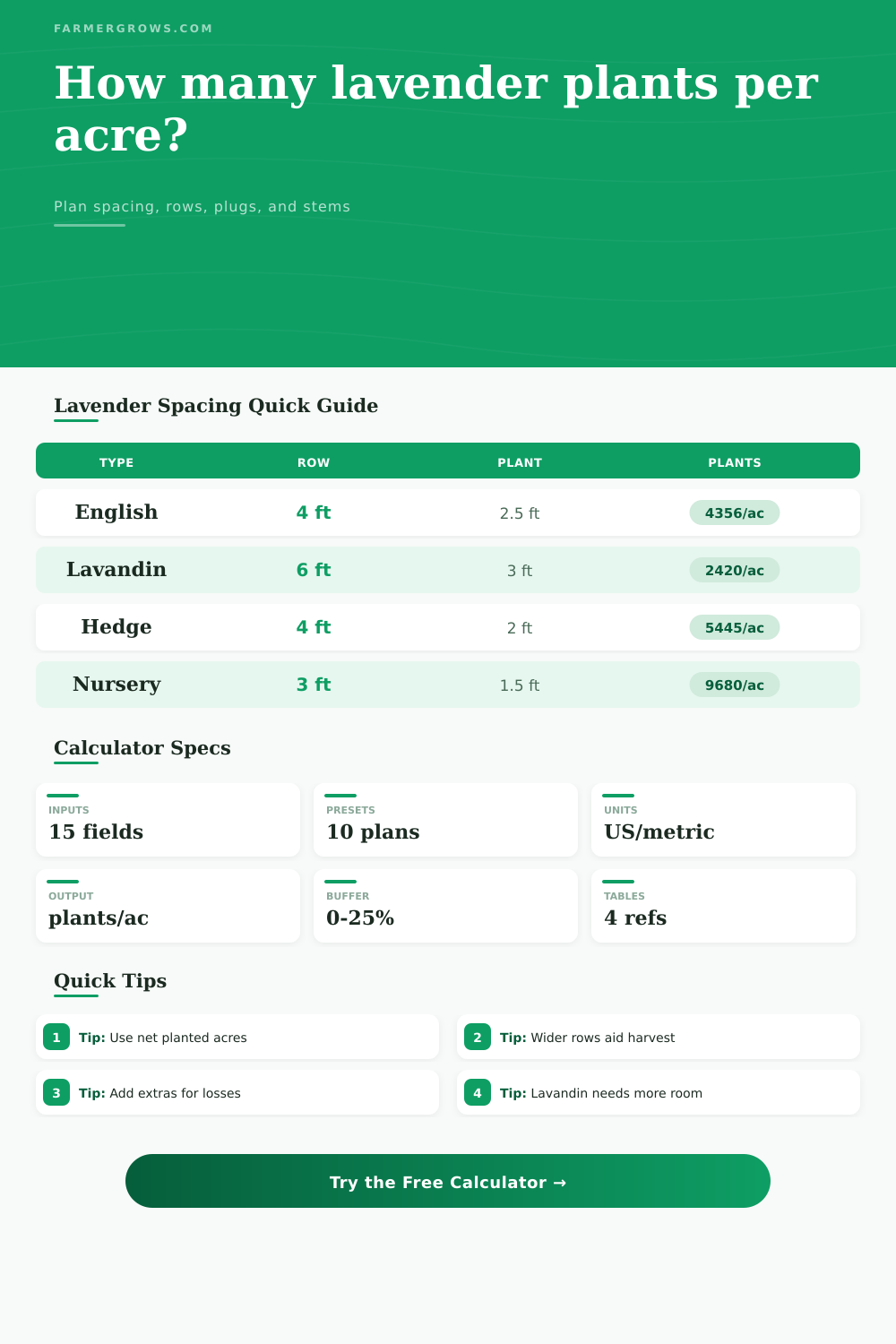
| Planting type | Typical row spacing | Typical plant spacing | Approx plants per acre | Planning note |
|---|---|---|---|---|
| English lavender, hand harvest | 3.5 to 4.5 ft | 2 to 3 ft | 3,200 to 6,200 | Good for compact cultivars and bundles |
| Lavandin oil or dried stems | 5 to 7 ft | 3 to 4 ft | 1,550 to 2,900 | Wider alleys fit mature plants and harvest carts |
| U-pick agritourism rows | 5 to 6 ft | 2.5 to 3.5 ft | 2,075 to 3,485 | Walking space can matter more than maximum density |
| Raised-bed double row | 5 to 6 ft bed centers | 2 to 2.5 ft | 5,800 to 8,700 | Use only where airflow and pruning are managed |
| Dryland or low irrigation | 6 to 8 ft | 3.5 to 5 ft | 1,090 to 2,075 | Lower density reduces water competition |
| Field scale | Square feet | Hectares | At 2,420/ac | At 4,356/ac |
|---|---|---|---|---|
| 0.10 acre | 4,356 | 0.040 ha | 242 plants | 436 plants |
| 0.25 acre | 10,890 | 0.101 ha | 605 plants | 1,089 plants |
| 0.50 acre | 21,780 | 0.202 ha | 1,210 plants | 2,178 plants |
| 1.00 acre | 43,560 | 0.405 ha | 2,420 plants | 4,356 plants |
| 2.00 acres | 87,120 | 0.809 ha | 4,840 plants | 8,712 plants |
| Spacing formula | Imperial calculation | Metric equivalent | Best use | Watch point |
|---|---|---|---|---|
| Single row density | 43,560 / row ft / plant ft | 10,000 / row m / plant m | Most lavender fields | Use row centers, not clear alley width |
| Double-row bed | 43,560 x 2 / bed ft / plant ft | 10,000 x 2 / bed m / plant m | Raised beds and small farms | Canopies can close quickly |
| Known row length | Row ft / plant ft | Row m / plant m | Existing beds or tunnels | Subtract row ends and skips |
| Order adjustment | Plants / survival x buffer | Same ratio | Plug and liner orders | Do not double count reserves |
| Planning factor | Low input | Typical | High care | How to use it |
|---|---|---|---|---|
| Usable planted area | 70% | 85% to 90% | 95% | Lower it for roads, headlands, drains, and public paths |
| Establishment survival | 80% | 90% to 94% | 97% | Lower it for hot planting, weak plugs, or poor drainage |
| Order buffer | 5% | 10% | 20% to 25% | Use extra plants for skips, culls, and early replacements |
| Row-end loss | 3% | 5% | 8% to 12% | Accounts for valves, turnarounds, curves, and odd edges |
| Mature stand factor | 60% | 100% | 115% | Use lower values for young, drought-stressed, or winter-damaged blocks |
For plant orders: Base purchases on final planting stations, establishment rate, order buffer, and a small replacement reserve. Wider lavandin spacing may need fewer plants than expected.
For layout: Measure row centers from plant-row center to plant-row center. That spacing includes alleys, mower lanes, harvest access, drip layout, and airflow around mature mounds.
When most farmers envision growing lavender, they imagine a repeating purple row that stretches out as far as eye can see. What they get instead? A spreadsheet headache. Why? Because lavender is no throw-it-in-the-ground-and-forget-about-it kind of crop. It require geometry. You are not just purchasing plants. You are also buying space, airflow, and potential access points for both visitors and your harvester.
Too many together and they’ll choke. Too many apart and you’re leaving money on the ground. Once you input your desired plant density (how close to together) and your field’s dimensions, this calculator will do the math for you, no need to guess at conversions and coefficients. It converts your real-life space into a clear number of what you should of order in terms of liners or plugs.
Why Lavender Needs Careful Planning
What’s the width of your rows? That’s the first question, because it determines all the rest. Because English lavenders is compact, they will frequently allow two-and-a-half feet between plant within a four-foot-wide row. This packs thousands of plants into a single acre. Lavandin hybrids become giant mounds up to five feet across or wider. They don’t fit into snug rows without creating humid tunnels that invite botrytis. Additionally, turning them becomes a nightmare. To get equipment around and air flowing, you’ll want to be able to turn the machinery inside alleys. The calculator includes these variables and reduces overall plant count as spacing increases. This is not a bug but a feature of sustainable growing.
Second, fess up on your land. Your fields aren’t a perfect rectangle. They have headlands where tractors makes turns. They have drainage ditches, access roads and goofy corners where planting simply won’t work. That’s why we take into account the percentage of the field that’s planted. When you plan as if every square inch of a gross acre is capable of being planted, you’ll end up ordering short. You’ll show up in the field without a plan. You will have empty stations all around you. Ten or fifteen percent off for areas you’re not going to plant doesn’t mean you’re being negative. It means you’re being realistic. You’ve got enough plants to fit into the real estate, not just the lines on a map.
Then there is that secret price: Survival rate. How many of those thousand plugs will actualy make it? Not all. There are always weak ones no matter how perfectly you irrigate. Some spots has poor drainage. Voles ate some before they even rooted out. That’s what the tool factors in, as well as a plug-order buffer, so you can account for any losses. Want a 90-percent survival rate? Just tell the calculator and it will adjust your order to match. And add a replacement reserve if you want to keep some on hand for fill-in later. So no more patchy stands in year two from underordering for year one.
Then there are row ends. Each row has an end and a beginning. When rows is close together, placing valves or turning around can waste some of that end space. A little lost efficiency but hey, it still adds up when you’re talking about hundreds of rows. Accounting for row-end loss will help you include that inefficiency. A tiny fraction, yes, but all day long. Who wants to count stems on plants they didn’t get in the ground?
Last but not least, think about your harvest: What will you be using it for (U-pick tourism, oil, dried bundles)? Those factors impacts spacing. You’ll want wider walkways in a U-pick field. In an oil field, you may want maximum plant density to increase yield per acre. By toggling between those preset options in the tool, you can visualize the difference on the bottom line.
That determines not only how many plants go into space but also how many are productive. It’s a balance between how much you want to produce and what that production requires; between creating space for healthy plants and amount of space needed for healthy roots. Between wanting to buffer your blunders (or at least minimize them) and not having too many gaps between plants where light doesn’t reach them. The lavender block-planning calculator will do the math for you, translating those tradeoffs into a clear number. But first there are decisions to be made that only you can make, which is why the wisdoms in the inputs… The ones you supply before you hit ‘calculate.’