Pomegranate Plants Per Acre Calculator
Estimate pomegranate plants per acre from row spacing, in-row spacing, hedge density, net planted area, establishment survival, reserve plants, drip emitter count, companion variety share, and mature yield assumptions.
Use net planted area for the most realistic count. Deduct headlands, roads, frost-fan pads, drains, pump sites, and turning alleys before comparing open-center blocks with high-density pomegranate hedgerows.
Pomegranate Orchard Planting Results
Adjust the spacing and orchard area, then calculate to see plant counts.
| Spacing | Cell Area | Plants Per Acre | Plants Per Hectare |
|---|---|---|---|
| 16 x 20 ft or 4.9 x 6.1 m | 320 sq ft | 136 | 336 |
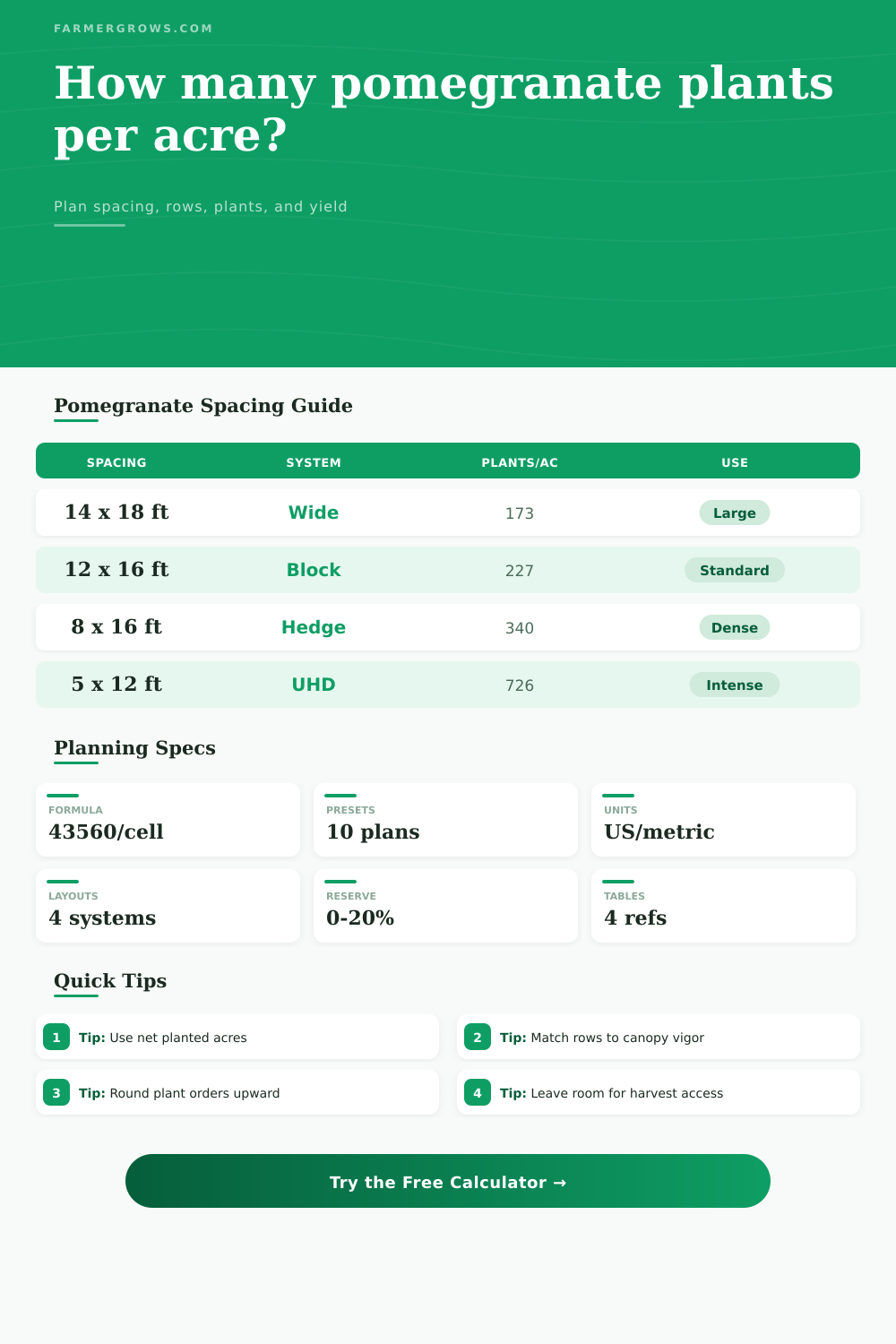
| 14 x 18 ft or 4.3 x 5.5 m | 252 sq ft | 173 | 427 |
| 12 x 16 ft or 3.7 x 4.9 m | 192 sq ft | 227 | 562 |
| 10 x 15 ft or 3.0 x 4.6 m | 150 sq ft | 290 | 717 |
| 8 x 16 ft or 2.4 x 4.9 m | 128 sq ft | 340 | 841 |
| 6 x 14 ft or 1.8 x 4.3 m | 84 sq ft | 519 | 1282 |
| 5 x 12 ft or 1.5 x 3.7 m | 60 sq ft | 726 | 1794 |
| System | Spacing Range | Density Character | Calculator Use |
|---|---|---|---|
| Wide bush orchard | 14-20 ft rows | Lower count, more access | Open-center blocks and fresh market fruit |
| Standard block | 10-16 ft rows | Balanced plant count | General pomegranate acreage planning |
| Managed hedgerow | 5-10 ft in-row | Higher count, pruning critical | Fruiting wall or mechanical operations |
| Triangular layout | Same spacings | 15.5 percent denser | Only when rows can be staggered cleanly |
| Planning Item | Formula | Why It Matters | Output Location |
|---|---|---|---|
| Net planted acres | Gross x usable percent | Separates planted ground from lanes | Result card and breakdown |
| Plant row feet | Net area / row spacing | Checks drip lateral and row workload | Field planting spots card |
| Emitter count | Plants x emitters each | Sizes drip hardware counts | Canopy meter line |
| Canopy pressure | Canopy width / row spacing | Flags crowding risk at maturity | Canopy clearance meter |
| Block Plan | Spacing | Net Plant Spots | Order With 10 Percent Reserve |
|---|---|---|---|
| Half-acre trial, 12 x 16 ft, 90 percent planted | 227 per acre | 102 plants | 113 plants |
| One-acre wide bush, 14 x 18 ft, 92 percent planted | 173 per acre | 159 plants | 175 plants |
| Five-acre hedge, 8 x 16 ft, 88 percent planted | 340 per acre | 1498 plants | 1648 plants |
| Ten-acre dense block, 6 x 14 ft, 85 percent planted | 519 per acre | 4410 plants | 4851 plants |
Spacing note: Pomegranate density should match cultivar vigor, pruning style, soil strength, sunlight, frost-management rows, and harvest access. Confirm close hedgerows before ordering trees.
Ordering note: Order whole plants after rounding field stations upward. Keep reserve plants separate from the planted count so replanting losses do not distort acreage density.
But most growers starts out with yield expectations and a variety to get there without any attention paid to geometry. “I want some fruit. I’ll find the best genetics, see how much it costs, squeeze in as many plants per acre as I can on my ground.” Great plan … right up until you’re three years into it, and your pruning shears are starting to complain from fending off sun-starved tedium.
For the next couple of decades, the answer to the spacing question will affect how many hours of sunlight penetrate the canopy; what that volume will be; and how much labor is require. The calculator does the math for you regarding rows and square feet, but how do you know what that means?
Choosing the Right Tree Spacing
The magic number here is usable acreage entry field. A planted acre is where actual land can support a tree. A legal boundary is called a gross acre. Before calculating your density, subtract out drain lines, frost fan pads, access roads, headlands etc. Put in trees where the equipment won’t go if you don’t make this deduction. Sounds like a minor correction on paper but you are saving yourself from ordering something you cannot get into the ground.
So here’s where it gets interesting: Pomegranates is all about the trade-off between wide vs. Dense. In the wide system… Like fourteen by eighteen feet, you can accommodates wide-turning equipment, big bins, heavy-duty sprayers, etc. In year one, it feel manageable; it feels open. But you have fewer plant per acre to make up for extra space. That means you’ve got to get them to crop more heavily since they’re carrying a bigger fruit load on any given tree. This invites overcropping. To avoid it, you need higher skill at thinning and pruning.
With a dense hedge system (say five by twelve feet) you get maximum plant count and early returns. The canopy closes-in faster, and you create a uniform wall of fruit. The gamble is that you’re betting on aggressive hedging and perfect irrigation to keep everything alive right down the middle of row. Fail on either front, fail to get enough light or water into the middle of that hedge, and you’ll lose volume quickly.
Then there’s the fact that nature happens, as it will: no nursery stock emerges from its packages with 100 percent survival rate. With this tool you can specify how many spare percent you want added to your order (because some grafts fail, and some plants get lost to windfall). Better to pay for an extra ten plant in a pot than have ten open spots in a full production row. Your reserve buffer will take the initial-year casualty loss but not lessen your planned density.
The “variegated vigor” input is not as much as you might think. A fast-growing Wonderful pomegranate on a vigorous rootstock gets bigger, for example, different than a slower growing compact processing variety. And if you plant a vigorous tree into a tight hedge spacing, you’ll have a pruning nightmare.
That canopy width input lets you see what it’s going to look like when the trees get big. If your desired mature canopy width comes close to row spacing, then the trees will be shading one another. Limbs that don’t get full sun makes smaller fruit with less sugar. That’s how the light fuels the fruit quality you’re trying to achieve.
Consider this: How are you going to pick the trees in the orchard in five years? Are you driving a mechanical harvester down a broad lane, or walking between two adult-sized sofa with a ladder? Your answer locks in your labor strategy and that should guide your spacing decision. A wider row allow for mechanization but demands more skill per tree; a tighter row simplifies the pruning profile but means more labor per hour.
In any given field there’s no one right answer. How close should they be? It depends on how much water your soil can hold, the amount of labor you have available, and how aggressively you’re prepared to prune. You aren’t purchasing trees. You’re purchasing a management system.
Note what happens with the plant count and row length when you change spacing in the calculator. That adjustment is a different harvest season, a different equipment list, a different daily routine. Select the spacing that fits the work you’re ready to put in, not just the potential yield you anticipate. Give the trees the geometry and they’ll follow. You should of considered this earlier.