Cotton Plants Per Acre Calculator
Convert cotton stand counts into plants per acre, adjust for skip-row planting, estimate seed drop and bags, and compare stand density with a lint yield sensitivity check.
Use emerged, harvestable cotton plants for stand counts. The calculator separates measured stand, planned seed drop, germination, field survival, planted acreage, and skip-row patterns so population decisions stay tied to the actual field layout.
Cotton Stand Results
Your measured stand and seed-rate plan will appear here.
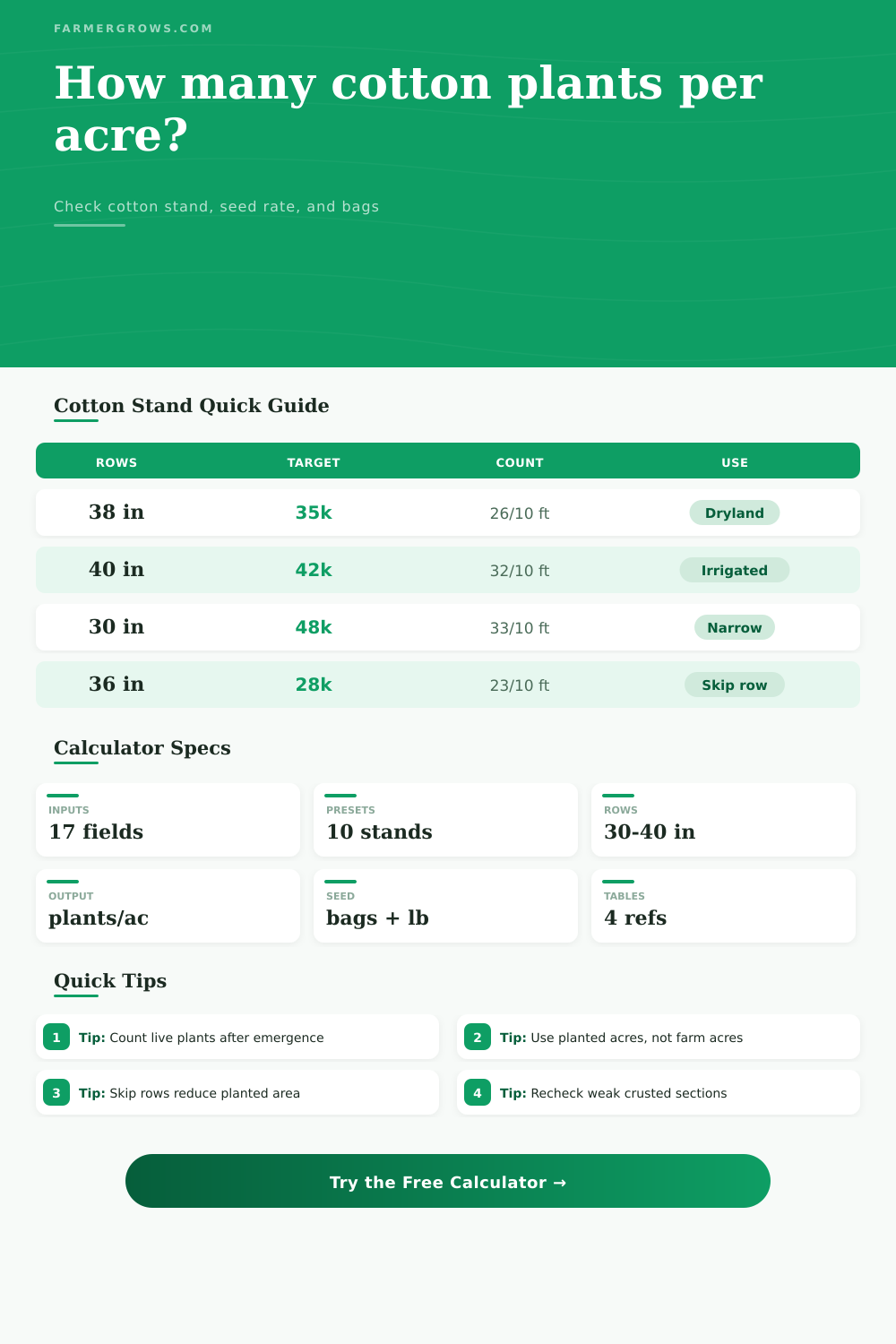
| Row spacing | Target plants/ac | Plants in 10 ft row | Plants per row foot |
|---|---|---|---|
| 40 in rows | 30,000 | 23 | 2.30 |
| 38 in rows | 35,000 | 27 | 2.69 |
| 36 in rows | 40,000 | 33 | 3.31 |
| 30 in rows | 50,000 | 34 | 3.44 |
| 15 in rows | 65,000 | 19 | 1.87 |
| Seeds per acre | 38 in drop spacing | 40 in drop spacing | 230k bags per 100 ac |
|---|---|---|---|
| 36,000 | 4.58 in | 4.36 in | 15.7 |
| 44,000 | 3.75 in | 3.57 in | 19.1 |
| 52,000 | 3.17 in | 3.02 in | 22.6 |
| 60,000 | 2.75 in | 2.61 in | 26.1 |
| 68,000 | 2.42 in | 2.31 in | 29.6 |
| Pattern | Planted factor | 100 field acres | Seed order effect |
|---|---|---|---|
| Solid rows | 1.000 | 100 planted acres | Full seed rate |
| 4 planted, 1 skipped | 0.800 | 80 planted acres | Order 20% less |
| 3 planted, 1 skipped | 0.750 | 75 planted acres | Order 25% less |
| 2 planted, 1 skipped | 0.667 | 66.7 planted acres | Order 33% less |
| 1 planted, 1 skipped | 0.500 | 50 planted acres | Order 50% less |
| System | Typical target | Common row spacing | Stand note |
|---|---|---|---|
| Dryland picker cotton | 24,000-38,000 plants/ac | 36-40 in | Uniformity often matters more than high density. |
| Irrigated picker cotton | 35,000-52,000 plants/ac | 30-40 in | Higher targets can fit strong water and fertility. |
| Narrow-row cotton | 45,000-65,000 plants/ac | 20-30 in | Canopy timing and picker setup matter. |
| Ultra-narrow cotton | 60,000-90,000 plants/ac | 7.5-15 in | Usually managed as a different harvest system. |
| Late or replant cotton | 40,000-60,000 plants/ac | 30-40 in | Calendar pressure may justify a stronger stand. |
Count tip: Sample weak, average, and strong zones separately before averaging. A uniform 26,000 plants per acre can be easier to manage than a patchy 36,000 stand.
Seed tip: Enter germination and field survival separately. Cotton seed with high lab germination can still lose stand to cold soil, crusting, thrips, or planter skips.
In early spring, then, the dirt settles and true leaf unfurl. A planter’s shape becomes real. At that moment, the math isn’t just theory; it begins to count heads. Seed genetics and soil types, talk all you like, but until you know precisely how many viable plant there are in each row, you’re flying blind.
From here, the calculator above do the math, leaving you free to concentrate on what numbers say about your crop. It translates raw numbers into information you can act on, and bridges gap between the field and the spreadsheet.
Why Plant Counting Matters for Your Farm
The target population… The number of plants you want in the ground, is at the center of most growers’ attention. Those who run dryland land is targeting somewhere between 24 and 35 thousand plants per acre; those on irrigated land will push it closer to 50 thousand plants per acre. But all that really matters is space between what’s planted and what survives in ground.
What about seed germination? Seed companies make it seem great on a lab tag, but then it fails out there in the cold, crusted soil. What about early season insect damage or disease loss? What about impact on final stand if field survival drop? The tool breaks down these variables so you can model effect on your final stand. It forces you to face difference between what goes into ground and what makes it to harvest, a distinction that often gets lost during the rush of planting season.
And then there’s row spacing. This is especially true if you’re dealing with a skip-row pattern like we do here to reduce drought. When planting every-other row, for instance, you’re halving your planted acreage without changing overall size of field. That will change your seed requirement per field acre a lot. You can guess that you’ll still need the same amount of seed, or maybe not? Well, you’re covering half as much ground.
The calculator take those quirks into account so you don’t have to worry about getting right number of bags ordered. This stops you from just winging it and potentially making an expensive mistake, like running out of seed or wasting money by ordering too many bags and not accounting for empty space between rows of cotton.
This becomes even more important on narrow-row systems. In these systems, populations shifts much higher to keep up with weed competition, and canopy closure occur faster.
Just like calculating right, counting right is important too. There’s a temptation when walking through the strongest section of the field to take a ten-foot sample and say “Done.” Doing that will give you best case instead of the average. Instead, count normal areas, the crusty areas and the weaker areas apart. Sometimes a patchy stand of 30,000 (with big holes) won’t be worth more than a uniform stand of 26,000. Uniformity leads to consistent maturity which in turn helps with efficient harvests.
The charts on this page allow you to compare your counts to commonly accepted industry norms. This provides a quick measure of how close to the comfort zone… Or danger zone, you might be. Think of it as an eye-reality check.
Seed isn’t cheap, so you need an accurate idea of how many bag to dig out of the stash. This one will convert your field size and desired population into the exact number of bags you’ll need (down to the last seed per pound on that particular variety). No more guessing when it comes to inventory. No more running back to the store on a steamy afternoon after underestimating space. No more half-full bag taking up room in storage (and going bad while they’re waiting). The math give you a straight-up order amount, connecting your farming requirements to purchasing logistics. It transforms biological objectives into logistical directions.
Cotton management boils down to that balance of vigor within each plant versus its closeness to its neighbors. Crowd them all together, sure, but let ‘em breathe a bit and give their roots some place to drink.
The context comes from you; the framework comes from the calculator. Observe those seedlings push through, feel the soil temperature, look at the moisture content, and check back on the math when the leaves first open to the sunshine. The numbers say you’re here; now you get to decide where you go next.
And if it all adds up in the mud, well then you’ll know.