Onion Plants Per Acre Calculator
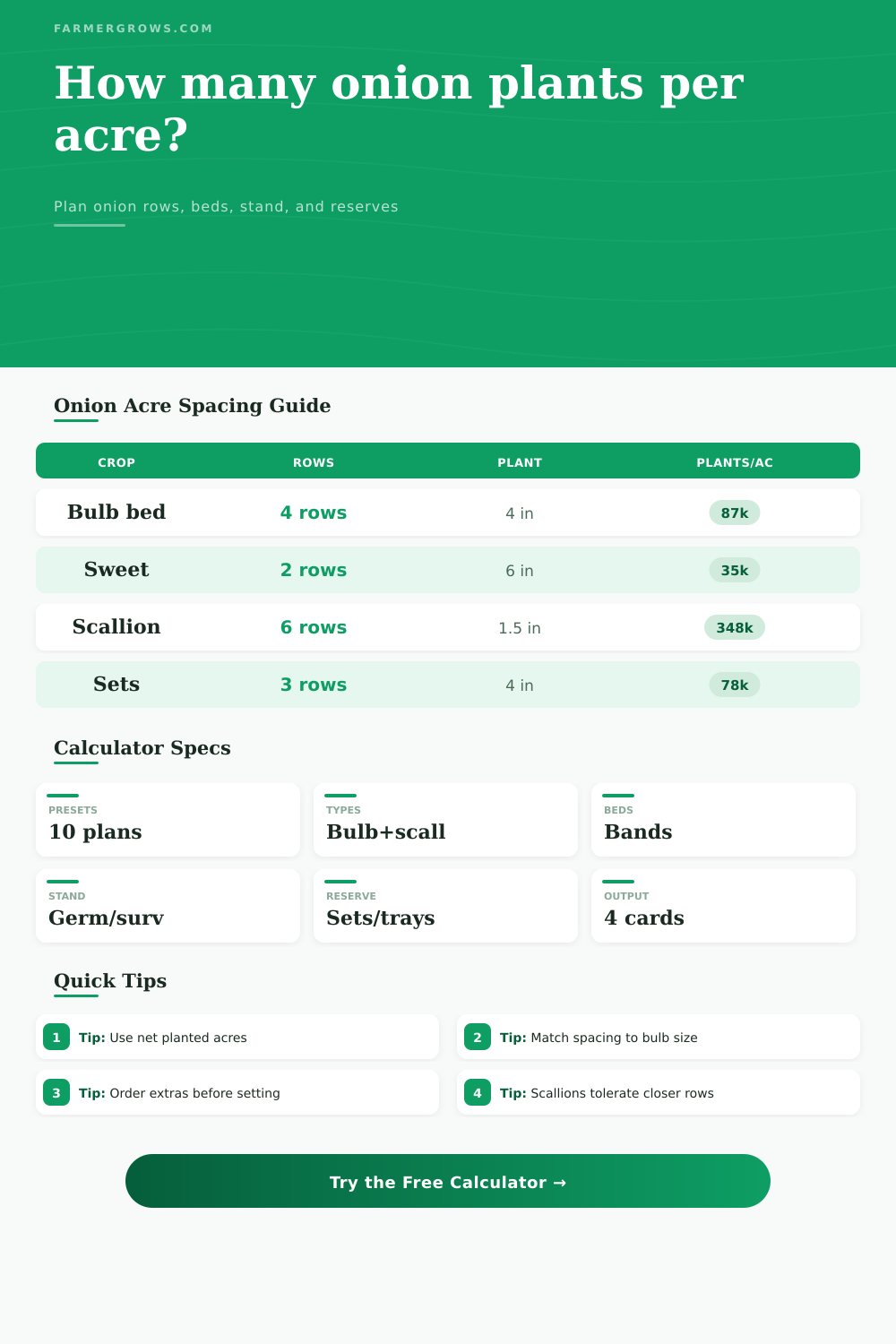
Estimate bulb onion or scallion plant population from row spacing, in-row spacing, bed bands, stand percentage, marketable percentage, bulb size target, and set or seedling reserves.
Choose a named field layout, then adjust the spacing, survival, reserve, and marketable harvest assumptions to match your onion crop.
Onion Acre Population Results
Four-row raised beds often balance good bulb size, drip coverage, cultivation access, and harvest airflow.
Use fewer rows or wider in-row spacing when the market wants large bulbs and thick necks can dry properly.
Calculate seed from expected field emergence, then thin or precision seed to the final target stand.
Scallions can sit close because the harvest target is slender plants or bunches rather than storage bulbs.
| Onion crop target | Common row spacing | Common in-row spacing | Approximate plants per acre |
|---|---|---|---|
| Single-row bulb onions | 30 in centers | 4 in | 52,272 planting spots/ac |
| Storage bulb grid | 12 in row spacing | 4 in | 130,680 planting spots/ac |
| Large sweet bulbs | 18 in row spacing | 6 in | 58,080 planting spots/ac |
| Baby or pearl onions | 6 in row spacing | 2 in | 522,720 planting spots/ac |
| Scallion or bunching onions | 12 in row spacing | 1 in | 522,720 planting spots/ac |
| Bed band setup | Rows per bed | Bed centers | Population at 4 in spacing |
|---|---|---|---|
| 40 in top, drip-centered storage bed | 4 rows | 72 in | 87,120 spots/ac before stand loss |
| 42 in top, close direct-seeded bed | 5 rows | 72 in | 108,900 spots/ac before stand loss |
| 30 in top, narrow raised bed | 3 rows | 60 in | 78,408 spots/ac before stand loss |
| Jumbo bulb, two-row bed | 2 rows | 72 in | 43,560 spots/ac before stand loss |
| Scallion six-line bed at 1.5 in | 6 rows | 72 in | 348,480 spots/ac before stand loss |
| Field stand | Gap-fill recovery | Final stand factor | Order multiplier with 10% reserve |
|---|---|---|---|
| 95% stand | 20% of misses filled | 96.0% final stand | 1.16 times planting spots |
| 90% stand | 35% of misses filled | 93.5% final stand | 1.22 times planting spots |
| 85% stand | 50% of misses filled | 92.5% final stand | 1.29 times planting spots |
| 75% direct seed emergence | 25% of misses filled | 81.3% final stand | 1.47 times planting spots |
| Target class | Planning diameter | Planning weight | Spacing note |
|---|---|---|---|
| Pearl or baby onion | 1 to 1.75 in | 0.05 lb per bulb | Close spacing, short finish window |
| Small bulb | 2 to 2.5 in | 0.12 lb per bulb | Useful for bags and mixed grades |
| Medium bulb | 2.5 to 3.25 in | 0.28 lb per bulb | Common fresh market planning size |
| Large bulb | 3.25 to 3.75 in | 0.45 lb per bulb | Give more space and steady water |
| Jumbo bulb | 3.75 in plus | 0.65 lb per bulb | Use wide spacing and lower density |
| Scallion bunching | Slender stems | 8 plants per bunch | Count marketable bunches, not bulbs |
Bed band tip: Check row fit before ordering plants. A four-line onion bed on 40 inches of top width leaves much less edge room than the same four rows on a 48 inch top.
Reserve tip: Keep the reserve tied to real stand history. Direct-seeded onions usually need more seed reserve than clean transplants or graded sets.
Onions are finicky: More plants don’t necessarily equal more pounds. How tightly to plant determines whether you’ll have a profitable crop or a field full of disappointing splits. If the plants gets crowded, they end up competing, growing smaller, retaining moisture on their skins (which invites rot), and generally not making happy campers.
This tool on the page help you get into narrow sweet spot where your row density overlaps with quality. You enter your beds’ dimensions, tell it what bulb size you’re shooting for, and provide your stand expectations. Then, it will do the math for you. No guessing at how close you can pack the rows while still using all the soil’s potential.
How to Plant Onions Correctly
Geometry: What’s the size of your bed? Most growers begins there. How many rows can they fit on the width at the top? A top of 40 inches sounds generous enough to hold five lines, right? But add in a edge guard, which prevents the outer plants from growing against looser soil at the shoulder (where water is also irregular). Squeeze extra rows up against the edges and you’ll postpone harvest, or settle for some grade of smaller bulbs.
As the tool’s accompanying tables explains, moving from one row to multiple lines reduces population. Yes, you’ll get more that way; but it’s about making sure each line gets sufficient space to stretch its legs. The trade-offs involve how you space plants within a row. Want a jumbo bulb? You’re going for the local farmers market and that will mean wider space in the row, six inches or more. Going for the wholesale bag market? Tighten things up to four inches. The calculator accounts for this decision, adjusting the overall number of plant to match.
But it also accounts for what makes it. Stand loss is the silent killer of yield plans. Despite best transplant efforts you make, expect to lose five to ten percent of your plants to early pest pressure, poor root contact or wind. Direct seeding is even worse. The tool allows you to enter a germination rate and gap-fill percentage. Why does this matter? This way you know how many more trays… Or sets. You need to order so that when the field dries out, you don’t get caught short-handed.
And then there’s reserve planning, which is so frequently done intuitively, thinking you’ll make 10 percent more for error, for instance? No way. With direct seeding, the variation is far greater then that. The calculator takes your base requirement and multiplies it by a reserve factor and expresses it in bags or trays. That means you won’t find yourself short on seedlings half-way through planting, panicked.
And it factors in marketable yield: Not all plants that stand up go to market. Some are doubles, others is too small, and some have necks that do not cure well. If you apply a marketability percentage, you’re seeing the actual harvest, not its theoretical stand.
Last, think about bands around the beds. When planting in multiple rows on a wide center (which is more efficient), how will you get around and cultivate? How do you keep the edges of those outside rows intact while moving your tool between the beds? Common scenarios have been pre-set into the device. For example, if you’re growing scallions bunched or storing bulbs, scallions can be much closer together. You’ll never harvest their swollen bulb; you just take off the tops. For storage onions, it’s all about airflow. Humidity gets trapped if you have them too close together, humidity means disease.
When I look at a big number of plants, I want to know: Can they cure fast enough? If not, you should of had too many in there. There’s a controlled compromise when planning for onions: how much do I want to grow and how many will the soil hold? How big should they be, since they won’t work if they are too small or too big? How does the weather play out? You plan the population so that the onions has a stand that holds up well. At harvest, you’ll walk in with a uniform bulb, a clean skin, and all the pieces you need.
The numbers is the thing that guides you but the field teaches you. Let the results tell you how far you can go, start with the math and adjust based off learning what works best on your particular land and in your particular climate.