Pepper Plants Per Acre Calculator
Estimate pepper plant population, bed length, plant row footage, transplant order quantity, tray count, stand density, and harvest range for bell, chile, jalapeno, banana, snack, processing, and high tunnel systems.
Use bed-center spacing from one bed, row, or tractor centerline to the next. The usable planted area factor removes headlands, turning lanes, drive rows, irrigation headers, and unplanted field edges before the calculator estimates pepper stand.
Pepper Population Results
Enter spacing and field details to calculate pepper stand.
| Pepper system | Bed or row center | Plant spacing | Rows per bed | Typical net density |
|---|---|---|---|---|
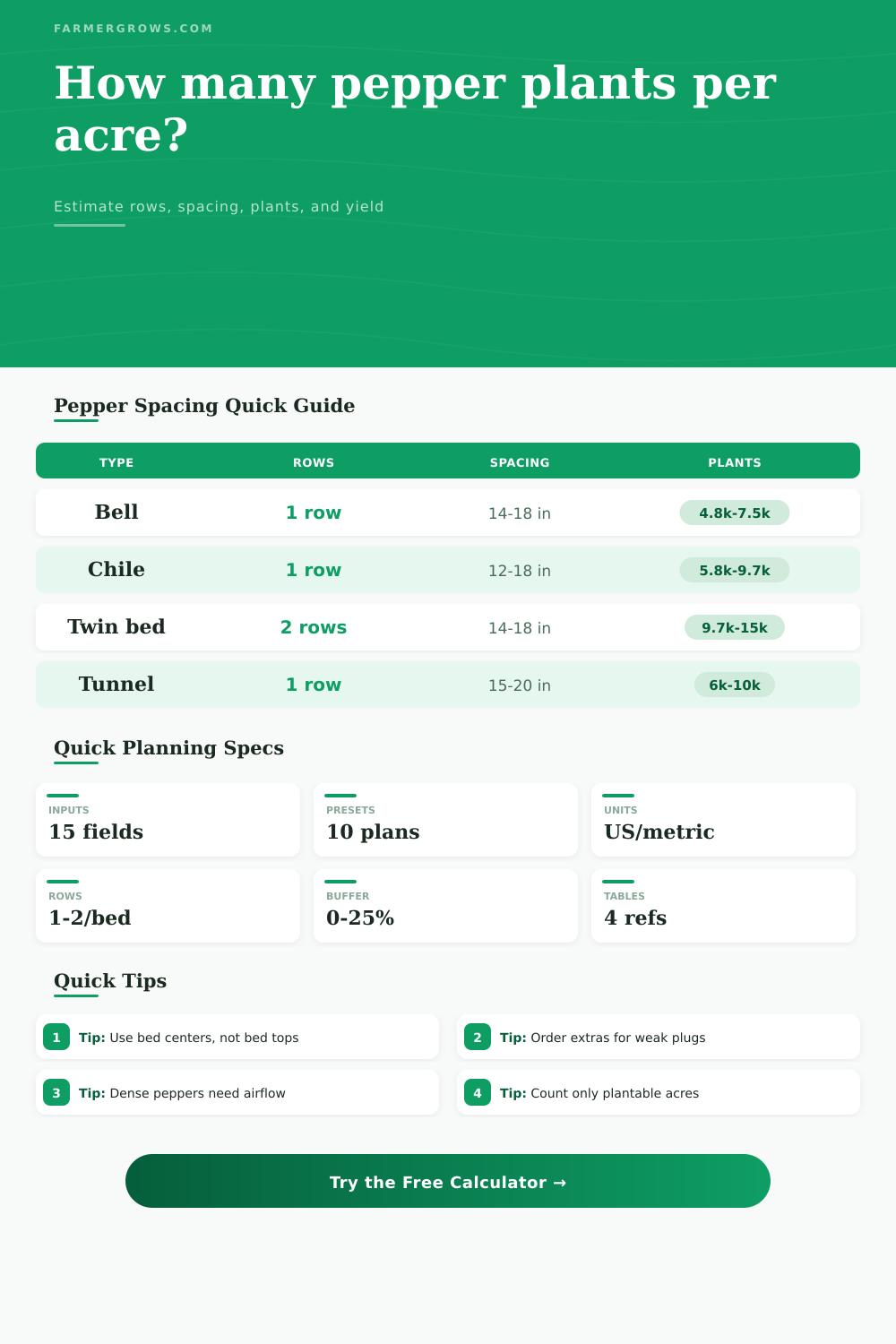
| Fresh-market bell, single row | 54 to 66 inches | 14 to 18 inches | 1 | 4,400 to 7,400 plants/ac |
| Bell pepper twin-row plastic bed | 60 to 72 inches | 14 to 18 inches | 2 | 9,700 to 14,900 plants/ac |
| Jalapeno or serrano hot pepper | 42 to 60 inches | 12 to 18 inches | 1 | 5,800 to 12,400 plants/ac |
| Anaheim, poblano, or chile pepper | 48 to 60 inches | 14 to 20 inches | 1 | 4,300 to 9,300 plants/ac |
| High tunnel trellised pepper | 36 to 48 inches | 15 to 20 inches | 1 | 6,500 to 11,600 plants/ac equivalent |
| Bed center | Rows per bed | 14 in spacing | 16 in spacing | 18 in spacing |
|---|---|---|---|---|
| 48 inches | 1 | 9,334/ac | 8,168/ac | 7,260/ac |
| 54 inches | 1 | 8,297/ac | 7,260/ac | 6,453/ac |
| 60 inches | 1 | 7,467/ac | 6,534/ac | 5,808/ac |
| 60 inches | 2 | 14,934/ac | 13,068/ac | 11,616/ac |
| 72 inches | 2 | 12,445/ac | 10,890/ac | 9,680/ac |
| Transplant planning item | Low allowance | Normal allowance | High allowance | Use when |
|---|---|---|---|---|
| Expected establishment | 88% | 94% | 97% | Use lower values for heat, wind, weak plugs, or late planting |
| Order buffer | 5% | 10% | 20% | Add extras for skips, replacement plugs, and bad cells |
| Row-end loss | 3% | 5% | 12% | Use higher values for short beds, valves, and odd edges |
| Tray size | 72 cells | 128 cells | 200 cells | Match the nursery plug count or your seeded tray format |
| Pepper crop type | Typical yield per plant | Harvest window | Cull range | Planning note |
|---|---|---|---|---|
| Bell pepper | 3 to 6 lb | 6 to 9 weeks | 8% to 18% | Fruit size can drop when density is very high |
| Jalapeno or serrano | 1.5 to 4 lb | 5 to 8 weeks | 6% to 15% | Small fruit types can handle higher plant counts |
| Anaheim, poblano, chile | 2 to 5 lb | 5 to 8 weeks | 8% to 18% | Large chile fruit need airflow and picking access |
| Habanero or specialty hot | 1 to 3 lb | 7 to 10 weeks | 6% to 16% | Plants may branch heavily and need wider spacing |
| High tunnel pepper | 5 to 12 lb | 10 to 18 weeks | 5% to 12% | Protected culture extends harvest and changes yield per plant |
For plastic beds: Enter the bed-center distance, not just the plastic top width. The aisle and wheel track are part of the acre and control total bed feet.
For dense hot peppers: Use the density check as a canopy warning. Tight plants can yield well, but staking, airflow, fertility, and picking labor become more important.
Start With Bed Center Not Width Of Plastic: When you’re planning out your pepper fields, this one are a frequent mistake. You’re going to measure width of the black mulch, say it’s thirty inches across, and then you do math on that. Wrong! There’s no such thing as just the bed width. There has to be a wheel track for the tractor. There has to be an aisle for the sprayer. Unless you account for what’s between the beds, you will overestimate your plant population by twenty percent or more. The calculator take gross field area and turns it into net planted acreage. It subtracts odd edges, turning lanes, and headlands. It tells you how many plants will fit in dirt.
Bell peppers is generous plants that branch and sprawl. Packed closely together, they produce smaller fruit. And their canopy grows humid, encouraging disease. For fresh market bells, plant them fourteen to eighteen inches apart in the row and about sixty inches between bed in center.
How to Space Your Peppers
Hots are another matter: Compact jalapenos and serranos handle tighter spacing without fungal trouble. If drainage’s good and your soil’s fertile, you can go twelve inches. These bands of densities is explained on the page, with reference tables showing where hot peppers fall. (A twin-row bed setup will double your population, versus one row.)
Yield potential depend on transplant success. Enter your establishment percentage into the calculator. Now: Don’t be greedy and type “ninety-seven.” A lot of us are. We want everything to go perfectly. Five percent of the stand could of die from heat stress, a bad plug or wind (before we even water it). Type a lower number, say ninety-four, as your survival rate. That will force you to get more trays order. Seems pricey now. But an empty row doesn’t make money. It just costs you labor to walk past it. Get a ten percent buffer to provide cheap insurance against a patchy stand.
Take a look at row footage. Headlands eat up space in a narrow field with lots of turns. Enter the dimension of the rectangle, or enter how long it was, a known row length. If you’ve already flagged out the beds, this will help. You can plan for labor knowing exactly what number of feet of plants is on each row.
Peppers take time to harvest. And when there’s a lot of them in a dense stand, they’re harder to pick because pickers has farther to go into the canopy. Not only does that break more fruit, it slows down the pickers. Poor air flow isn’t just a plant health problem. It’s a logistics problem, too.
The high-tunnel twist is that protected culture prolongs harvest period by weeks or even months. Because each plant stays productive for longer, you can run wider spacing. A plant that produces three pounds in the field will produce ten or twelve in a tunnel. Spacing in the field doesn’t work in the tunnel (wasted space). Spacing in the tunnel doesn’t work in the field (poor fruit). Depending on the crop, the calculator narrow the yield range to match. Compare a bell pepper with a long season on a trellis different than a jalapeno with a quick summertime flush.
Call the nursery: Know that they sell in trays. Not single plugs, so if you do math and find you need nine hundred and forty-five plants, you must order entire tray. (The calculator includes cells per tray and rounds up, so there will be no three-hundred-plant shortfall on planting day; or worse, no forty spares.) A little piece of administration, yes, but it will save you a mad April phone call.
It’s a race against the season, planting peppers. It’s also a race against biology: how far apart do you plant them? How can you get enough air and light circulation without sacrificing volume? The math will be your guide. Your eyes will be your guide (when it gets crowded in there, you’ll know).
Begin with the number cruncher. Sow that row. Observe as each of the plants begins to occupy its own space. Tweak, tweak, tweak for tomorrow’s garden. There is a learning curve. It is the first time around. Next time you know exactly how many feet apart those things want to grow.