Banana Plants Per Acre Calculator
Estimate banana mats per acre, nursery plant order, replacement plants, ratoon stand, harvestable bunches, and yield from spacing, layout pattern, usable field area, and stand survival.
Use this planner for banana fields where one planting station becomes one managed mat. Row spacing should be measured center to center, and net planted area should exclude roads, drains, irrigation headers, buildings, and wide harvest lanes.
Banana Plant Population Results
Your banana planting estimate will appear here.
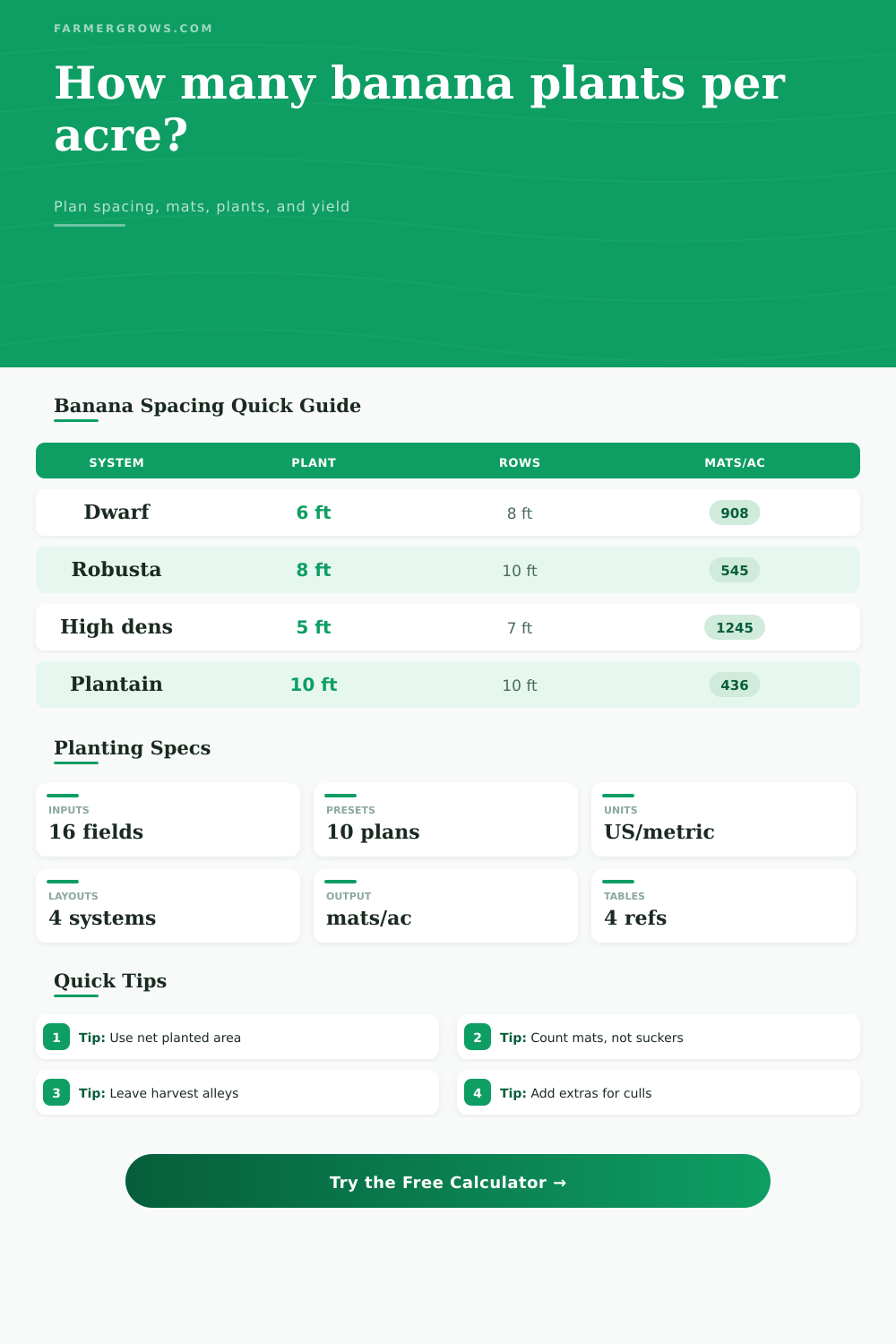
| Spacing system | Footprint per mat | Square mats per acre | Triangular mats per acre | Common use |
|---|---|---|---|---|
| 5 x 7 ft | 35 sq ft | 1,245 | 1,437 | Very dense dessert banana block |
| 6 x 8 ft | 48 sq ft | 908 | 1,049 | Dwarf or close-managed banana |
| 8 x 8 ft | 64 sq ft | 681 | 786 | Moderate density with small machinery |
| 8 x 10 ft | 80 sq ft | 545 | 629 | Common dessert banana spacing |
| 10 x 10 ft | 100 sq ft | 436 | 503 | Plantain, vigorous types, or airflow |
| Spacing in meters | Footprint | Mats per hectare | Mats per acre | Planning note |
|---|---|---|---|---|
| 1.8 x 1.8 m | 3.24 sq m | 3,086 | 1,249 | High density dwarf or intensive dessert |
| 2.0 x 2.0 m | 4.00 sq m | 2,500 | 1,012 | Close banana plantation spacing |
| 2.4 x 2.4 m | 5.76 sq m | 1,736 | 703 | Moderate spacing with access room |
| 2.5 x 3.0 m | 7.50 sq m | 1,333 | 540 | Common dessert banana spacing |
| 3.0 x 3.0 m | 9.00 sq m | 1,111 | 450 | Wide plantain or airflow layout |
| Crop type | Typical spacing | Expected survival | Bunch weight range | Density caution |
|---|---|---|---|---|
| Dwarf banana | 6-8 ft rows, 6-8 ft plants | 90-95% | 25-45 lb | Can handle tighter spacing if managed |
| Cavendish dessert | 8-10 ft rows, 7-9 ft plants | 90-96% | 35-60 lb | Balance leaf canopy and harvest access |
| Plantain | 9-12 ft rows, 9-12 ft plants | 88-94% | 25-50 lb | Needs more air and mat space |
| High-density block | 5-7 ft rows, 5-7 ft plants | 85-93% | 30-50 lb | Requires strong fertility and desuckering |
| Organic airflow | 10-12 ft rows, 8-10 ft plants | 88-94% | 30-55 lb | Lower density, easier scouting |
| Field scale | Gross area | At 545 mats/ac | At 908 mats/ac | At 1,245 mats/ac |
|---|---|---|---|---|
| Backyard patch | 0.10 acre | 55 mats | 91 mats | 125 mats |
| Quarter acre | 0.25 acre | 136 mats | 227 mats | 311 mats |
| Half acre | 0.50 acre | 272 mats | 454 mats | 623 mats |
| One acre | 1.00 acre | 545 mats | 908 mats | 1,245 mats |
| Five acres | 5.00 acres | 2,723 mats | 4,538 mats | 6,223 mats |
For plant counts: Treat one planting station as one managed banana mat. Extra followers inside the mat should not be counted as extra acre population unless the block is intentionally multi-stemmed.
For plant orders: Tissue-culture plants, sword suckers, culls, water stress, and early disease losses can change survival. Keep replacement plants separate from the planted mat count.
Standing at the edge of a field ready to plant, you have a spreadsheet open on your phone. How many do you want? That’s often the first question, which sound like basic math, but turns out to be an exercise in risk management and geometry. One little miscalculation in estimating survival rates or one extra inch of space per plant can result in gaps in your field versus a complete canopy. Put in assumptions for your survival rate and field dimensions, and the calculator will do the work for you.
No more guesswork as to what fits in your field as viable mats vs. Square footage. Each station will be a cluster. You’re planting a managed mat, not single tree. They must be spaced apart so machinery can move through and each plant gets air. Too close, and you form a humidity trap inviting disease. Too much open ground between them, and you lose soil potential and steal sunlight.
How to Plan Your Plant Layout
With the tool you can select either a triangular staggered pattern or a square grid. Triangular provides about fifteen percent more density then square at equivalent spacing. Why? Because plant fits in the gap created by the row ahead. It is a small change in geometry, but it matter if planning yields results.
Be truthful about what you can actualy plant. Not all parts of an acre are plantable. There is water management like drains, equipment turns around headlands, and maybe even an irrigation header crossing through the center. Forty-three thousand five-hundred and sixty square feet isn’t an acre, so if you’re planning by gross acres you’ll be out of stock by the time you get to planting. The planner allows you to account for the unplantable surface areas up front. It makes you think off the actual field instead of an idealized rectangle on paper. This saves you from panicking when you realize half way into planting week that you’re down thirty plants.
Optimism also doesn’t help with survival rates when budgeting. Though tissue culture plants are tough, they’re still not immortal. Some transplant will have early transplant shock. Some will get stressed by water. Some will be culled unexpectedly. Your stand will thin out. This might seem pessimistic, but it is normal practice to add a ten or fifteen percent buffer to your nursery order. Besides, you’ll have to plan for replacement reserves for subsequent seasons, too. What if a storm blows over a section of your block? You’d better have plants ready to fill those gaps immediately, rather then wait until the next order comes in. The calculator tells the difference between the initial order and these reserve requirements so you can budget accordingly.
A twist is that plantains and other bananas also ratoon. After their initial harvest, the main stem dies back. Then, suckers take over the stand and grow into new plants. They don’t replant the entire field. They manage the followers. How many are kept depends on your retention rate. This rate varies depending on the expected fruit size and how close the plants is to crowding. The closer to crowding, the smaller the fruit. Retaining too few means lost potential yield; retaining too many, a crowded mat with reduced fruit size.
Balancing this requires accounting for both your variety’s strength as well as the airflow provided by your site. Vigorous varieties require more space than dwarf kinds. The comparison table on the page shows this, so you can compare systems directly. In the end, it’s a balancing act between what the land can bear (in terms of yield-per-acre) versus what your labor and irrigation resources will allow. Your eyeball and experience are the final judge. Your eyes tell you yes or no; the numbers tells you when to stop.
Begin with the presets, tweak them according to your terrain, and see how the yields change. Instead of overplanting the field in hopes of a higher yield, it is better to plant slightly less densely with healthy, strong plants so you do not have to struggle against disease all year. Planning makes a mess of a jungle into an economically viable farm.