Hemp Plants Per Acre Calculator
Estimate hemp plant population from row spacing, in-row spacing, beds, usable acres, germination, survival, seed size, and transplant tray capacity for CBD, CBG, grain, fiber, or nursery blocks.
Use legal net planted acres and the spacing actually used in the field. For drilled grain or fiber hemp, treat row spacing and in-row seed spacing as an average stand target after thinning, skips, and emergence loss.
Wide spacing supports branching, airflow, scouting lanes, and individual plant management.
Tray cells, survival, and buffer estimate the clone or plug order needed for net planted acres.
Narrow rows and seed size drive high populations and pounds of seed per acre.
Dense stands push upright stems and reduce branching, so the calculator flags canopy pressure.
Hemp Plant Population Results
Spacing and field totals will appear here.
| Spacing pattern | Plants per acre | Plants per hectare | Common hemp use |
|---|---|---|---|
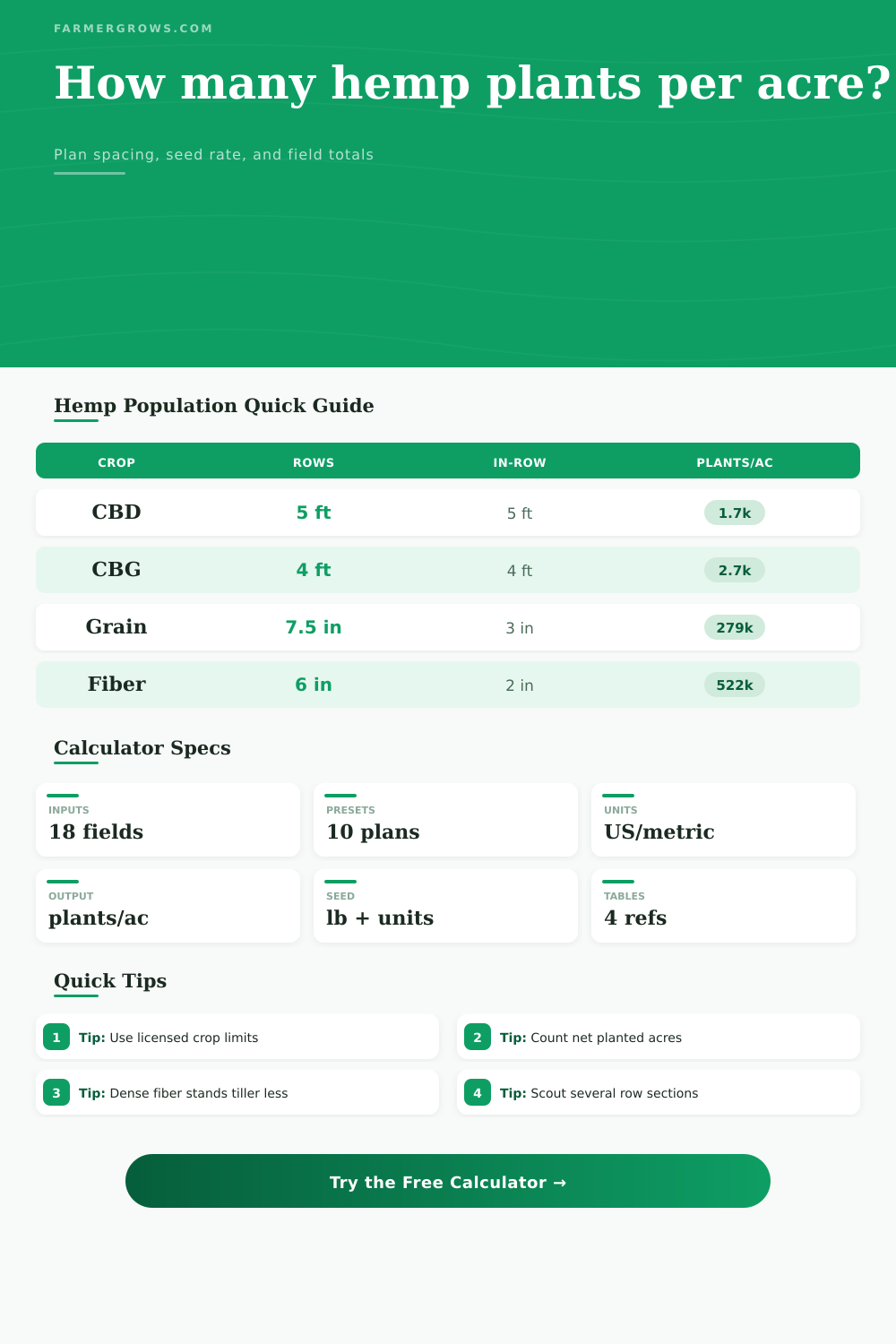
| 6 ft rows x 6 ft plants | 1,210 | 2,990 | Large CBD or mother stock |
| 5 ft rows x 5 ft plants | 1,742 | 4,304 | Wide CBD field spacing |
| 4 ft rows x 4 ft plants | 2,723 | 6,728 | Dense flower hemp block |
| 3 ft rows x 3 ft plants | 4,840 | 11,960 | Seed increase or nursery rows |
| 30 in rows x 12 in plants | 17,424 | 43,055 | Experimental close-row crop |
| Drill setup | Average in-row spacing | Plants per acre | Best fit |
|---|---|---|---|
| 10 in rows | 4 in | 156,816 | Low-density grain stand |
| 7.5 in rows | 3 in | 278,784 | Typical grain planning band |
| 7.5 in rows | 2 in | 418,176 | Dual-purpose or dense grain |
| 6 in rows | 2 in | 522,720 | Fiber stem-density target |
| 6 in rows | 1.5 in | 696,960 | Very dense fiber stand |
| Seed size | Seeds per pound | 50k seed units | Pounds for 300k seeds |
|---|---|---|---|
| Large seed lot | 18,000 | 6.0 units | 16.7 lb |
| Medium seed lot | 22,000 | 6.0 units | 13.6 lb |
| Small seed lot | 26,000 | 6.0 units | 11.5 lb |
| Very small cleaned lot | 30,000 | 6.0 units | 10.0 lb |
| Planning factor | Conservative | Typical | High confidence |
|---|---|---|---|
| Clone or plug take | 88% | 94% | 98% |
| Direct seed emergence | 65% | 78% | 88% |
| Field survival | 85% | 92% | 97% |
| Ordering buffer | 5% | 10% | 20% |
| Late stand loss | 3% | 5% | 12% |
For flower hemp: Confirm that plant totals, plant sex, sampling tags, buffers, and field maps match the license and reporting rules used in your location.
For grain or fiber: Recheck seed lots because seeds per pound, germination, and drill calibration can change population more than the row spacing alone.
For most new hemp farmers, it’s all spreadsheet and hope. They hope that their field plan will work. They hope they has visualized everything correctly, including what canopy should look like and what the final harvest will look like.
How many plants can fits? What is the right density? That answer hinges on crop itself. For fiber hemp, it has to be packed tightly enough that stems stays standing. For CBD flower, it has to be spaced out widely enough to allow air flow and branch development.
How to Plan Your Hemp Field
Before going out and making those farming goals real, you need to turn them into actualy inputs. Get this wrong. Populating too much or not enough, and either your flowers will grow mildewy from crowding or your stalks will bend and fall over.
When you enter your loss factors and spacing, the calculator do the math for you. You do not need to guess at conversions and coefficients or make assumptions about what might happen with seed emergence and survival.
When buying seed, many grower think they’ll get one hundred percent germination. That’s an iffy assumption given that seed viability can vary, and field conditions can be different than expected. Use realistic germination and survival rates. This will increase your population target to make up for likely losses. It also helps you avoid having gaps in row during critical periods of early growth.
It all depends on crop type. If it’s a high-dollar product like CBG or CBD flower, the emphasis is on quality (not quantity). This means managing each plant individually, something easier with wide spacing, like five-foot rows. Then convert this spacing to a grand total of plants per acre within your licensed land. Take into account the usable area (never all gross acres because there are headlands and buffer zones). Running past the legal limit (or ordering more plants than necessary) happens when you forget about non-plantable edges.
This tool eliminates waste… Now you’ll have an exact count of how much can go in plantable zone.
Growing grain and fiber hemp is a different matter. We want them to be tall and we want them to be straight, so we space the seedlings close and then drill them out. Close spacing creates competition; plants stretch upwards trying to outdo each other.
The calculator also factors in seed size, which can vary widely from one lot to another. If you have a big-seeded lot, you’ll get fewer seeds per pound. To achieve your desired population, you’ll require more pounds of seed. Tables on the page illustrates the relationship between spacing pattern and final stand count. Switching from six- to seven-and-a-quarter inch rows dramatically affects the number of plants produced. A small shift in shape yields a huge difference in logistics.
Then there’s transplanting. Now it’s not just seeds but also trays and plugs. The calculator will estimate how many trays you’ll need based off cell size and a safety buffer. Why the buffer? Transplants can fail during handling or while they are first starting to grow. If you don’t have one, you may run out of transplants partway through the field, with gaps that destroy the uniformity of your harvest. Set the percentage buffer for this in the tool and order sufficient material to cover all potential failure points and even end rows.
Stand counts help with both scouting and compliance as well. Once you know how many you’re aiming for in each row, you can make sure to sample enough of the row to get your count. This lets you confirm that amount you see emerging is what you expected. For example if it’s much less than your target number, you know it’s not a spacing problem, you’ve got an emergence problem on your hands. That gives you a diagnostic power, transforming a static plan into a dynamic management tool; you can find issues when there is still time to do something about them (not at harvest time).
It’s not just about yield; it’s about planning for risk too. These are real live plants we’re talking about. They each need space, water, nutrients, etc. We take those factors into account by carefully populating the fields’ dimensions, loss rates, and spacing. This gives us a realistic road map of the growing year. It means we don’t waste land potential through underplanting and we also prevent over-planting, which causes disease. A good plan aims at a balanced field, each plant has enough space to thrive, nothing more or less.
You should of used this tool earlier. Enter the field size and order wisely according to the math. Accurate data beats hopeful guesses. A well planned acre is a profitable one.