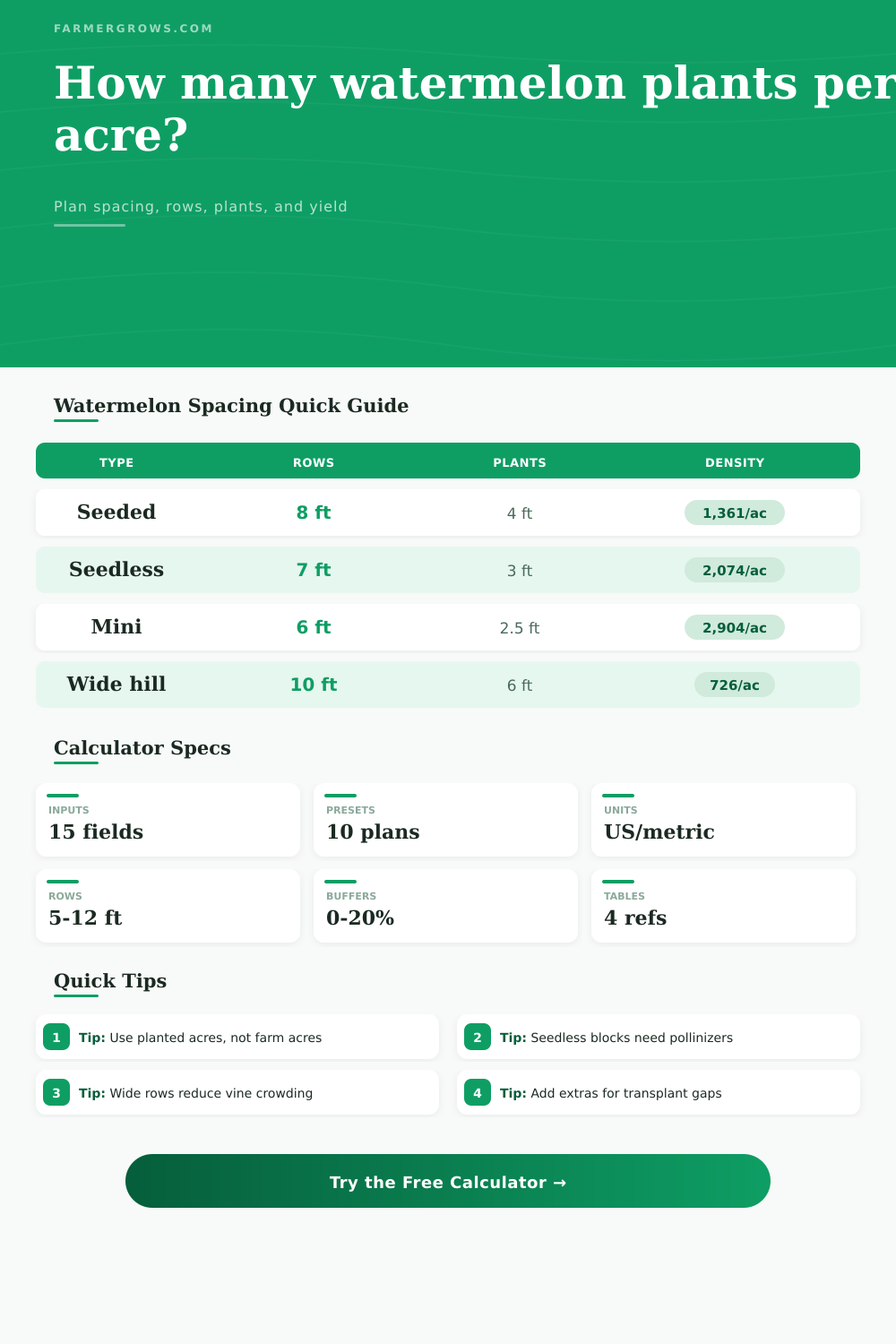
Watermelon Plants Per Acre Calculator
Estimate watermelon plants per acre from row spacing, in-row spacing, hills, usable field area, seedless pollinizers, transplant survival, and yield assumptions.
Use net planted acres for the most useful population estimate. Headlands, roads, irrigation headers, turning areas, and field edges can reduce the watermelon stand that actually fits inside a gross acre.
Watermelon Plant Population Results
Calculated from row spacing, in-row spacing, planted area, and stand assumptions.
| Row spacing | In-row spacing | Stations per acre | With 2 plants per hill | Common use |
|---|---|---|---|---|
| 6 ft | 2.5 ft | 2,904 | 5,808 | Mini or intensive transplants |
| 7 ft | 3 ft | 2,074 | 4,149 | Dense seedless or plasticulture |
| 8 ft | 4 ft | 1,361 | 2,723 | Seeded and seedless market blocks |
| 9 ft | 5 ft | 968 | 1,936 | Large-vine seeded varieties |
| 10 ft | 6 ft | 726 | 1,452 | Wide hills or low-density dryland |
| Pollinizer plan | Pollinizer share | Fruiting share | Example at 2,000 plants | Planning note |
|---|---|---|---|---|
| Diploid seeded | 0% | 100% | 2,000 fruiting | No separate pollen source needed |
| One in five | 20% | 80% | 1,600 + 400 | Common seedless layout target |
| One in four | 25% | 75% | 1,500 + 500 | Strong pollen coverage for triploids |
| One in three | 33% | 67% | 1,340 + 660 | Used when pollen risk is high |
| Planting stock | Survival to use | Buffer range | Calculator use | Field cue |
|---|---|---|---|---|
| Greenhouse transplants | 90% to 96% | 5% to 15% | Order trays or cells | Good for seedless stands |
| Direct seeded | 70% to 90% | 10% to 20% | Order seed units | Adjust for germination and thinning |
| Dryland hills | 75% to 88% | 10% to 20% | Order extra seed | Emergence can vary by moisture |
| Plastic mulch drip | 92% to 98% | 5% to 10% | Order fewer extras | Uniform water improves stand |
| Gross field size | At 80% planted | At 90% planted | Plants at 1,500/ac | Plants at 2,200/ac |
|---|---|---|---|---|
| 0.25 acre | 0.20 ac | 0.23 ac | 300 to 338 | 440 to 495 |
| 0.50 acre | 0.40 ac | 0.45 ac | 600 to 675 | 880 to 990 |
| 1.00 acre | 0.80 ac | 0.90 ac | 1,200 to 1,350 | 1,760 to 1,980 |
| 5.00 acres | 4.00 ac | 4.50 ac | 6,000 to 6,750 | 8,800 to 9,900 |
For seedless fields: Count pollinizers separately from fruiting triploid plants. If pollinizers replace planting stations, fruiting plants per acre will be lower than total plants per acre.
For hill planting: Enter the distance between hills as in-row station spacing, then enter the final thinned plants per hill. The calculator multiplies stations by final plants.
There is a bag of seeds, a patch of dirt, and the promise of summer fruit. Sounds simple enough. But as with all growing, there is more to it then meets the eye. With watermelons, there is more to it even than planting seed in the earth.
How many plant do you sow? When? Where? Survival rate, pollen, those are just some of the factors that determines whether you’ll have a few nice fruits or a jumble of sickly ones. Plant count can make difference between success and failure…small, but big on your bottom line.
How to Grow Watermelons
We’re used to thinking about gross acreage: the amount of land you possess or rent. It’s the wrong figure for planting purposes. Turning areas, irrigation headers, and headlands eat up space your vines won’t ever touch. What you want is the net planted area; the actual square footage you’ll get fruit from. The calculator does that. It lets you adjust for usable area by stripping out dead zones. It also reflects your actual population density.
Planting based off gross acres, you will inevitably crowd the viable rows. Your fruit will be smaller, your humidity higher, and it invites fungal rot.
How does it change the equation? Watermelon varieties differ; kind of melon matters. With seedless types (sterile), you’ll want to plant some plants with two sets of chromosomes for the watermelon to get its pollen from, and with seeded ones (where each plant makes fruit) there’s no guessing. One plant make a melon (easy).
The other lever: density. You can gets more plants per acre by making spacing tighter, such as with two-and-a-half-foot station-to-station and six feet between rows. This is good for personal- or mini-sized melons, which has a lighter fruit load on smaller vines. It is not so good for big-seeded kinds that sprawl around. If crowded, their foliage blocks each others’ air flow and makes harvest impossible.
The tool’s reference tables lays out standard spacings, ranging from wide hill planting for dryland crops to very tight spacing with dense plasticulture. These are not simply numbers, but the result of years of agronomic tests to strike the right balance between vine cover and fruit size.
The last variable is transplant survival. If you start seed in a greenhouse, it will be very high (often above ninety percent). With direct sowing, it’s risky (unless your weather and soil conditions is perfect), and it depends on whether the soil is moist and relatively warm when seeds go down. Always order a few extra, just in case, to fill in any gaps (you don’t want holes left bare, or weed-choked areas that takes food away from your melons). To make sure you have an even stand of plants, you should of ordered ten to fifteen percent more than your desired number.
The number of melons per surviving plant determines the yield estimates; a typical marketable yield range from one point two to one point eight fruit per plant. Multiply this by your final stand, adjust according to an average fruit weight, and you have a tonnage estimate. It is a rough guide but it’s still good for storage and labor planning.
Farming watermelons is a game of percentages and inches. Respect what’s usable. Account for the pollinators. Get the spacing right, and you’ll give your crop the best shot at thriving. The math clears the path. It’s still up to you to grow.
Begin with space; fill it wisely.