Grape Vines Per Acre Calculator
Estimate vineyard vine density from row spacing, vine spacing, planted-acre efficiency, row-end loss, survival, order buffer, trellis posts, wire runs, drip emitters, and realistic yield range.
Choose a starting vineyard layout, then adjust acreage, planted-area deduction, row spacing, vine spacing, trellis type, survival, replacement reserve, emitters, and yield assumptions for your block.
Vineyard Density Results
Enter vineyard spacing and area to estimate vine density.
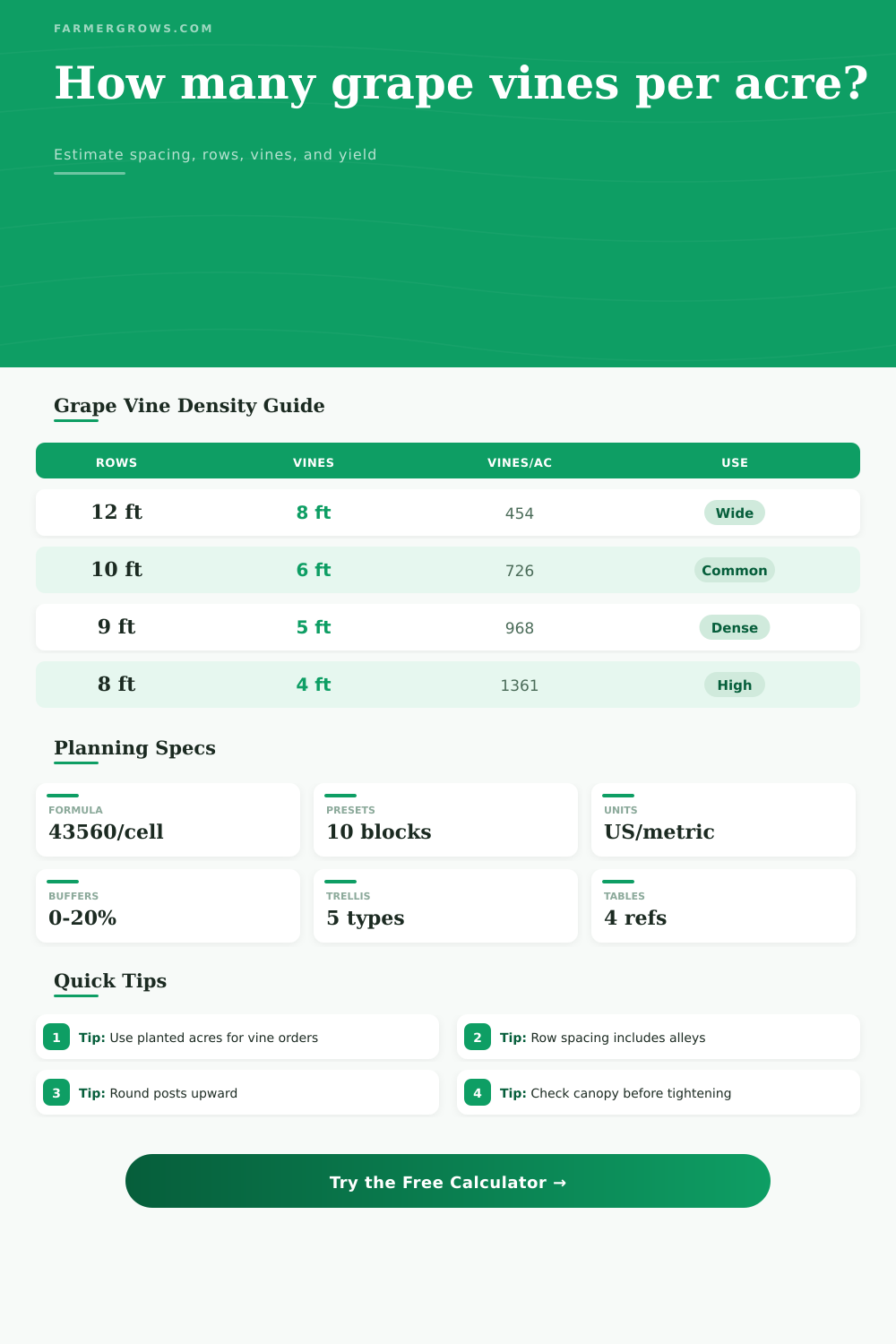
| Row x Vine Spacing | Cell Area | Vines Per Acre | Vines Per Hectare | Typical Use |
|---|---|---|---|---|
| 12 x 8 ft or 3.7 x 2.4 m | 96 sq ft | 454 | 1,121 | Wide table grapes, large canopies, equipment access |
| 12 x 6 ft or 3.7 x 1.8 m | 72 sq ft | 605 | 1,495 | Wide vineyard rows with moderate vine vigor |
| 10 x 6 ft or 3.0 x 1.8 m | 60 sq ft | 726 | 1,794 | Common wine grape planning density |
| 10 x 5 ft or 3.0 x 1.5 m | 50 sq ft | 871 | 2,152 | Balanced VSP with moderate vigor |
| 9 x 5 ft or 2.7 x 1.5 m | 45 sq ft | 968 | 2,392 | Dense wine block with canopy control |
| 8 x 4 ft or 2.4 x 1.2 m | 32 sq ft | 1,361 | 3,362 | High-density planting, strong management required |
| Trellis System | Typical Wire Runs | Post Spacing | Best Fit | Calculator Uses |
|---|---|---|---|---|
| Vertical shoot positioning | 4 wires | 20 to 28 ft | Wine grapes with upright canopy | Wire length and line post count |
| High cordon | 3 wires | 24 to 32 ft | Juice grapes and mechanically managed rows | Lower wire count, wider post spacing |
| Lyre or divided canopy | 6 wires | 20 to 26 ft | Vigorous sites needing divided foliage | Higher wire takeoff per row foot |
| Table grape arbor | 8 wires | 18 to 24 ft | Overhead or cross-arm table grape systems | Large wire estimate and closer posts |
| Nursery training wire | 2 wires | 16 to 24 ft | Young vines, trials, and propagation rows | Starter trellis takeoff |
| Block Plan | Spacing | Usable Area | Approx Vine Sites | Nursery Order At 10% |
|---|---|---|---|---|
| Quarter-acre backyard wine block | 9 x 5 ft | 85% | 206 vines | 241 vines at 94% survival |
| One-acre common wine block | 10 x 6 ft | 88% | 613 vines | 718 vines at 94% survival |
| Five-acre machine harvest block | 12 x 6 ft | 90% | 2,613 vines | 3,058 vines at 94% survival |
| One-acre high-density VSP | 8 x 4 ft | 86% | 1,124 vines | 1,315 vines at 94% survival |
| Vineyard Type | Lower Yield | Upper Yield | Density Note | Planning Use |
|---|---|---|---|---|
| Premium wine grapes | 3 lb/vine | 8 lb/vine | Often tighter spacing | Quality-focused crop estimates |
| Balanced wine grapes | 6 lb/vine | 14 lb/vine | Moderate vigor sites | General vineyard budgeting by tonnage |
| Juice grapes | 12 lb/vine | 24 lb/vine | Wider rows common | Machine harvest planning |
| Table grapes | 15 lb/vine | 35 lb/vine | Large canopy footprint | Picking labor and packing estimates |
For ordering: Base nursery quantities on plantable vine sites, then add survival and buffer. Keep replacement reserve visible as a separate management number.
For layout: Row spacing is center-to-center. It includes equipment alleys, canopy width, spray access, row-end clearance, and erosion or drainage set-backs.
You are planting a vineyard. Everyone imagines this act involve selecting which grapes to plant. That’s the romantic bit; that’s the easy bit.
The difficult task is creating the grid before any root hits the ground. How many vines per acre? And here’s where everything changes, because if you’re off by just a few plants per acre, you’re either purchasing air or elbowing for space with your own canopy. For the next four decades. Once you input the size of your block and rows, the calculator does the rest, no need for guesswork on coefficients and conversions.
How to Plan Your Vineyard Layout
How wide should the rows be? Twelve-foot alleys seem wide enough if you’re walking down them, but that same space take away from your planted area; you can fit only so many bins of grapes in there before tractor’s mirror clips something. Six feet (or perhaps even seven) means you’ll squeeze more vines onto an acre but you’ll have a tunnel of vines that will be dark and humid and invite disease. There’s no free lunch here; it’s a matter of maximizing plants vs. Providing ample room for machines.
If you look at the reference table on the page, you see why industry-standard ten- by six feet is just that, standard. It’s got enough width to clear machinery yet enough vines to make sense. Now we get to the spacing between the vines, within each row. That’s where yield math really happens.
Space the vines too closely together and they starts competing for sunlight and nutrients. You’ll spend all your time trimming things back and trying to thin the canopy, yet you still won’t grow healthy fruit. Space it out too far, though, and you’re paying for ground that isn’t doing anything. With the tool you can set this exactly right.
You can take into account any odd shapes in the blocks, as most aren’t perfect rectangles, and the loss at both ends of the row. There will be drainage ditches, headlands, and then there is the weird corner by that damn oak tree. It’s the most common error new growers make: ignoring these strips that are unusable for growing vines. They’ll buy enough vines for gross acreage. Then they suddenly realize there are fifty left sitting in a nursery pot, drying out because they’re not sure what to do with them.
Hidden expenses also include trellis materials, which increase as the planting gets denser. More vines = more wire + more posts. If the block is high density, that’s a strong structure to carry weight of all those fruit, and the force of the wind. Whether you’re doing vertical shoot positioning or something like a wider cordon, the calculator break down the wire runs and the post counts accordingly. It’s not just about supporting the plant; it’s about erecting a skeleton that won’t buckle under pressure of a good vintage.
And don’t neglect the buffer. Plants die. And nurseries sell them by the box. That’s just how it is. A hundred percent isn’t realistic; that’s optimism bordering on negligence. Add an order buffer and some replacement reserve to equation with the tool. Ten extra vines are better than ten empty holes. Empty holes turn into weeds, then problems.
And this is where money comes into it: How many pounds of grapes will each vine produce? It produces eight pounds in an off year and perhaps fourteen in a good one. Seven-hundred vines times eight or fourteen equals what? That is quite a lot of weight. But there’s more to yield than quantity. There’s also quality. Vines growing shoulder-to-shoulder tend to bear fruit that has been watered down by too much leafy tissue (less complex in its flavor).
Building out a vineyard is all about restraint. As much vine as your soil will bear (but no more), that’s how many vines you plan for. The math is straightforward, but the judgment calls are the hard part. How big will the mature vines be? How do they fit into the space? Will you leave room for a tractor to travel up the alley? What about the rain on the foliage or the wind in the wire? The bare stick you’re planting now isn’t the same thing as the vine it becomes. So you need to imagine that. Then there is the matter of actualy digging it up.