Corn Plants Per Acre Calculator
Convert corn stand counts into plants per acre, compare final stand with target, estimate seed drop spacing, seed units, field totals, and a quick yield sensitivity range.
Use live, harvestable plants for stand checks after emergence is mostly complete. Count several representative row sections, then adjust the target, germination, field loss, and seed unit size to match your hybrid and planter plan.
Corn Plant Population Results
Calculated from row spacing, stand count, and seed-rate inputs.
| Row spacing | Row feet per acre | Plants per foot at 28k | Plants per foot at 34k | Kernel spacing at 34k |
|---|---|---|---|---|
| 15 inches | 34,848 ft | 0.80 | 0.98 | 12.3 inches |
| 20 inches | 26,136 ft | 1.07 | 1.30 | 9.2 inches |
| 22 inches | 23,760 ft | 1.18 | 1.43 | 8.4 inches |
| 30 inches | 17,424 ft | 1.61 | 1.95 | 6.1 inches |
| 36 inches | 14,520 ft | 1.93 | 2.34 | 5.1 inches |
| 38 inches | 13,755 ft | 2.04 | 2.47 | 4.9 inches |
| Target final stand | Kernels/ac at 90% | Kernels/ac at 85% | 80k units/100 ac | Common use |
|---|---|---|---|---|
| 24,000 plants/ac | 26,667 | 28,235 | 35.3 units | Dryland or stress-limited fields |
| 30,000 plants/ac | 33,333 | 35,294 | 44.1 units | Moderate grain stand |
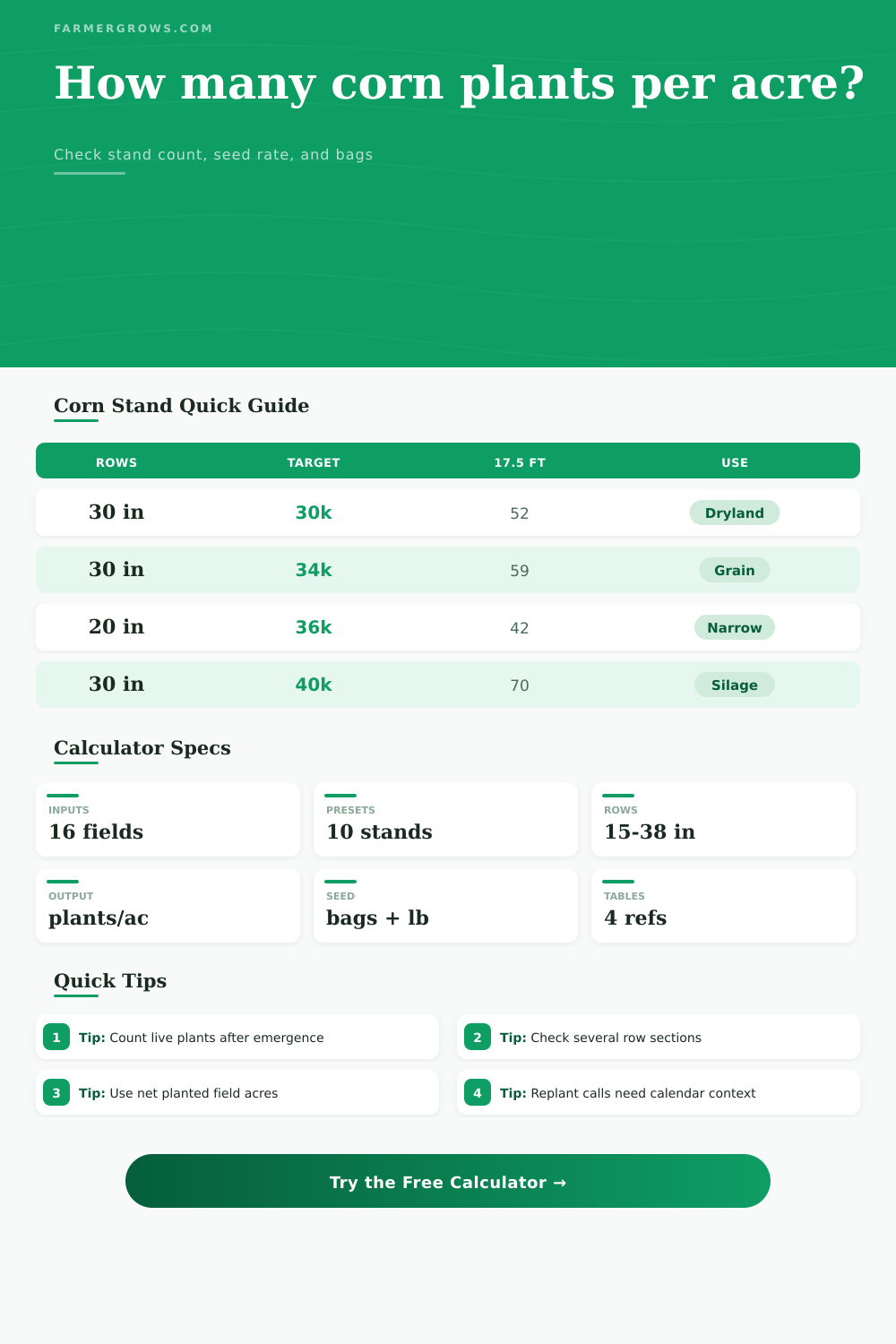
| 34,000 plants/ac | 37,778 | 40,000 | 50.0 units | Common grain target in strong fields |
| 38,000 plants/ac | 42,222 | 44,706 | 55.9 units | High yield or irrigated grain |
| 42,000 plants/ac | 46,667 | 49,412 | 61.8 units | Silage or very high biomass systems |
| Stand check method | Area represented | Fast formula | Best use |
|---|---|---|---|
| Rows and length | Row spacing x row length | Plants / sq ft x 43,560 | Most flexible scouting method |
| 17.42 ft at 30 in | 43.55 sq ft | Plants x 1,000 | Fast 30 inch grain corn shortcut |
| 1/1000 acre row | Depends on row width | Count x 1,000 | Use the correct row length per spacing |
| Metric row check | Spacing m x length m | Plants/m² x 10,000 | Plants/ha stand conversion |
| Observed stand | General interpretation | What to check next | Calculator cue |
|---|---|---|---|
| At or above target | Stand is dense enough for the plan | Doubles, lodging risk, fertility demand | Excellent |
| 90% to 100% of target | Usually a workable emerged stand | Uniformity, skips, weak areas | Adequate |
| Near replant floor | Decision depends on date and gaps | Calendar, hybrid maturity, plant health | Borderline |
| Below replant floor | Thin stand needs a closer review | Patch size, survival, replant yield penalty | Review |
For stand counts: Sample enough row sections to represent good, average, and weak areas. A single perfect row can make the field look better than it is.
For seed planning: Use net planted acres, not farm acres. Remove headlands, waterways, lanes, and skips when ordering or checking seed units.
When we walk the field after emergence, it’s not like when we plant. Then, it was all about seed tags and planter settings. Now, it’s about the actual livig thing that came up from what was in ground. Your whole season hinges on the difference between what you sowed and what stands before you. Why count those plants? Because that’s the point where intent meets reality.
The one thousandth acre trick is a handy shortcut and most growers use it. They measure 17.42 feet of a 30 inch row, they count up all their live plant, they multiply that number by a thousand, and voila! This is the population. The calculator above does that math for you. Just put in your sample length and row spacing; then let it do its thing. At once it takes that raw count and turns it into a per acre figure.
Why Count Your Plants?
That’s nice, but what’s really valuable? It is not so much the number itself, but how it compares to your target. Did I meet my mark or not? Am I within five percent? Am I looking at a thin stand where I’d better replant or not?
Germination is only half of the battle; factors like soil and insects also impact your survival rate. If you’re sowing in cool soils or heavy clay, you’ll have a poorer chance at getting a good stand. If you’re sowing in cool soils or heavy clay, you’ll have a poorer chance at getting a good stand. You might think, “I got ninety five percent germination out of the bag.” Okay, fine. True. But the bag doesn’t talk to the soil. Crusts, insects and double plant gnaw at it before ever seeing the leaf surface. The tool allows you to make up for such losses on the field.
You must accept the fact that sowing 40 kernels per acre doesn’t necessarily equal 40 plants come emergence time. You sow enough to cover the dead ones. And that’s where folks go off track. They make plans based off ideal circumstances, then wonder why things go wrong when the situation isn’t perfect.
The geometry of the problem also is affected by row spacing. Why do we use 30 inch row spacing? Because it’s a good size. It works well with most equipment. Switching to 20 inch rows would increase the number of row feet per acre. Also, the rows would be closer together. That impacts the space between each kernel in the row. Your target population matches a physical distance between seeds. The planter meter operates within that geometry.
If you want a stand of 34 thousand plants on 30 inch rows, seed must be dropped about six inches apart; or so the calculator will tell you. Narrower rows require tighter drops to reach the same density. It’s simple geometry, but it does impact how the planter meter will perform. Too tight and you get doubles. Too loose and you get skips. Either destroys yield potential.
The other side of the coin is the amount of seed to buy. How many bags? Before you get out of the store, you ought to know. It figures the number of seed unit you need per net acre. And by the way, it says net acreage. No, you don’t plant the waterways. No, you don’t plant the headlands. It is a waste of money and seed to calculate for gross acres. Maybe it doesn’t matter much on a ten acre field. On a thousand acres, it matters. Use the right sized field. This lets you buy enough seed for what you actualy plan to grow without paying extra for areas you won’t be planting.
The last check comes in the form of yield estimates. Based off kernel density and ear count, it’ll give a range. It is not a prophecy. It is a sensitivity test. You want to know if those plants will be able to compensate by growing bigger ears, especially if your stand is thin. Often they do. Corn’s a resilient crop. But there’s a floor. When the population gets down into a certain range, no matter how big you make the ears, you’re not making up for that lost biomass. The tool alerts you when you start to approach that danger zone. And it gives an estimate of your yield swing, or how much difference exists in the stand you have.
The bottom line: That’s the point, eliminating guessing at the scouting game. You take a random number of plants out of the ground and convert that into a plan of action for the rest of the year. Knowing how many stands exist is key to making decisions on replanting, adjusting fertilization plans…whatever. Measure, know, manage. What you don’t know can definitely end up hurting you. Numbers speak volumes. Listen to the story they’re telling before the season ends with one of its own.