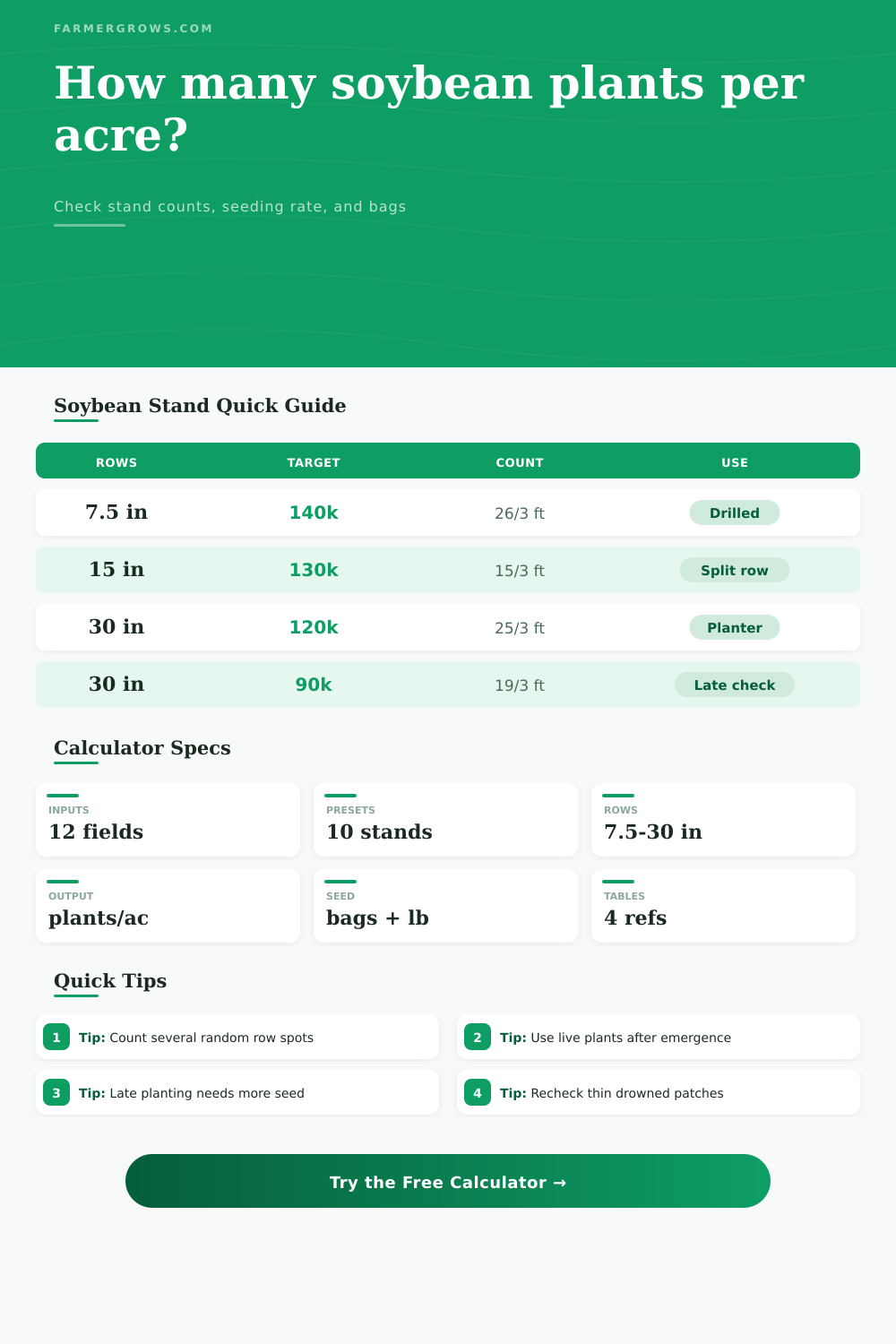
Soybean Plants Per Acre Calculator
Convert soybean stand counts into plants per acre, compare the stand with your target, estimate seed drop, and size bags or pounds for a field.
Choose a realistic field situation, then adjust row spacing, sample counts, expected establishment, and acres to match your planting or post-emergence stand check.
Soybean Plant Population Results
Calculated from row spacing, live plants counted, and total sampled row length.
| Row spacing | Row feet per acre | Plants per foot at 100k | Plants per foot at 140k | Field use |
|---|---|---|---|---|
| 7.5 inches | 69,696 ft | 1.43 | 2.01 | Drilled or very narrow soybean stands |
| 10 inches | 52,272 ft | 1.91 | 2.68 | Narrow-row air seeder or drill setup |
| 15 inches | 34,848 ft | 2.87 | 4.02 | Split-row planter, common high-yield setup |
| 20 inches | 26,136 ft | 3.83 | 5.36 | Intermediate row planter spacing |
| 30 inches | 17,424 ft | 5.74 | 8.04 | Wide-row planter or cultivation-friendly rows |
| Final stand goal | Seeds/ac at 90% | Seeds/ac at 85% | Seeds/ac at 80% | Where it fits |
|---|---|---|---|---|
| 100,000 plants/ac | 111,111 | 117,647 | 125,000 | Excellent conditions, lower-rate trials |
| 120,000 plants/ac | 133,333 | 141,176 | 150,000 | Common planter target in many fields |
| 140,000 plants/ac | 155,556 | 164,706 | 175,000 | Narrow rows, variable emergence, early planting |
| 160,000 plants/ac | 177,778 | 188,235 | 200,000 | Late, double-crop, or difficult seedbeds |
| Sample method | Area represented | Fast formula | Best practice |
|---|---|---|---|
| Rows and length | Row spacing x row length | Plants / sampled area x 43,560 | Use several random row segments across the field |
| 3 ft row check | Spacing in feet x 3 ft | Count x 14,520 / row spacing ft | Quick scouting after full emergence |
| 17.42 ft at 30 in | 43.55 sq ft | Count x 1,000 | Easy wide-row population shortcut |
| Metric row check | Spacing m x length m | Plants / m² x 10,000 | Convert plants/ha to plants/ac if needed |
| Observed stand | General interpretation | What to check next | Calculator cue |
|---|---|---|---|
| Above target | Stand is dense enough for canopy | Lodging risk, disease pressure, seed cost | Excellent or adequate |
| 85% to 100% of target | Usually a workable stand | Uniformity, skips, pest injury | Adequate |
| Near replant floor | Decision depends on date and gaps | Calendar, weed pressure, surviving plants | Borderline |
| Below replant floor | Thin stand deserves a closer look | Patch size, stand health, replant seed rate | Replant review |
Count live plants, not seedlings hoped for. Take samples after emergence is mostly complete, avoid field edges, and include weak areas when they represent real acres.
Use population with spacing and uniformity. A fair plants-per-acre number can still hide long skips, crusted zones, ponded spots, or planter-row problems worth mapping.
When the combine gets rolling, though, you learn that it’s not the seed, but the soil itself that determines yield. It’s almost silent work. Long before anybody else see the field, you’re working on the soil.
Sure, you plant an immaculate acre of soybeans, but fail to hit the right stand count early and guess what: Measurable mediocrity awaits. Simple math with enormous pressure: Did the seeds become plants? And did enough survive to leave this field be?
Why Counting Plants Matters for Farming
But the truth is: it’s not so simple. Because the ground isn’t flat, which means counting isn’t either. There will be thick patches, where everything looks nice and green (but what does that tell you? It tells you nothing about thin areas up by the fence line or the crusty mud behind the planter. You’ve got to get down on your knees. Pick a spot, measure a row, then count the plants. Live ones.
That’s where most folks mess up. They count seeds in the furrow; they guess based off how dense it looks. You need live stems. The above calculator does all this for you, it converts that handful of numbers into real life, on an acre scale. Take the guessing out of above/below.
The math shifts when it comes to row spacing. For example: When you make rows wider (thirty inches), you must have a higher plant count per foot to achieve the same population as narrower rows (seven-and-a-half inches). It list the number of plants you’d plant per foot of row for various spacings.
See? It is a matter of geometry. Fewer rows per acre means each of those remaining rows needs to carries more weight. That’s one reason a narrow-row set-up will appear thinner to the naked eye, even though there are more total plants. The tool accounts for that automatically. You don’t have to bend over in the dirt to do the arithmetic yourself.
Soil conditions determine how much you can get into the ground. Theory says you might go with one hundred and thirty thousand plants per acre, but experience shows that the establishment rate of those plants will be different than expected. And sometimes it’s best to up the seeding rate when emergence might be poor because conditions are cold and wet. The calculator allows you to enter an expected establishment percentage.
In other words, it connects the dots between seed bag and final stand. It is a little thing, but it matters. If you don’t consider this factor, you’re planting for a perfect world, not the one out your window.
Another thing to watch out for is seed size. A hundred thousand sound like a lot of seeds, but what if they’re tiny? Then you’re putting less poundage on the ground than you thought. The tool will convert your number of seeds to pounds and even bag units. That’s how you load and buy the seed. It will help you see the logistics and cost.
And it’s not just about numbers anymore, it’s about inventory management. You have a forty-acre field, so you know exactly how many bags you’ll need… Three and a half. This is better than knowing you need a hundred and sixty thousand seeds.
The most difficult part is deciding if I need to replant or not, though the tool doesn’t make that decision for me. In reality there isn’t some magic number that works across the board. Several factors goes into this decision, such as your planting date, weather conditions (like if it was dry and warm), and how many weeds were in your stand.
The replant concern floor is the warning light on the calculator. It tells you, ‘You may want to take a closer look.’ If you are above the floor, you probably can let the stand go. Below the floor you should of taken a closer look. The tool does not make the decision for you. It provides the data for you to make an informed decision without panicking.”
Precision farming is paying close attention to details. You must measure as much as possible and rely on math to make up for things that aren’t measurable. If you listen to the numbers early enough, they will tell you all about what your field could be like. Do this before it gets too late and the plants gets too big to cover their tracks.