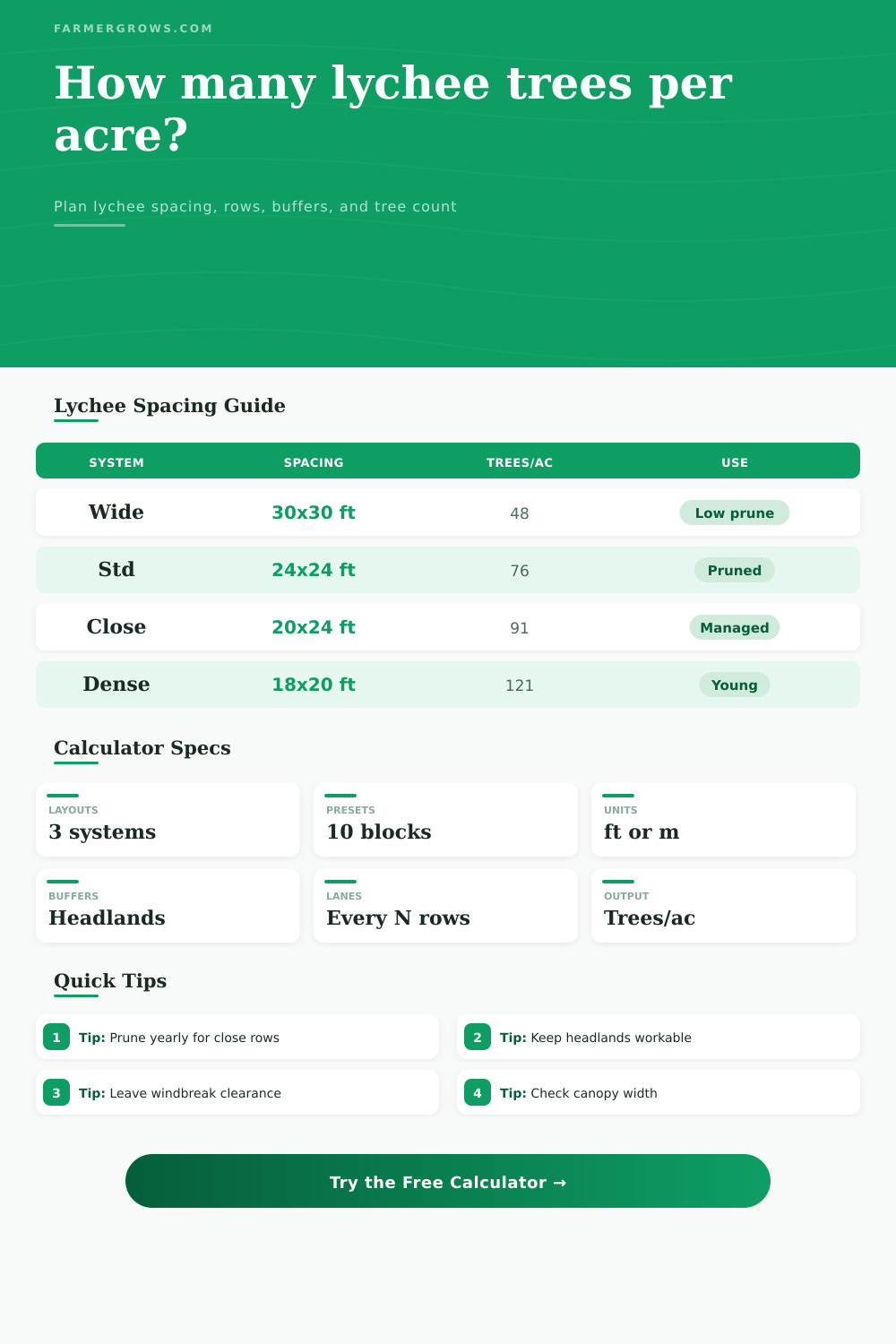
Lychee Trees Per Acre Calculator
Estimate lychee orchard density from tree spacing, row spacing, planting pattern, headlands, service lanes, windbreak clearance, and mature canopy management.
Pick a real lychee block style, then fine tune the acres, shape, row lanes, pruning width, and spacing. Commercial lychee plantings often land near 50 to 100 trees per acre when annual pruning keeps the canopy controlled.
Lychee Orchard Density Results
Your lychee spacing plan is calculated below.
Easiest to mark, mow, irrigate, and prune. Use this for most commercial lychee rows.
Adds about 15% more planting positions at the same spacing but complicates access and irrigation layout.
Useful for hedgerows, trial strips, or narrow fields where row count matters more than acre density.
| Lychee spacing | Square grid trees/ac | Triangular trees/ac | Management note |
|---|---|---|---|
| 30 ft x 30 ft | 48 | 56 | Low pressure on pruning, easy equipment movement, slower acre fill. |
| 25 ft x 25 ft | 70 | 80 | Balanced spacing for vigorous sites and mature canopy room. |
| 24 ft x 24 ft | 76 | 87 | Good commercial baseline when trees are pruned after harvest. |
| 20 ft x 24 ft | 91 | 105 | Works with planned height control and clear picking alleys. |
| 20 ft x 20 ft | 109 | 126 | High density; canopy closure must be managed deliberately. |
| 18 ft x 20 ft | 121 | 140 | Young orchard or intensive block, with future thinning possible. |
| Planning allowance | Typical range | Use in calculator | Why it matters |
|---|---|---|---|
| Headland at row ends | 15 to 35 ft | Subtracts from row length | Leaves turning room for mowers, sprayers, carts, and harvest bins. |
| Side buffer or windbreak clearance | 10 to 25 ft | Subtracts from block width | Keeps lychee canopies away from fences, shade, and windbreak roots. |
| Service lane every N rows | 4 to 8 rows | Reduces row count | Creates access for harvest, pruning, and airblast or utility equipment. |
| Usable planted area | 85% to 96% | Adjusts known-acre mode | Accounts for roads, drainage, pump pads, non-square fields, and setbacks. |
| Canopy target | Best spacing fit | Clearance goal | Pruning implication |
|---|---|---|---|
| 16 ft canopy | 20 to 24 ft rows | 4 to 8 ft alley | Annual skirt and side pruning keeps harvest access open. |
| 18 ft canopy | 24 to 25 ft rows | 6 to 7 ft alley | Practical managed orchard size for many pruned lychee blocks. |
| 22 ft canopy | 25 to 30 ft rows | 3 to 8 ft alley | Give vigorous sites wider rows or accept more pruning labor. |
| 28 ft canopy | 30 ft plus rows | 2 ft plus alley | Mature shade can reduce flowering if trees are planted too close. |
| Common lychee block | Gross area | Suggested spacing | Approx trees |
|---|---|---|---|
| Backyard grove | 0.25 acre | 25 ft x 25 ft | 15 to 18 trees |
| Small farm block | 1 acre | 24 ft x 24 ft | 65 to 76 trees |
| Close managed acre | 1 acre | 20 ft x 24 ft | 80 to 91 trees |
| Commercial ten-acre block | 10 acres | 24 ft x 24 ft | 680 to 760 trees |
Use close lychee spacing only with a pruning plan. Dense rows can be profitable while trees are young, but mature lychee canopies need light on all sides for flowering, harvest access, and air movement.
Measure the planted block, not just the deeded acre. Roads, canals, windbreaks, well pads, headlands, and odd corners can remove enough area to change the tree order by several dozen trees.
Growing lychees is not easy. Lychee trees need care to be successful: space and light.
One thing in particular: how many should I plant? Where should I put them? When should I plant? How do I know where to plant? These are questions you ask yourself, then answers you seek before buying the tree.
How to Plan Your Lychee Orchard
The right answer balance production against land usage. You should not plant them so closely that you reduce productivity, but you shouldn’t plant them so widely spaced that valuable land is left unused for food or other income. This means more than just dividing available space by area occupied by a young tree. You have to think about size of canopy at maturity; the equipment you’ll use; wind patterns across your property.
There’s even a lychee tree per acre calculator which show you all this in clear terms. It makes abstract concrete.
Rarely does an acre of land equal an acre of planted area.” Yes, fields are edged by roads, dotted with drainage ditches, and interrupted here and there by features that stop fruit growth, like a fence or windbreak. With the tool you can punch in your overall acreage, then subtract buffer zones and headlands; the turning space left between rows for sprayer and mower use at either end. These side buffers exclude shade and competition, too. The calculator adjust for this reality, showing you how many trees actualy fit into the plantable portion of your block rather than theoretical total.
Many novices forget to take this factor into account: They figure they have X number of acres, so they can plant every square inch. Wrong. The calculator accounts for that fact of life. It doesn’t count all those acres; it counts only what’s available for tree-growing within the block.
Long term management depend on tree spacing. For example, if you want big canopy and don’t mind lots of space, you can go with a wide spacing such as 30 feet by 30 feet. That results in around forty-eight trees per acre. Those are trees that will do okay with little pruning. Because there’s plenty of room, they’ll grow without being messed with too often.
On the other hand, if you’re going for the moddern commercial look where you prune tightly year-after-year, you may opt for a tighter spacing, say 24 feet by 24 feet. With this density, you get closer to seventy-six trees per acre. To maintain a manageable canopy, you have to prune every year. And you must prune so that the inside branches gets enough light to start flowers.
You can set your starting spacing as wide or as tight as you wish. Just toggle back and forth to observe the impact on rows and how many tree will fit within the acreage.
Pruning makes high density possible. A high-density plantation without strict pruning will be a tangle of overgrown branches and inedible fruit. The calculator has an option for your pruning profile, which impacts how far apart you should space things. To plant close means to commit to heavy annual trimming. You’re effectively limiting the tree’s spread. For naturaly growth, you’ll need to leave plenty of space between rows. It also makes you think about the hard work you are signing up for. No high density without high maintenance.
Your last tree count also factors in service lanes and headlands. You need wide paths for wide equipment. There is fewer rows per acre. To account for this, you tell the calculator how wide your service lanes are and how frequently you want them inserted. That cuts back the number of planting positions. So you can access the fruit you’re growing. It is better to have fewer trees that you can access than a dense forest that you can’t. The tool will break these numbers out. It shows you how many trees you sacrifice for operational efficiency.
From here you get a pretty good idea of what your orchard will look like. How many rows? How many trees? How much space should be between tree canopies? How many trees should I set aside as reserves in case some don’t make it in their first year or two? (Since some inevitably will). This is all very helpful. And it allows you to stop guessing. And you can start planning.
Experiment with various scenarios. Is there a difference between a lot of trees and not so many? What about wide spaces vs narrow ones? Do buffers decrease the overall density? What about lanes? Try it out, and save yourself the headache, money and time.
Planning is fluid, planting is forever. You should of use it, and plan a lychee orchard that suits your land, your labor, and your trees.