Date Palm Trees Per Acre Calculator
Estimate date palm trees per acre from orchard spacing, planting pattern, productive area, male pollinator ratio, establishment survival, replacement reserve, row count, drip emitters, and expected bunch yield.
Choose a starting layout, then adjust the field shape, road deduction, spacing, pollination plan, reserve palms, survival, emitters, and mature yield assumptions for your block.
Date Palm Planting Estimate
Your date palm density and planting order will appear here.
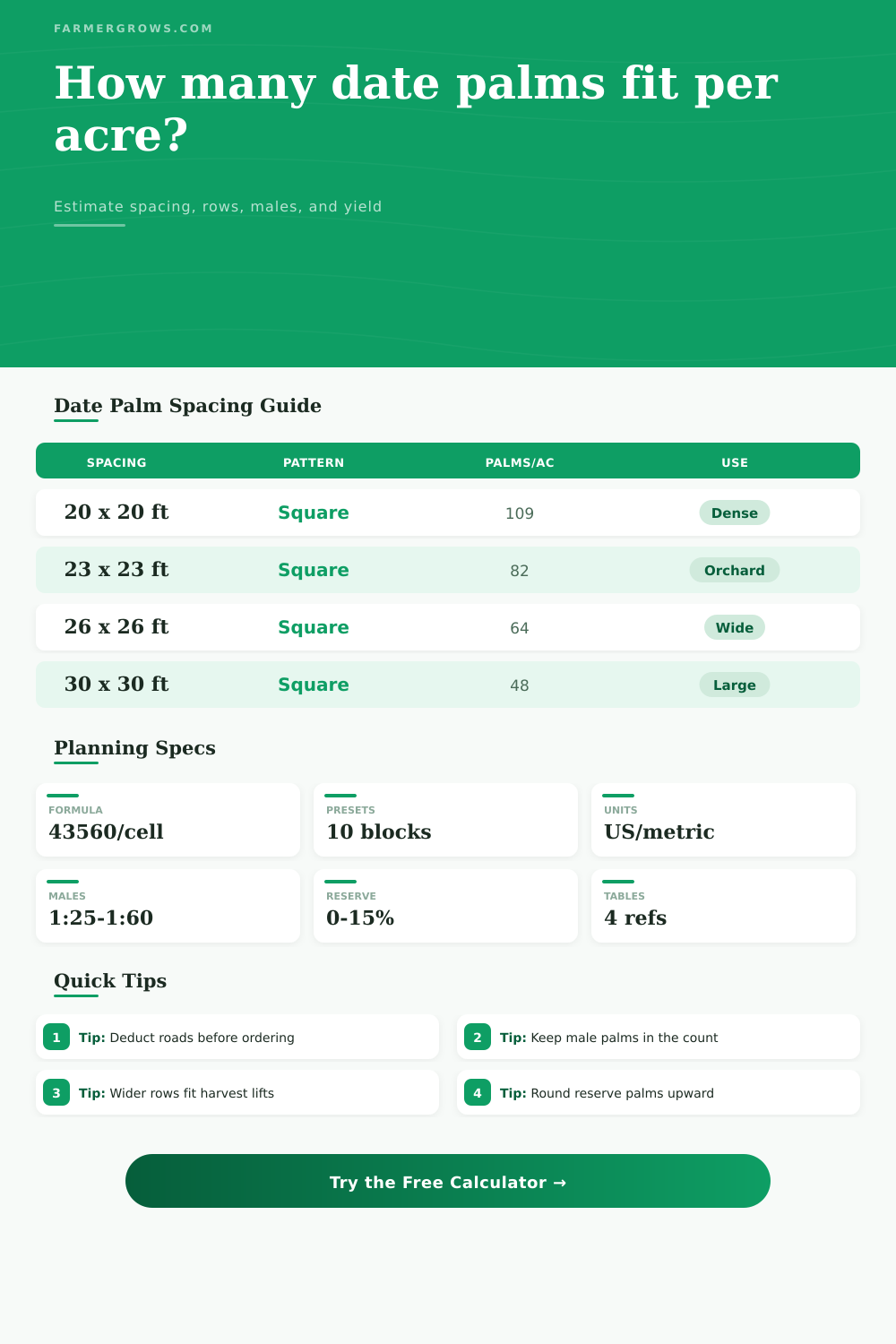
| Spacing | Cell Area | Palms Per Acre | Palms Per Hectare |
|---|---|---|---|
| 20 x 20 ft or 6.1 x 6.1 m | 400 sq ft | 109 | 269 |
| 23 x 23 ft or 7 x 7 m | 529 sq ft | 82 | 203 |
| 25 x 25 ft or 7.6 x 7.6 m | 625 sq ft | 70 | 172 |
| 26.2 x 26.2 ft or 8 x 8 m | 689 sq ft | 63 | 156 |
| 32.8 x 26.2 ft or 10 x 8 m | 861 sq ft | 51 | 125 |
| 30 x 30 ft or 9.1 x 9.1 m | 900 sq ft | 48 | 120 |
| Female Per Male Ratio | Male Share | Use Case | Example In 100 Spots |
|---|---|---|---|
| 25 females per male | 3.8 percent | Conservative pollen plan | 96 female, 4 male |
| 40 females per male | 2.4 percent | Balanced commercial plan | 98 female, 2 male |
| 50 females per male | 2.0 percent | Good pollen and labor timing | 98 female, 2 male |
| 60 females per male | 1.6 percent | Strong pollen supply nearby | 98 female, 2 male |
| Block Plan | Spacing | Field Spots | Order With Reserve |
|---|---|---|---|
| Half-acre small farm, 25 x 25 ft | 70 per acre | 35 palms | 37 palms |
| One-acre Medjool block, 25 x 25 ft | 70 per acre | 70 palms | 74 palms |
| Five-acre 23 x 23 ft block, 8 percent roads | 82 per acre | 378 palms | 397 palms |
| Ten-acre 8 x 8 m block, 12 percent roads | 63 per acre | 554 palms | 582 palms |
| Planning Item | Formula | Why It Matters | Calculator Output |
|---|---|---|---|
| Net planted acres | Gross x usable share | Excludes roads and headlands | Breakdown row |
| Row estimate | Block width / row spacing | Checks row count and layout | Rows card |
| Emitter count | Spots x emitters | Sizes irrigation takeoffs | Rows card |
| Lateral length | Rows x block length | Rough drip lateral planning | Breakdown row |
Spacing note: Date palm spacing is usually set from mature crown size, harvest access, pollination work, soil vigor, and irrigation design. Use the calculator as a layout estimate before staking the field.
Ordering note: Tissue-culture plants and offshoots are normally ordered as whole palms. Round up field spots, male palms, and reserve palms so the planting crew is not short.
Spacing is a tension between density and operational ease that you manage with math. Since each date palm shows its personality over years or even decades, who can be sure when planting them? Too close together, and you’re wasting effort clawing your way around, while also risking blocking sunlight from lower fronds. Too far apart mean leaving money on the table (empty space between productive neighbor). Growers gets trapped in this dance of convenience versus density, which is why having a plan beforehand makes all the differance before ordering offshoots.
The math’s done by the calculator; what you learn about the inputs is the real deal.
How to Space Date Palms
Begin with the spacing pattern, since it determines all else. The classic is the square grid, which accommodates clean movement of pollination equipment (and later harvest lifts) without any collision with trunks. Some people say to use a triangular grid if higher density matter. The math says you can plant fifteen percent more trees, but the challenge of moving through staggered rows usually offsets that benefit. Because of that, most growers stick with squares or rectangles. Straight lines is easier and cheaper to manage over the long term.
This is where theory meets messy reality. Pollination. For this you can specifies a male-to-female ratio (typically between 1:25 to 1:60), which is both a matter of biology and also a labor constraint. Having too many males in your field means it’s wasting space that might otherwise bear fruit. But if you get realy good at timing labor or have good wind pollination, you can push that higher. The calculator will handle the allocation. It makes sure you hold back enough spots for the males so the palms sets fruit and there are enough to make the block realy set.
Don’t neglect the roads and headland deduction. It’s tempting to think you’ll just plant all the way to the fence line, but remember: there has to be room for machines to turn, and water lines must have access. To be realistic (not pessimistic), deduct between eight and twelve percent of your gross acres for infrastructure. That’s the cost of doing business. If you don’t do this step, you’re going to wind up with a nice-looking planting plan on paper but a cramped, inaccessible field when those palms gets big. Your usable acreage number puts things in perspective for you; what you can realy plant as opposed to what you’d like to plant.
Finally, there’s the test of yield. Your own intuition about how your planting was laid out will improve as the tool multiplies your number of females by the number of bunches you expect each to produce. That’s a production target for all the fruit on that acreage. It’s not a promise; it’s a best case scenario based on averages. Still, seeing the numbers lets you know what kind of farm you have: Twenty-five pound bunches off seventy palms per acre is very different than forty-eight palms spread out over an acre (more like an orchard), a lot more space between trees, and a much different kind of logistics. You’ll be able to figure out how big your packing house needs to be. How many people to employ. You can figure out how much storage you will need when the first crop comes in.
Nature is unpredictable; the reserve palms are our insurance, and survival rates. Some plants won’t make it through the establishment period even if we irrigate perfectly. Having a five to ten percent reserve ensures I always have new ones on hand without having to scramble to the nursery mid-season. This little insurance policy pays for itself by maintaining consistent density.
The bottom line is: How many date palms do I plant? It’s a question of accessibility vs. Ambition. Ideally, there are just enough that they’ll repay the investment in land, but not too many that it’s impossible to navigate between them. That number tells you when to stop, but what you’re aiming for is a field that feels full enough (to reward) while remaining open enough (to work). You should of made room for the lift to turn when your first dates start to get ripe.