Oil Palm Trees Per Acre Calculator
Estimate oil palm stand density from triangular, square, rectangular, contour, or avenue spacing, then add road reserves, drains, replacement palms, and survival assumptions.
Start with a common plantation layout, then adjust spacing, roads, drains, and establishment buffers to match the surveyed block.
Oil Palm Density Results
Enter spacing and area to estimate planting density.
Uses a 0.866 row factor because palms sit in staggered equilateral rows.
Useful for quick checking, but it usually holds fewer palms than triangular layout.
Add layout loss for curves, bench edges, erosion strips, and unplantable corners.
Wider collection avenues can lower density while improving harvest movement.
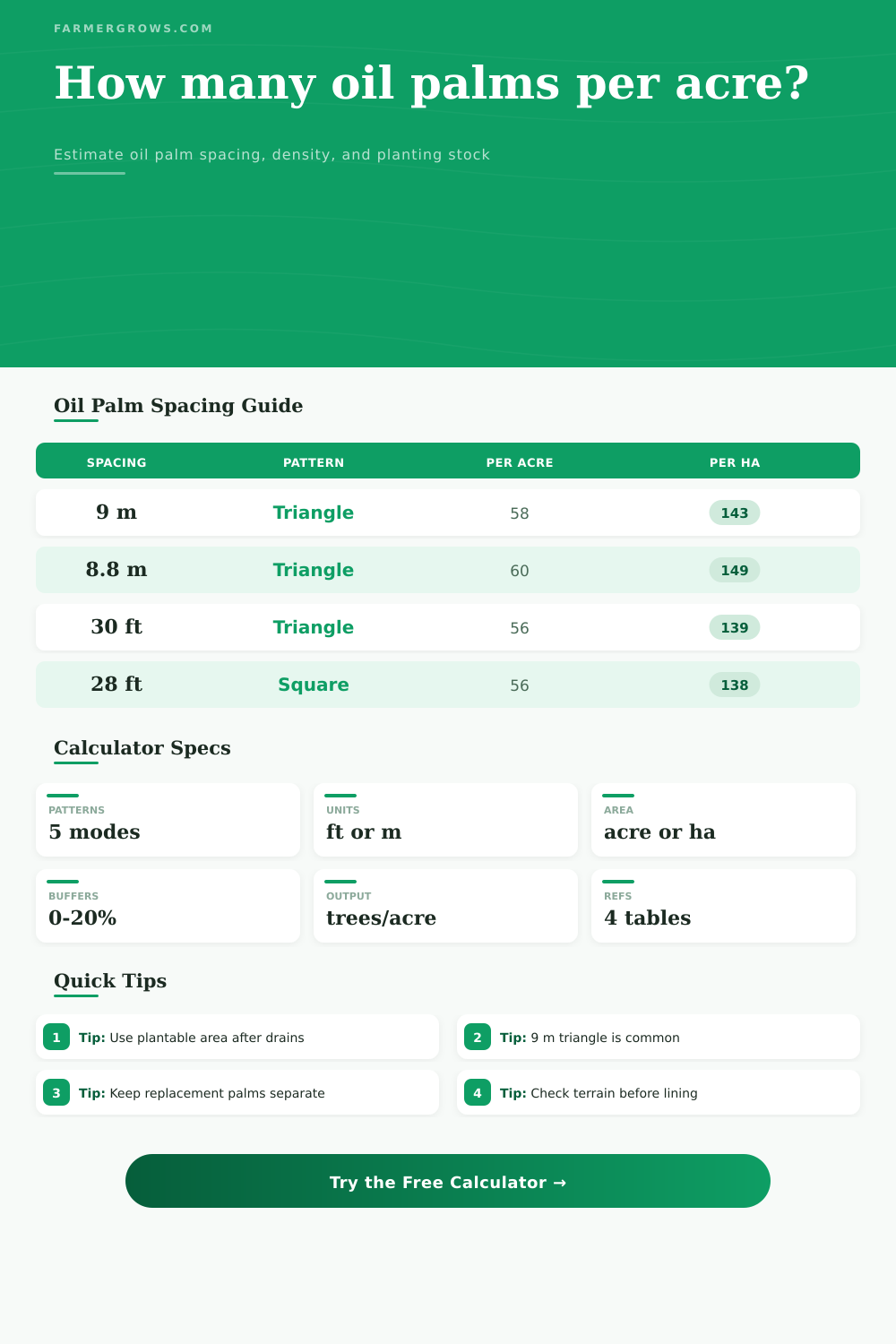
| Spacing | Pattern | Area per palm | Palms per acre | Palms per hectare |
|---|---|---|---|---|
| 9 m x 9 m | Triangular | 70.1 m² | 57.7 | 142.6 |
| 8.8 m x 8.8 m | Triangular | 67.1 m² | 60.2 | 148.9 |
| 30 ft x 30 ft | Triangular | 779 ft² | 55.9 | 138.2 |
| 29 ft x 29 ft | Triangular | 728 ft² | 59.8 | 147.8 |
| 30 ft x 30 ft | Square | 900 ft² | 48.4 | 119.6 |
| 28 ft x 28 ft | Square | 784 ft² | 55.6 | 137.6 |
| Pattern choice | Density factor | Best fit | Calculation note |
|---|---|---|---|
| Triangular or equilateral | 0.866 x spacing cell | Most new oil palm blocks | Highest density for equal spacing and light interception |
| Square grid | 1.000 x spacing cell | Simple boundaries or training blocks | Palms per acre equals 43,560 divided by row x palm spacing |
| Rectangular rows | 1.000 x spacing cell | Mechanical access or uneven widths | Use different row and in-row distances when needed |
| Contour or terrace-adjusted | 1.050 x spacing cell | Rolling and hilly land | Allows extra space lost to curves and terrace edges |
| Double-row harvest avenue | 1.180 x spacing cell | Blocks needing wider collection access | Density drops because avenue land is intentionally opened |
| Block condition | Typical reserve | Extra seedlings | Use in calculator |
|---|---|---|---|
| Clean rectangular mineral soil block | 3% to 6% | 3% to 5% | Low reserve, low replacement allowance |
| Smallholder block with house path and drains | 6% to 10% | 5% to 8% | Default reserve and normal stock buffer |
| Peat or wet block with collector drains | 10% to 18% | 8% to 12% | Higher reserve and higher seedling allowance |
| Steep block with terraces and buffers | 12% to 25% | 8% to 15% | Use contour pattern plus layout loss |
| Project size | Gross area | 9 m triangular base | With 8% reserve | With 8% extra stock |
|---|---|---|---|---|
| Single acre trial | 1 acre | 58 palms | 53 planted palms | 58 seedlings |
| Smallholder field | 5 acres | 288 palms | 265 planted palms | 286 seedlings |
| Medium block | 25 acres | 1,442 palms | 1,327 planted palms | 1,434 seedlings |
| Estate section | 100 acres | 5,768 palms | 5,306 planted palms | 5,731 seedlings |
Calculate from plantable land, not title land. Oil palm blocks lose real area to roads, main drains, waterways, buildings, steep strips, and riparian buffers. Survey those exclusions before ordering seedlings.
Separate replacement seedlings from density. Palms per acre describes the intended field stand; nursery stock includes extras for damaged, dead, weak, or off-type seedlings during establishment.
You’re standing on a piece of surveyed land. What you see: Flat. The calculator sees lost terrain, drains, roads, and reserves. And it’s the gap between what you see and what the calculator sees that will make or break your planting plan, turning it from a budget winner into a budget loser.
Planting density doesn’t simply involve dividing the number of acres by the trunk diameter of each plant. It involves calculating how much of an acre can support a palm. How much terrain has been lost? Where are the roads? Where are the drains? Where are the reserves? That’s the math and geometry of plantable area.
The Math Behind Your Planting Plan
Our tool figures it out for you so you don’t need to do it all in your head.
The 9-meter triangular spacing is where most planners begin. Why? Because it’s an industry standard (and there’s a reason for that). A triangular layout gets more palms in each hectare of land compared to a square grid because the staggered rows utilize the empty space between plants more efficienty. That’s why the calculator’s coefficient is 0.866: that’s the math. At the same distance but switching to a square grid means less density, which directly translates to fewer fresh fruit bunches per hectare.
But it is not just about that. You also need to consider how much land you’re realy working with. That’s why the reserve percentage input is key here. You have a hectare, according to your title deed. But the ground says otherwise. Space gets taken up by main roads. Collection drains gobble up some more. Then there are waterways and buffer zones that take still more. Unless you account for those exclusions, you’ll order fewer seedlings than you need.
That’s what the calculator does. It allows you to subtract a percentage to reflect how much infrastructure space you’re going to need. This way, when the density math is run, the resulting tree number represent only the plantable area, not the gross area. No need to realize halfway into your planting that you forgot about the main collector road and you’re running out of seedlings!
And what about replacement stock? Nothing gets planted and established without loss. Some palms dies because of pests, others because of bad soil prep, still more because they simply get waterlogged. It’s good to have a stockpile of seedling on hand. Include an allowance for them in the calculator (there’s a field for it). Most people use a standard 5 to 8 percent as their buffer. Depending on where you’re planting (on peaty soil, for instance) or how far away the block is (harder logistics), you may wish to go higher.
These additional palms don’t count toward your final number of growing trees; they’re insurance. The tool breaks out your base planting number from your total nursery order (a big difference when budgeting). You’ll pay for the extras but only reap from the survivors.
And then there’s the matter of terrain. Because your block may be situated on a hillside, you can’t use a perfect grid. You’ll need to follow the contour lines so as not to erode, right? In this case, the calculator has a contour mode that includes a layout loss factor. This factor takes into account the weird shapes you create with all those curved lines where you previously had straight ones (the unplantable corners). It is a little thing, yes. But it is important if you’re ordering up thousands of seedlings. Without adjusting for irregularities in your terrain, you get gaps in the canopy; and waste resources doing it.
This is spelled out nicely in the reference tables on the page. For example, they spell out that when you move from 9 meter spacing to 8.8 meter spacing, the density changes. They spell out that a 30-foot triangular spacing has more trees per area then a 30-foot square spacing. This allows you to compare and understand the tradeoffs. More trees if you space them tighter, but less room each tree will have to grow. More competition between trees for nutrients and light, which increases as the trees mature. Wider spacing makes it easier to harvest, but there is less overall yield potential.
The other parameter is the survival rate input. That’s your guess about how many of those palms will survive establishment and be productive at harvest time. If you have good field prep and a high quality nursery, the rate is perhaps 96 percent. In less-than-ideal circumstances, maybe it’ll decline. The calculator takes this into account and predicts the actual productive stand size. Not day one. But what it’ll look like five years from now: What does the plantation realy look like?
Managing expectations vs physical constraints is all planning is. The calculator takes the guessing out of the math for spacing. It makes you think about what you’re planting. It also makes you consider the palms you’ll be losing and the ground you won’t be able to use for planting. Aligning your nursery order with the reality of the ground stops you from fighting the layout. It helps you work with it. And the result is a block that fills the space, growing as intended and wasting no single seedling.