Macadamia Trees Per Acre Calculator
Estimate macadamia trees per acre, plantable rows, nursery order quantity, pollinizer trees, planned thinning, canopy fit, irrigation flow, and mature nut-in-shell yield from orchard spacing.
Choose a starting block, then edit field area, planting pattern, spacing, non-planted area, pollinizer ratio, temporary fillers, canopy size, yield, and drip hardware.
Macadamia Orchard Estimate
Results will update as the block settings change.
| Spacing example | Approx trees per acre | Approx trees per hectare | Planning note |
|---|---|---|---|
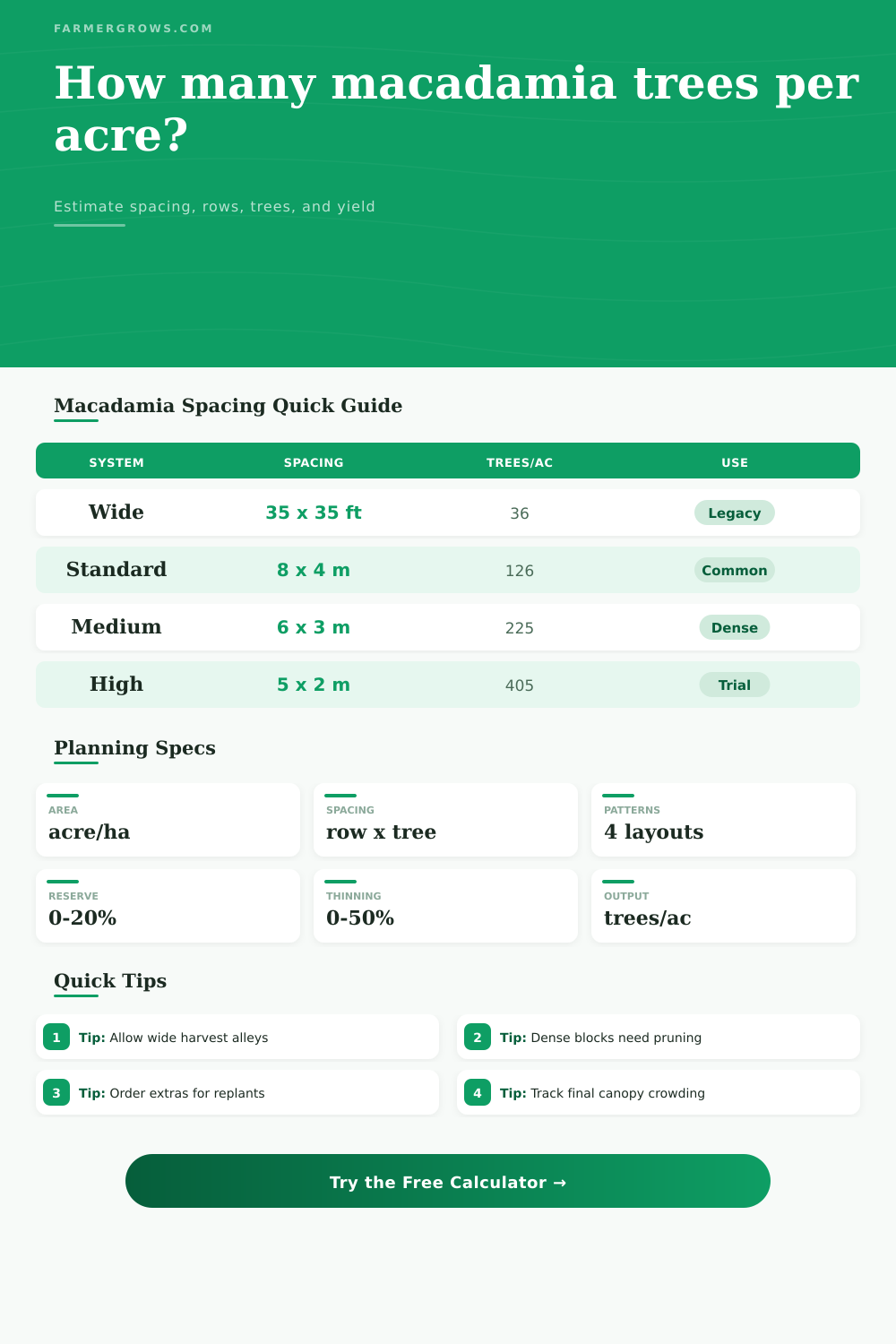
| 35 x 35 ft square | 36 | 88 | Older wide system with large mature canopies and easier equipment access. |
| 25 x 25 ft square | 70 | 172 | Traditional close starter spacing if later thinning is planned. |
| 8 x 5 m rectangle | 101 | 250 | Moderate commercial spacing where pruning still matters after canopy closure. |
| 8 x 4 m rectangle | 126 | 313 | Common standard block density for many modern macadamia plantings. |
| 6 x 3 m rectangle | 225 | 556 | Medium high density; row light, machinery width, and skirting must be planned. |
| 5 x 2 m rectangle | 405 | 1000 | Very high density trial spacing; usually needs intensive pruning and monitoring. |
| Pattern | Effective tree area | Best use | Watch point |
|---|---|---|---|
| Rectangular grid | row spacing x tree spacing | Most commercial row orchards and square blocks. | Headlands and drains should be deducted separately. |
| Triangular grid | row x tree x 0.866 | Staggered blocks seeking more plants at similar center spacing. | Machinery paths and row direction are harder to estimate. |
| Paired hedge | tree x average pair spacing | Intensive blocks with a narrow pair and wider harvest alley. | Do not double-count the alley as a separate road deduction. |
| Custom area | entered sq ft or sq m | Contour plantings, odd grids, terraces, or mapped GPS layouts. | Use the true average tree footprint from the field map. |
| Block | Area | Spacing | Estimated trees |
|---|---|---|---|
| Small farm trial | 1 acre | 8 x 4 m | About 126 before field deductions. |
| Five-acre commercial block | 5 acres | 8 x 4 m | About 630 before roads and reserve plants. |
| Ten-acre medium-density block | 10 acres | 6 x 3 m | About 2250 before headland and contour deductions. |
| Quarter-acre backyard planting | 0.25 acre | 25 x 25 ft | About 17 positions before boundary buffers. |
| High-density one hectare | 1 ha | 5 x 2 m | About 1000 positions before thinning. |
| Wide legacy acre | 1 acre | 35 x 35 ft | About 36 long-term canopy trees. |
| Planning item | Typical input | Calculator output | How to use it |
|---|---|---|---|
| Pollinizer mix | 5% to 15% | Main cultivar and pollinizer count | Pair compatible flowering groups and keep pollinizers distributed. |
| Nursery reserve | 5% to 10% | Extra trees to order | Hold replacements for weak trees, transport loss, or early establishment gaps. |
| Managed canopy | 12 to 30 ft | Row and in-row clearance | Negative clearance means pruning or later thinning is part of the design. |
| Nut-in-shell yield | 20 to 35 lb/tree | Total and per-acre NIS yield | Use local mature-tree records when available rather than a broad average. |
| Drip hardware | 2 to 6 emitters/tree | Total emitters and zone flow | Compare total flow with pump capacity and irrigation set size. |
| Harvest work | 40 to 80 trees/day | Worker-days estimate | Use the estimate to compare row access and harvest scheduling pressure. |
Spacing note: Macadamia canopies expand for years, so a high early tree count is only useful when pruning, skirting, hedging, or planned thinning is realistic.
Area note: Enter plantable acreage, then deduct roads, drains, headlands, steep corners, and turning zones so the tree order matches the actual row map.
How many trees to plant? Where should you put them? What will your yield be? It’s just after lunch, and there you stand: a blank plot of land with a telephone call pending to the nursery. They want to know now; they need to know now. But what do you tell them?
You’re about to buy a highly valuable crop. Macadamia nuts; but the difference between profit and loss can hinge on decisions made well in advance of planting, such as spacing. Enter: this tree-calculation tool, which does all the complicated math and turns your crude sketch into a set plan involving rows, trees, and output.
How to Plan Your Macadamia Orchard
It is an easy mistake to assume that more trees mean more nuts. Except not so with macadamias, who has their own space needs (of both light and air). The most critical thing to do is decide on a spacing system.
Old orchards tended to be spaced widely, sometimes thirty-five feet across, so each tree had plenty of room, but also left a lot of land unused. Moddern commercial blocks are often tighter still: eight by four meters, for example, packing many more trees onto an acre.
With this tool, you can toggle back-and-forth between systems in seconds. Begin with one of the presets that’s been set up for you and then tweak the row spacing to watch what happens when you change the density.
This is why it works… You get immediate feedback. You’re not guessing, you’re making a model of the tradeoff between tree health (which suffers if they get too close) and land efficiency (which improves as trees gets closer together). Get it too tight and the canopy closes up, inner branches lose light, and you’ll have a poorer crop.
Other factors also reduce the amount of area you can plant. You must also allow for things that aren’t plantable within the field itself. Every orchard has headlands, access roads, and drainage ditches. The calculator prompts you to enter the percent of such areas to deduct from total acreage. It doesn’t sound like much…but ten acres of unrealized potential on a hundred-acre block isn’t nothing.
Order too few trees, and you’ll have gaps in the row that won’t fill in, resulting in an uneven canopy closure…or order too many, and those extra trees will suffer, sitting in their nursery pots, losing vigor each week. Under-estimate, and you won’t have enough; over-estimate, and there will be to many. A five or ten percent reserve is often wise, particularly when transport involves distance and thus time.
Then there’s the tricky layer of pollinators, another thing that can trip people up: Macadamias aren’t self-fertile (unlike apples). To get the flowers pollinated, you must have suitable varieties planted close by. The tool provides a field for mixing your pollinators; you’ll want to reserve 10 or 15 percent of places in your planting areas for these helper tree. At the start, it feels like wasted space. But without those trees, half your yield may fail. Fortunately, the calculator does the math and tells you how many trees of each kind you need to keep that ratio.
The next question is: what will be the canopy diameter of the tree? Enter your expected mature width. Are you planning for closer planting than the canopy diameter? You’re signing up for some serious pruning. This is great if you have the labor and equipment to handle it, but it adds a significant operational cost.
The page features typical spacing examples ranging from wide traditional planting to high-density trial setups. Check yourself against what the industry is doing. Four hundred trees per acre is very dense, yes… But only when you manage the orchard like a hedge. Nobody wants to work that hard.
Then there’s water: How much do I irrigate? How many gallons an hour from each emitter will my drip system require? And what about the harvest: How many nuts in shell will I get per tree, how many bearing trees will I have, and what is the total?
The calculator can help size the drip system for you, calculate flow rates and emitters; it estimates your nut-in-shell production based off the number of bearing trees and per-tree yields. That’s where the plan comes into play. Can your pump deliver enough volume? Better to find out before July, when half the orchard wilts.
Macadamia’s a long game. You’re investing in an asset that will pay you back years from now. Get the spacing correct up-front so you don’t regret it for the rest of your life. If you input the truth into the calculator, about yourself, about your objectives, about your land, the numbers won’t lie. Try out scenarios using the calculator, and select the one that meets your budget but also matches your capacity to care for the trees.
A dense orchard isn’t always the best orchard. The best orchard is one that is easy to drive in and out of, with enough sunlight on each tree to help them grow well.