Neem Trees Per Acre Calculator
Estimate neem trees per acre, planting rows, seedlings to order, survival-adjusted stand, thinning stems, canopy room, and seed or leaf harvest from spacing and block layout.
Pick a neem layout, then adjust area, spacing pattern, access deduction, seedling reserve, dry-season survival, thinning, canopy size, and expected mature harvest per bearing tree.
Neem Planting Results
Your neem spacing estimate will appear here.
| Spacing | Square feet per tree | Trees per acre | Trees per hectare |
|---|---|---|---|
| 25 x 25 ft | 625 sq ft | 70 | 172 |
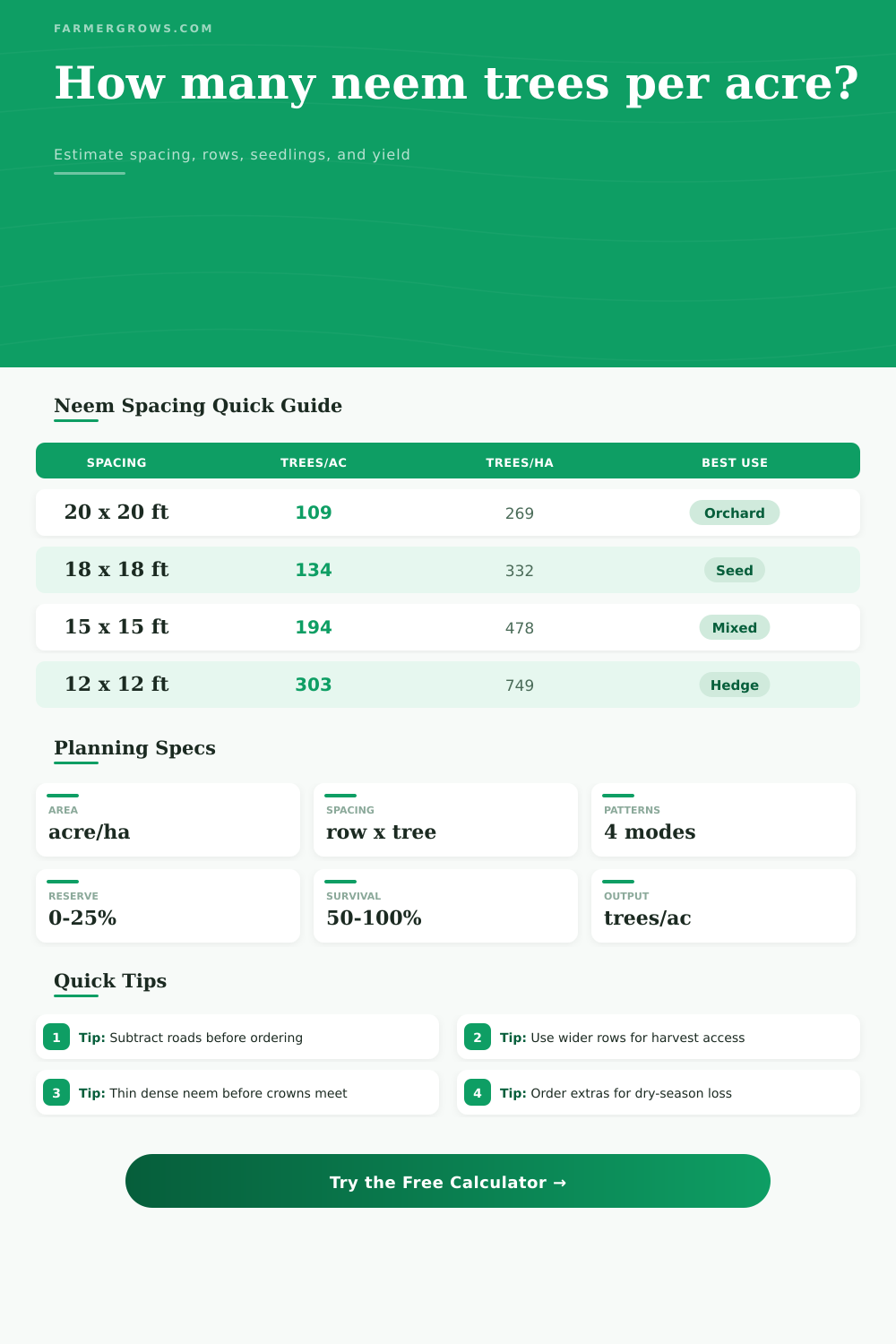
| 20 x 20 ft | 400 sq ft | 109 | 269 |
| 18 x 18 ft | 324 sq ft | 134 | 332 |
| 15 x 15 ft | 225 sq ft | 194 | 478 |
| 12 x 12 ft | 144 sq ft | 303 | 749 |
| 10 x 10 ft | 100 sq ft | 436 | 1,076 |
| Neem use | Typical spacing | Density goal | Calculator adjustment |
|---|---|---|---|
| Seed and oil orchard | 18 to 25 ft | 70 to 135 trees/ac | Low thinning, larger crown diameter, higher bearing share. |
| Mixed farm boundary | 15 to 20 ft | 110 to 195 trees/ac | Moderate access deduction for lanes and crop edges. |
| Windbreak or shelter belt | 10 to 15 ft | 190 to 435 trees/ac | Higher initial density with planned cull or thinning. |
| Leaf harvest hedge | 8 to 12 ft | 300 to 680 trees/ac | Smaller crown target and higher leaf harvest per acre. |
| Planning item | Low range | High range | Why it matters |
|---|---|---|---|
| Access deduction | 4% | 18% | Roads, firebreaks, water points, and drains reduce plantable acres. |
| Nursery reserve | 5% | 20% | Dry sites and browsing pressure need more replacement plants. |
| First-year survival | 75% | 95% | Survival changes the live stand and the future thinning count. |
| Mature crown | 12 ft | 28 ft | Crown width checks whether spacing is permanent or temporary. |
Separate gross acres from plantable acres. A one-acre field rarely holds a full acre of neem trees after tracks, basins, drains, and turning space are removed.
Use crown size as a long-term check. Dense neem layouts can work for early windbreaks or leaf harvest, but wide seed orchards need room for mature canopy and picking access.
The instinct says: Plant every last tree that this land will support. But in reality, you go from dreaming of a stand of neem trees to waking up one day with nothing but an impenetrable thicket of straggly saplings. Why? Because you got carried away planting trees, and then you didn’t get the spacing right.
The instinct is to clear the field, set out the seedlings, and plant as many as the land can hold, but that usually leads to a tangled mess of competition. And for two years it look amazing: a forest of young greens. For about two years. After that, there’s war. Trees fight canopy-to-canopy, and root systems compete for moisture. In no time the sunlight is gone. When you wake up and see your mistake, when the trees has grown too large to relocate, you’re stuck with a jumble of competing trees.
How to Plan Your Tree Spacing
There are too many. But there are also too few. How many is too many? That depends on how much you want to reap, and how little you want to feed. You must find a balance: give every tree enough room to grow, but do not plant them so closely that they cannot mature.
It’s basic math (but with a lot of variables). One acre equals forty-three thousand five hundred sixty square feet. At a generous spacing of twenty feet between trees in all directions, you’d end up with approximately one hundred nine trees per acre. A wide orchard gives you enough room to access your seeds and provides a nice wide canopy when the trees are grown up.
But maybe you just need a hedge of leaves, or even a windbreak? Push that down to twelve feet. Now you’ve got three-hundredish trees per acre. To figure out what fits on your land (and how long it’ll take you), run it through the calculator above. Feed it some reasonable assumptions about your land and your patience.
The tool factors in the fact that not every single acre can be planted perfectly. A large amount of the land is used by roads, drainage ditches, and areas where machines turn around. If you don’t account for those subtractions, you’ll order too few seedlings and end up with an uneven-looking, scraggly patch (not exactly what you’re aiming for).
Optimists also trip up farmers with the survival rate. Maybe you think all your seedlings will take hold. Not so much in bad years or in poor soil. The calculator allows you to adjust for expected survival in your first year. And it allows you to make a nursery reserve for loss. This is a little something to save you from having to run to the nursery again…twice.
Plan for more up front. Know some won’t make it. Tuck them into gaps later. Keep it on track. Keep the math predictable. The reserve isn’t waste; it’s insurance.
The most controversial aspect of the exercise is thinning. Sure, planting thickly provides you with more options early on. Later, you can cull out the weaker trees and keep the best ones. That’s selection thinning. Good thing to do if you’re up for the labor required. Otherwise, leaving too many trees in one spot for too long means a dense stand that becomes leggy and stunted. No energy goes into wood or fruit; they stretch to reach light.
The calculator includes a field for planned thinning. So as you enter the number of trees you plant, you also plug in how many you’ll take out later. It makes you think of the eventual stand you want before you dig any holes. You are not just planting trees, but building a landscape to come.
It’s laid out in plain figures on the page (the reference table). But the actual choice is in knowing what the use is: Will you be growing neem for oil seed? Then you’ll want to spread them wide, so they have time to develop into full-size trees that yield well. Is it a shade or boundary tree? In which case, who cares about size of each individual tree so much as getting a nice thick stand of them? That’s where the calculator can help you see those trade-offs visually.
How many trees will there be? And how big a hole does all their foliage take up on the ground? Will the planned crown sizes fit comfortabley within the given space? Does the canopy room check tell you you’re heading into overpopulation territory? Listen to that voice. Better to go bigger then needed at planting time, rather than having regrets later.
Neem trees are tough. They take heat. They can handle poor soil. They’re no magic tree, though. They also require space, light and air to do well.
The calculator isn’t a crystal ball. It’s a tool for planning. It provides the numbers; now you must provide the context. Do you live in an area with good water? What is the size of your field? How much work are you willing to put in? When you know these things, the math comes together.
The outcome: A plan that doesn’t fight nature but works with it. A grove that is not only productive but also beautiful, and one that you can actualy manage. And someday, looking out on all those neat rows of seedlings, you’ll be able to see that there is room for them to grow. Which is exactly what this is all about.