Cypress Trees Per Acre Calculator
Estimate cypress trees per acre, total planting positions, nursery order quantity, expected survival, row footage, privacy screen length, and mature crown fit from species, spacing, and plantable acreage.
Choose a cypress layout, then adjust area, row spacing, in-row spacing, plantable share, service lanes, reserve plants, survival, and future thinning.
Use tighter in-row spacing for fast closure, but keep enough row room for mowing and pruning.
Bald cypress can be planned as restoration clusters where water, access, and survival vary by microsite.
Multiple rows reduce effective density because edge gaps and service alleys matter more than pure grid math.
The calculator separates planting positions, reserve trees, surviving stand, and post-thinning density.
Cypress acreage plan
Results update as you change the inputs.
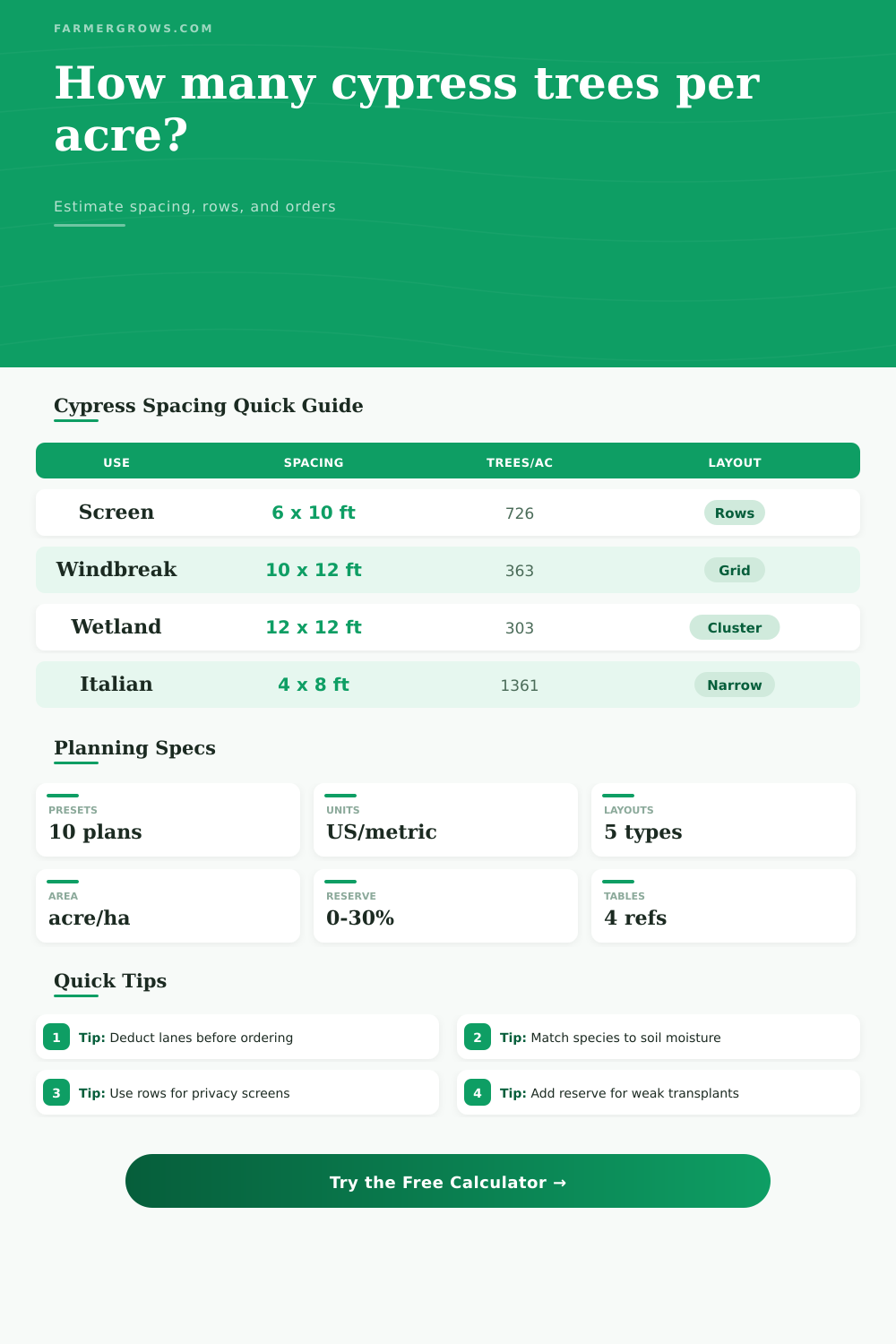
| Cypress use | Common spacing | Base trees per acre | Planning note |
|---|---|---|---|
| Leyland privacy screen | 6 ft x 10 ft | 726 | Fast closure with good row access for trimming and mowing. |
| Arizona cypress windbreak | 10 ft x 12 ft | 363 | Moderate density for shelter rows and drier sites. |
| Bald cypress wetland planting | 12 ft x 12 ft | 303 | Works for restoration where water depth and survival vary. |
| Italian cypress column row | 4 ft x 8 ft | 1,361 | Narrow vertical form allows denser ornamental rows. |
| Wide landscape cypress | 15 ft x 20 ft | 145 | Better for specimen trees and long-term crown spread. |
| Layout | Footprint factor | Density effect | Use this when |
|---|---|---|---|
| Straight grid rows | 1.000 | Base formula | The block is a clean orchard, screen, or plantation grid. |
| Triangular staggered grid | 0.866 | About 15% denser | You offset rows to close canopy or stabilize restoration sites. |
| Screen row with service lane | 1.080 | About 7% lower | Privacy rows need a mow lane, fence setback, or trimming aisle. |
| Paired windbreak rows | 1.160 | About 14% lower | Rows are grouped with a wider alley after each pair. |
| Wetland clusters | 1.250 | About 20% lower | Planting follows hummocks, water edges, or wildlife pockets. |
| Planting situation | Expected survival | Reserve range | Why it matters |
|---|---|---|---|
| Irrigated privacy screen | 90% to 96% | 5% to 8% | Good watering and small blocks usually reduce replacement needs. |
| Dry windbreak site | 75% to 88% | 8% to 15% | Heat, wind, browsing, and limited water can create gaps. |
| Wetland bald cypress | 65% to 85% | 10% to 20% | Water level, sediment, and herbivory can make survival patchy. |
| Remote restoration block | 70% to 88% | 12% to 25% | Extra transplants help avoid a second delivery or missed season. |
Use plantable acres: Cypress screens often lose area to fence offsets, gates, ditches, utility easements, drainage swales, and turning space. Deduct those before using the order total.
Check mature width: Fast closure can be useful for privacy, but the crown check shows whether the spacing will require regular pruning, removal, or accepting canopy overlap.
Match species to site: Bald cypress tolerates wet ground better than most screen cypress choices, while Arizona and Italian cypress need different airflow, soil, and climate assumptions.
Plan replacements early: The reserve percentage is for skipped holes, weak plants, transport losses, wildlife damage, and early mortality before gaps become permanent in a screen.
Four hundred trees is what the spreadsheet says you should plant, but the truck holds only two hundred. The reason is that raw geometry ignores reality. There are ditches to traverse and fences to avoid. Some of those seedling won’t make it past their first winter. A perfect grid exists only in dreams; planning a cypress planting mean accounting for distance between dream and fact.
Your boundary lines create an area of reality where the arithmetic begins which spares you having to guess at conversions and coefficients that eventually bite. The first one, typically the most important variable, is the one where people assumes acreage rather than plantable square feet. On paper, an acre is a nice round number. In the field, it is not so much. There’s the area lost to drainage swales and utility easements. And then there’s the area lost to the loader’s turning radius.
Make Smart Choices for Planting Trees
Most folks don’t account for this. This is why adjusting the percent plantable factor in tool matters. Because your trees aren’t going to go everywhere, right? It’s just a little bit, but it adds up when you’re placing thousands of plants and every dollar counts.
Next, consider which species to use. That’s what determines your spacing, far more then money ever will. For example, leyland cypress closes spaces rapidly, and it moves fast. If all you want is a privacy screen, that’s your go-to. It grows fast and provides instant visual cover within three years rather than twenty.
But if you plant a bald cypress widely in a zone being restored as a wetland, you have to allow for water flow. You also have to allow for the tree’s buttressing of its own roots. That’s why that reference table on the page makes it easy to see how a block of twelve feet by twelve feet for a wetland project provide wildly less dense planting than a six-foot by ten-foot grid does for a screen. Different kinds of cypress have different habits when mature, you don’t space them the same.
Optimism can actualy cost you money when it comes to survival rates. Gaps in your screen and pissed-off clients await if you assume 100% survival. Field conditions like heat stress, herbivory, and soil moisture varies widely. With the tool, you can specify the expected survival rate and include a percentage of reserve orders. This reflects the number of additional trees you should of purchase to fill holes that appear before the canopy closes. Better having leftover balled-and-burlapped trees in the spring than empty ones in the fall.
The nuts and bolts are that zone planning and row footage makes this thing real. Knowing your numbers for lineal feet of rows will tell you how much to stake, and how much the job will cost based off labor. Break it down into bite-sized pieces by dividing it into zones where the deliveries and crews can be staggered, minimizing the number of nursery trucks parked on the place like its a parking lot. The calculator does that breakdown for you, so instead of one big scary number you’ve got a usable schedule you can really work with.
The last bit of sanity checking involves knowing how wide their crown get when mature. Now, perhaps you can plant two hundred trees per acre and things look great, but those eight-foot-wide trees eventually combine to form a continuous wood wall; hard to keep up. Compare the mature width with the spacing and determine whether you need to thin trees in five years or if the initial density is sustainable. Small details matter for how things look and for their long-term health.
Bottom line: Planting trees is a bet on the future. You’re investing in a promise of future privacy and shade with little sticks. Let the numbers help you, not hurt you. Adjust them for reality. Buy some reserve to account for the unexpected. Then let the math go to work for you. It’s not about getting every inch filled in, it’s about creating an intentional-looking stand of trees in a decade.