Lime Trees Per Acre Calculator
Estimate lime tree density, planted acreage, row length, tree order reserve, canopy clearance, drip emitters, irrigation flow, and harvest potential for Persian, Bearss, Key, and high-density lime plantings.
Start with a common lime block pattern, then adjust row spacing, in-row spacing, non-planted area, canopy diameter, reserve trees, and irrigation details.
Lime Orchard Estimate
Your calculated tree density and block layout will appear here.
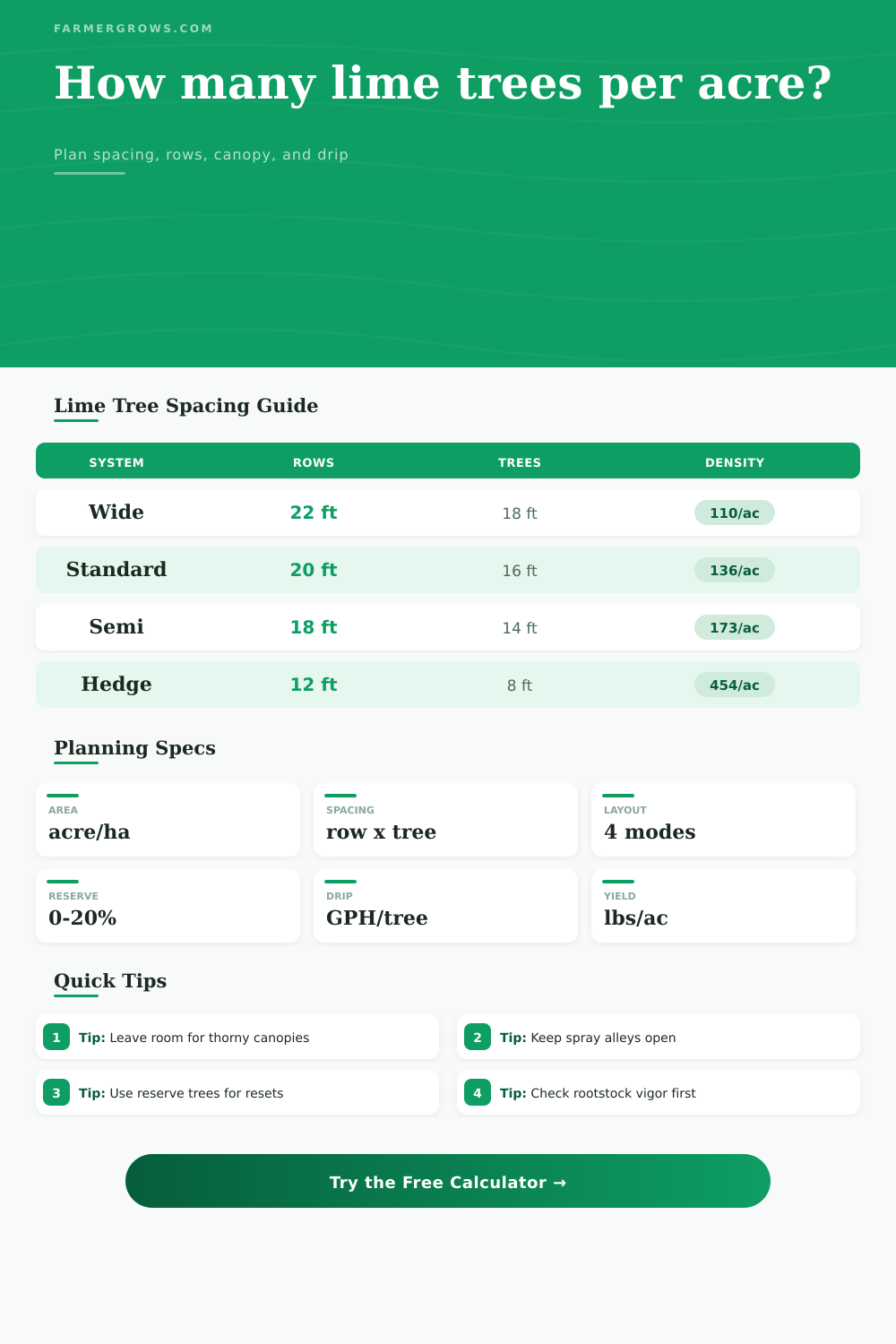
| Planting System | Typical Spacing | Approx. Trees/Acre | Best Use |
|---|---|---|---|
| Wide Persian lime | 22 ft x 18 ft | 110 | Large canopy, low pruning pressure, wider equipment lanes |
| Standard lime block | 20 ft x 16 ft | 136 | Balanced density for Tahiti, Persian, and Bearss lime orchards |
| Semi-dwarf lime | 18 ft x 14 ft | 173 | Smaller rootstock or higher management with regular skirt and side pruning |
| Key lime dense block | 16 ft x 12 ft | 227 | Compact trees where harvest access remains practical |
| Hedgerow lime | 12 ft x 8 ft | 454 | Managed fruiting wall or high-density trial with pruning discipline |
| Tree Density | 2 Emitters x 1 GPH | 4-Hour Set | Planning Note |
|---|---|---|---|
| 110 trees/ac | 220 GPH/ac | 880 gal/ac | Wide blocks often expand emitter count as canopy grows |
| 136 trees/ac | 272 GPH/ac | 1,088 gal/ac | Good baseline for moderate lime spacing |
| 173 trees/ac | 346 GPH/ac | 1,384 gal/ac | Check pump zone limits before planting |
| 227 trees/ac | 454 GPH/ac | 1,816 gal/ac | Higher density may need shorter irrigation sets |
| 454 trees/ac | 908 GPH/ac | 3,632 gal/ac | Hedgerow systems need careful zone sizing |
| Lime Type | Planning Canopy | Planning Yield | Spacing Caution |
|---|---|---|---|
| Persian / Tahiti | 14-18 ft | 90-160 lb/tree | Leave row middle room for thorny skirts and harvest bins |
| Bearss lime | 13-17 ft | 80-150 lb/tree | Works well in moderate-density citrus layouts |
| Key / Mexican lime | 10-14 ft | 50-110 lb/tree | Compact habit supports closer rows if pruned |
| Dwarf lime | 7-10 ft | 25-70 lb/tree | Dense spacing depends on rootstock and canopy training |
| Managed hedgerow | 6-9 ft | 30-80 lb/tree | Plan annual topping and side pruning before planting |
If canopy diameter is larger than in-row spacing, treat the count as a hedgerow plan and budget pruning from the start.
For lime trees, the alley clearance number matters as much as trees per acre because fruit harvest and spray access need repeatable row middles.
Establishing an income-producing orchard differs from planting a potted lime tree in big ways. With the orchard, there’s a need for spatial discipline. What looks like rooting around in soil is actualy an exercise in engineering a three-dimensional workplace. This includes the growth of canopy, storage space for heavy picking bin, spraying equipment, and room enough for your own two feet. Get the spacing incorrect up front and it’s a decade or more spent struggling for elbowroom.
This page’s calculator does the geometry for you (but not the hard part: understanding what all the numbers mean in the mud). First comes the pick of the density, which seems the most critical choice of all, and is. That will determine every other aspect.
How to Space Your Lime Trees
On the one extreme is wide spacing: eighteen feet between trees, with maybe twenty-two between them (one hundred ten trees an acre). Comfortabley. There’s room to maneuver, and the canopy has space to spread, so no tree chokes out it’s neighbor. The drawback is lower yield per acre. This make the cost per fruit go up, because you are growing less fruit on the same amount of land.
With tighter spacing, there’s more aggressive pruning needed; you push closer to three hundred or even four hundred trees per acre, and that means keeping those trees in check. If you don’t get enough light, you’ll end up with fruit on the outside and wood on the inside. No light, no fruit.
After choosing a layout, the tool above do the math for you. No more guesswork about whether the trees you ordered will really fit onto your irregular plot. It takes into account access roads and headlands. This is a key variable. There is no such thing as actual acre of trees when it is only theoretical. Space are required for machinery to maintain the health of the soil, for pumps, and for drains. Yes, that land may appear to be wasted space on paper, but it’s insurance against bottlenecking during rush time at harvest.
Before deciding where to place your grid, also think about what rootstock you’re growing. If it’s a Persian lime on vigorous rootstock, be prepared: It wants space. Key limes on the other hand (which tend toward being more bush-like than treelike) want to be closer together. But then again, they won’t do so unless you keeps them in check. For dwarfing rootstocks, it’s a whole different story. Because the tree won’t become huge, you can plant far closer. Just enter those differences in growth strength into the calculator. This helps you avoid mistake many make by thinking that one kind of citrus takes up as much space than another.
The other silent variable is water. Each tree you add mean another mouth at the trough. You should use standard drip irrigation, but how much water do you deliver? Higher density = higher total flow and more emitters. The calculator figures out your total gallons per hour that your system must accommodate. That’s something you can easily forget till you’ve dug a few holes and the pump’s screaming while one end of the row’s bone-dry. Know your water demand before you dig the first hole.
And then there’s the reserve. Trees go into shock when transplanted, and some are lost at the nursery. It is better to over-order than to under-order. Always plan on ordering more than you plant. A good rule of thumb is five percent, if your crew is experienced. If new, try 10 or even 12 percent. To have to wait six months for a replacement tree, when you’re out of step with the crop rhythm, costs more than ordering one you don’t use. You should of planned better.
Finally: Planting out your lime trees becomes a balancing act of space. How much do you want to get in, and how much do you want to get out? How much fruit do you want and still be able to reach it? How dense can you go before there’s disease? It’s all about numbers (and then it’s about seeing the pictures). Walk the row. Visualize the full canopy when they’re big. See where the sprayer will fit. When it makes sense in your mind, the math will support it.