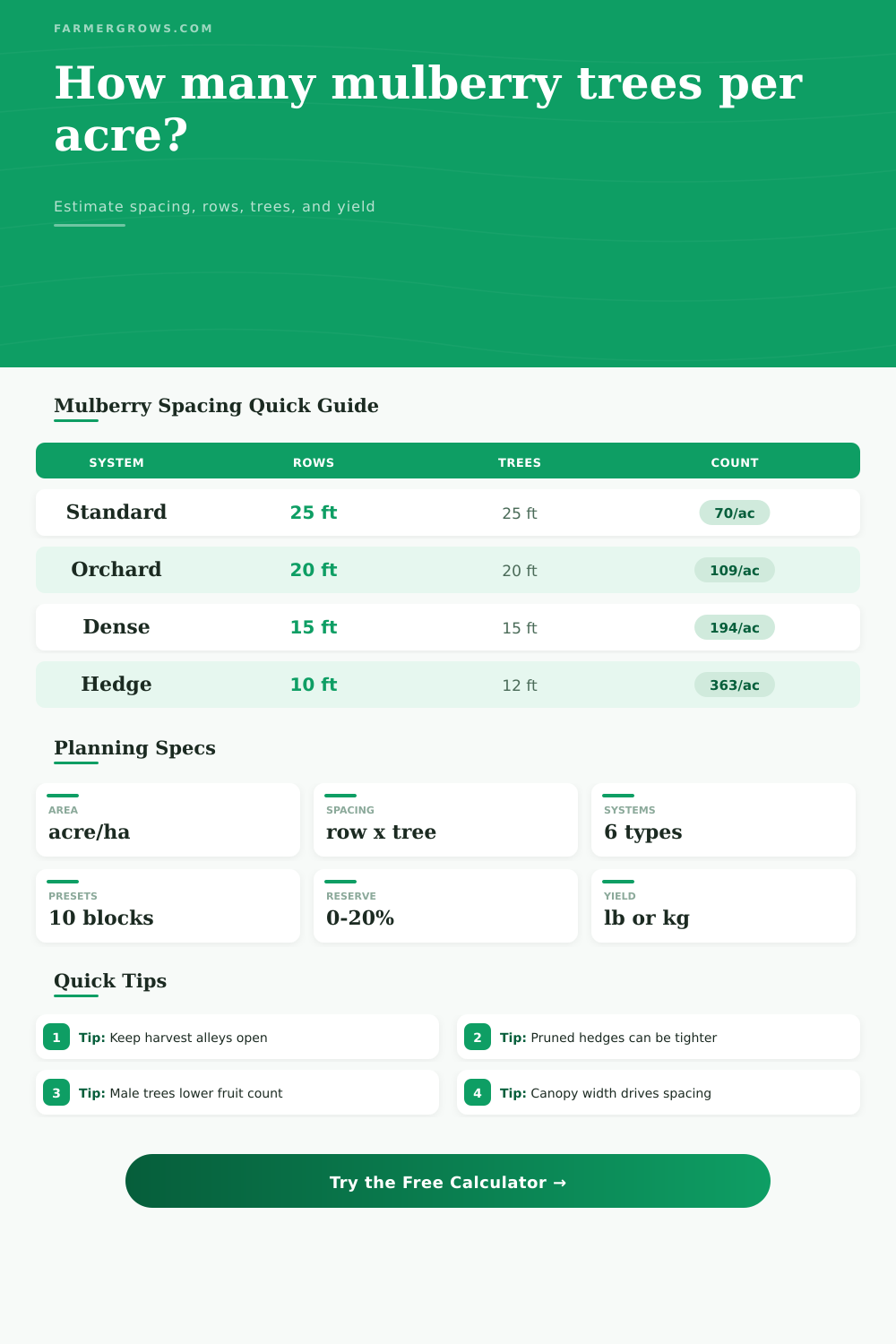
Mulberry Trees Per Acre Calculator
Estimate mulberry trees per acre, plantable tree count, row layout, reserve plants, canopy clearance, irrigation flow, and fruit or leaf yield from field size and tree spacing.
Choose a mulberry planting style, then adjust block shape, cultivar habit, harvest alley space, pruning intensity, replacement reserve, canopy width, irrigation emitters, and mature yield assumptions.
Mulberry Tree Spacing Results
Results update automatically as you adjust the calculator.
| Mulberry system | Typical spacing | Trees per acre | Best calculator use |
|---|---|---|---|
| Large white or red mulberry | 25 x 25 to 30 x 30 ft | 48 to 70 | Shade, wildlife, wide equipment access, and lower pruning demand. |
| Fruit orchard block | 18 x 18 to 22 x 22 ft | 90 to 134 | Hand harvest, manageable tree height, and moderate annual pruning. |
| Dwarf or compact cultivar | 10 x 12 to 14 x 14 ft | 222 to 363 | Small blocks, U-pick rows, and very regular canopy renewal. |
| Leaf or silkworm production | 6 x 10 to 10 x 10 ft | 436 to 726 | Coppice or pollard systems where foliage is harvested, not full-size canopies. |
| Hedgerow fruit system | 10 x 12 ft with alleys | 260 to 363 | High-density berry harvest with wide turns after paired rows. |
| Windbreak or boundary line | 30 x 30 ft or wider | 48 or less | Use custom area when trees are only on edges, not across the full acre. |
| Planting type | Default spacing | Canopy basis | Yield basis |
|---|---|---|---|
| White mulberry | 20 x 20 ft | 18 ft managed canopy | 45 lb fruit or leaf equivalent per productive tree. |
| Black mulberry | 25 x 25 ft | 24 ft broad canopy | 55 lb fruit per productive mature tree in a roomy block. |
| Pakistan or long-fruited | 18 x 18 ft | 17 ft pruned canopy | 50 lb fruit per productive tree under annual height control. |
| Dwarf mulberry | 12 x 12 ft | 10 ft compact canopy | 22 lb fruit per productive tree; density does more of the work. |
| Leaf coppice | 6 x 10 ft | 7 ft renewal canopy | 14 lb dry leaf or usable browse per productive stump. |
| Block example | Spacing basis | Planting positions | Order with reserve |
|---|---|---|---|
| 1 acre standard fruit block | 20 x 20 ft, 8% lanes | About 100 trees | 108 trees at 8% reserve. |
| 5 acre managed orchard | 18 x 18 ft, 10% lanes | About 605 trees | 654 trees at 8% reserve. |
| 1 acre dwarf block | 12 x 12 ft, 10% lanes | About 272 trees | 294 trees at 8% reserve. |
| 1 acre leaf coppice | 6 x 10 ft, 12% lanes | About 639 stools | 704 stools at 10% reserve. |
| 2 acre wide windbreak block | 30 x 30 ft, 6% lanes | About 91 trees | 96 trees at 5% reserve. |
| Check | Formula used | Why it matters | Adjustment idea |
|---|---|---|---|
| Effective tree area | Row spacing x tree spacing | Converts spacing into trees per acre before deductions. | Use custom area for irregular boundary plantings. |
| Triangular rows | Spacing area x 0.866 | Reflects the tighter staggered geometry. | Confirm machinery can follow the angled pattern. |
| Service lanes | Lane width over row interval | Subtracts non-planted harvest and spray corridors. | Widen lanes for mechanical harvest or larger tractors. |
| Canopy gap | Spacing minus pruned canopy | Shows when mature trees will touch or shade heavily. | Increase spacing or choose stronger pruning. |
| Total flow | Trees x emitters x flow | Sizes the block flow rate for irrigation zones. | Split dense blocks into smaller valve zones. |
Canopy tip: Mulberries tolerate pruning, but unmanaged trees can spread wider than the planting plan. Use the canopy gap result before ordering nursery stock.
Harvest tip: High-density fruit rows need alleys for picking sheets, carts, or small equipment. Add service lanes instead of using every square foot for trees.
Yield tip: Male or non-fruiting trees support pollination and wildlife but reduce fruit yield. Keep that percentage realistic for dioecious selections.
Leaf block tip: For silkworm or fodder blocks, choose the leaf/coppice preset and enter dry leaf or usable browse yield per productive stool.
Everyone starts with one mulberry tree in their back yard, usually. And it do well, sometimes better than you expected, and suddenly you know: This thing’s got legs. Now you’re thinking less about whether to plant one at all, and more like, “How many will I have room for?” How much of my acre do i want covered up with trees? How far apart should I space them before this becomes a impassible jungle? That’s when dreams collide with reality, in the form of spacing.
This involves not only how much space you need between trees (which means which ones you’ll purchase), but also how manageable each one is to prune, pick, and survive until those initial hot-and-dry years.
How to Space Your Mulberry Trees
Now you don’t need to sit there imagining rows and columns in your head, because that’s what the calculator up top does for you. It will take all that geometric work off your hands. Simply input how many acres you want to plant, select a spacing pattern, and it will tell you how many trees you’ll get from that plan. However, the numbers aren’t the point. The true benefit comes when you learn why certain spacings is important to your workflow (not just some arbitrary number).
With a 25 ft x 25 ft square grid, you’d end up with roughly 70 trees per acre. While that may sound sparse, you’ll leave enough space to minimize pruning and provide plenty of space for wide equipment access. In fact, a standard tractor could fit between these rows without needing to hold their breath. The catch? You will have fewer total trees per acre. This is not an issue if you are planting for wildlife habitat or personal use, but it is not ideal for commercial volume.
But tighten that grid to fifteen feet and suddenly you’re tripling the density. There are two hundred trees. That’s a lot more yield potential, but it also mean far greater management. You’ll have to prune like mad to prevent canopies from merging, trees touching each other block out light; air circulation declines, making disease an ever-present concern.
To factor all this in, the calculator allows you to enter expected canopy width. For example, say your trees splay out naturaly to twenty feet wide apiece, but you plant them fifteen feet apart. The calculator identifies a negative gap, which is a warning shot. Which means you’d better be prepared to regularly manage their heights and widths or those trees are going to fuse into one big, unmanageable shrub.
You also need to consider access to the harvest. If you can’t reach it, you can’t pick it. Wide alleys are absolutely mandatory in high-density systems. You must have enough space for yourself (or your picking crew) and your equipment (picking sheets, carts, whatever) without stepping on branches. Subtracting lane width for service aisles becomes possible with this tool. Eight percent may not seem like much, but on a five-acre block, that’s lost planting space. It is not waste, however. It is invested in accessibility. Without lanes, you end up with neglected outermost rows whose fruit never gets picked, because it’s simply too hard to get to.
There’s one more hidden factor: irrigation. Mulberries grow fast and they’re thirsty young plants. They want to put down deep roots, they also want regular watering. If you have three hundred trees, for example, you’ll need an irrigation system capable of delivering water to all of them at once without dropping pressure to zero. The calculator gives you an estimate of how much each emitter flows. A handy sanity check. Is the total number of gallons per hour too high for your pump? You may need to thin out some of those trees (or otherwise zone your field) before any get planted. Better to do it on paper now than watch a row of freshly-planted trees go limp as the water turns off.
Don’t ignore the reserve. Not all nursery stock is perfect. A few of your trees will come in damaged. Some won’t do well, and will be lost to transplant shock. The ten percent reserve lets you add to your order for those losses without having to panic at the nursery six months from now. It is a little insurance policy that keeps the design intact.
The bottom line: When it comes to space, everything’s a tradeoff. Fewer trees mean less work and wider rows. Narrower rows mean more fruit, but they also lead to more hair pulling and more work. No judgment here, just different gigs. Choose the gig you’d prefer doing and the rest will follow. Layout with what fits your body, your equipment, and your patience. The number of trees isn’t difficult to adjust, but that dirt wouldn’t of budged so easily.