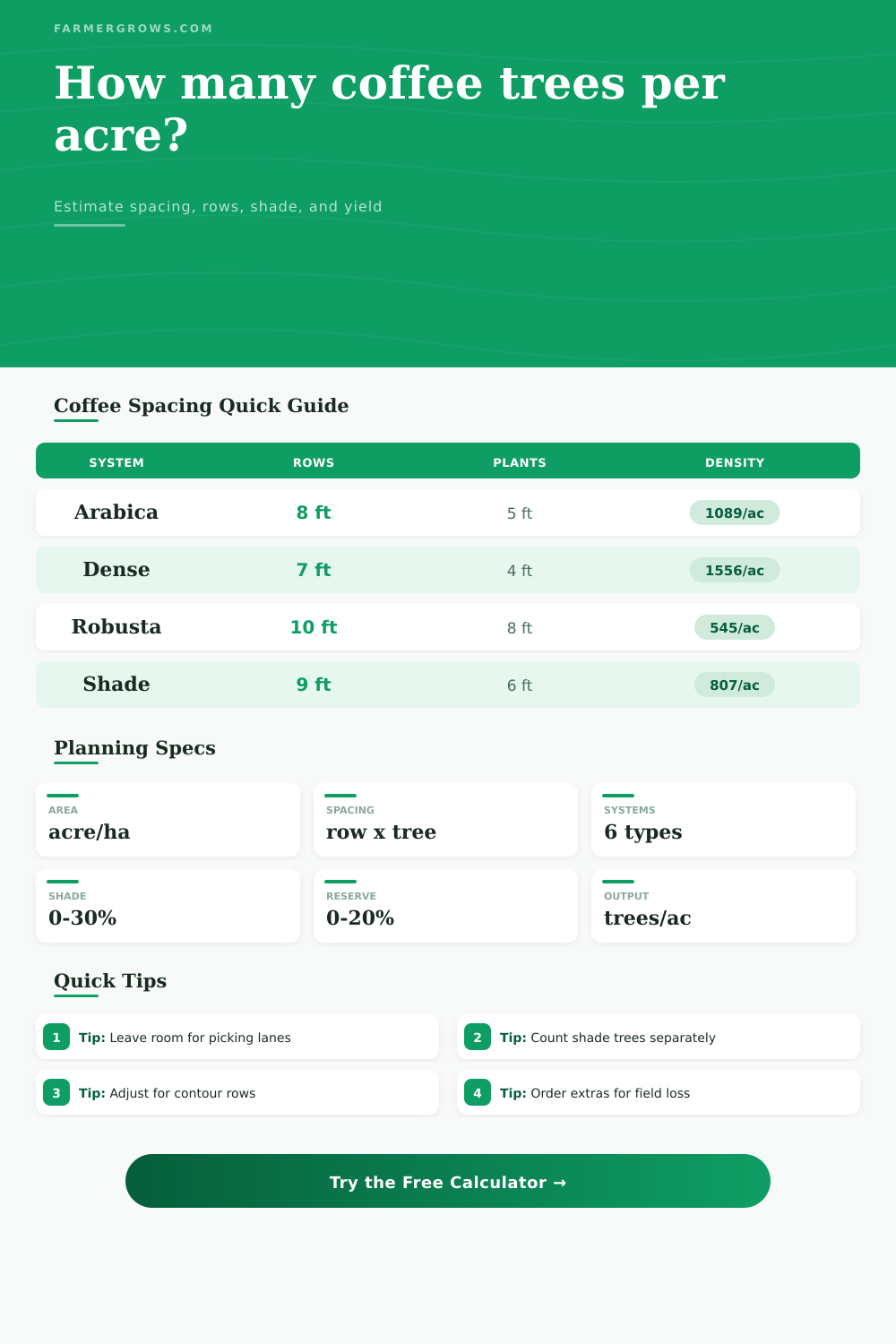
Coffee Trees Per Acre Calculator
Estimate coffee trees per acre, total nursery plants, rows, shade trees, contour losses, station density, irrigation emitters, and mature cherry yield from coffee spacing.
Choose a coffee planting style, then adjust area, row spacing, plant spacing, species, shade trees, slope loss, replant reserve, irrigation hardware, and expected yield per bearing tree.
Coffee Tree Spacing Results
Spacing results will appear after calculation.
Calculation Breakdown
| Coffee spacing | Stations per acre | Plants per hectare | Best fit |
|---|---|---|---|
| 10 x 10 ft | 436 | 1,077 | Large Robusta, low-density shade systems, and hand access |
| 10 x 8 ft | 545 | 1,346 | Robusta or vigorous Arabica where bush size must be respected |
| 9 x 6 ft | 807 | 1,995 | Shade-grown Arabica with moderate density and picking access |
| 8 x 5 ft | 1,089 | 2,690 | Common Arabica spacing for small farms and managed rows |
| 7 x 4 ft | 1,556 | 3,844 | Dense Arabica block with more pruning and faster canopy closure |
| 6 x 3 ft | 2,420 | 5,980 | Dwarf or intensive trial planting with close harvest lanes |
| Planning factor | Typical input | What it changes | Field note |
|---|---|---|---|
| Headlands and paths | 5% to 12% | Removes area before station count | Include tracks, washing access, drains, loading spots, and row ends |
| Contour or terrace loss | 3% to 18% | Accounts for curved rows and slope breaks | Higher slopes often plant fewer trees than flat spacing math suggests |
| Shade tree rate | 4 to 15 per 100 coffee | Adds shade-tree count for nursery planning | Shade density should match climate, cultivar, and pruning system |
| Plants per station | 1 to 3 | Multiplies plant count without changing station count | Use only where paired seedlings or hill planting is intentional |
| Nursery reserve | 5% to 15% | Adds extra coffee plants to order | Keep replacements separate from expected established stand |
| Coffee system | Emitters per plant | Flow range | Mature yield planning |
|---|---|---|---|
| Rainfed shade coffee | 0 | none | Use yield fields only; irrigation results can be left at zero |
| Standard Arabica drip | 1 to 2 | 0.5 to 1.0 gal/hr | Moderate plant count and stable delivery for dry months |
| Dense dwarf coffee | 1 | 0.25 to 0.5 gal/hr | High plant count means total block flow climbs quickly |
| Robusta block | 1 to 2 | 0.75 to 1.5 gal/hr | Wider spacing can still require strong per-plant water supply |
| Block example | Area | Spacing | Approximate result |
|---|---|---|---|
| Small Arabica plot | 1 acre | 8 x 5 ft | About 1,089 stations before paths, shade, and reserve plants |
| High-density Arabica trial | 2 acres | 7 x 4 ft | About 3,112 gross stations before deductions and nursery reserve |
| Shade-grown hillside | 5 acres | 9 x 6 ft | About 4,035 gross stations before contour and shade footprint loss |
| Robusta expansion | 10 acres | 10 x 8 ft | About 5,445 gross stations before access lanes and replant allowance |
Spacing: Coffee trees per acre equals 43,560 divided by effective square feet per station. Multi-plant stations multiply plant count after station density is calculated.
Shade: Shade trees are counted separately from coffee plants. The shade footprint deduction reduces usable coffee area before stations are estimated.
Slope: Contour rows, terraces, drains, and uneven row ends can lower planted density even when the row spacing is accurate on paper.
Yield: Mature production uses bearing trees, cherry weight per tree, and the cherry-to-green ratio. Young coffee blocks usually yield much less.
You must plan for terrain, labor, water, and light to plan out a coffee farm. Seedlings in hand, piece of ground in sight, but how many trees? That is not just about geometry.
Enter the coffee farmer’s best friend: the planting calculator (above). It takes care of the math. Turns your square feet into plants. It factors in shade trees, paths, and headlands. But to know what those numbers mean, you’ve got to see off the grid.
How to Plan Your Coffee Farm Layout
The primary trade-off is spacing. With narrow spacings like an Arabica on a seven-by-four-foot grid, you get maximum yields early and a rapid canopy that shades out weeds fast. Sounds good in principle; this require careful attention to disease management and some serious pruning. In exchange, you gain longer-lived trees over time, and easier picking later.
For Robusta, wider spacing. Ten by eight feet, allow the bushes to breathe and eases watering needs and pest management. However, it requires waiting for canopy closure and slower canopy growth initially. The calculator accounts for all of this intuitively.
It shows how a double-row system or triangles affect the area per station, as triangular grids change the actual space used per station. Staggering the layout allow you to fit more plants into same space without overcrowding the bushes themselves.
With varying slope, we alter surface area. A straight line becomes curved, rows on a hillside. But that curve mean less space is being used. The tool includes a setting for contour loss to make up for all those odd-shaped corners, terrace ends, row ends, and drain spaces. Until you run out of seedlings, most planners neglect it. Underestimating will be a major factor if you treat a steep slope as a perfect rectangle.
How dense a block/shade do you want? Are you planning a low-intensity shade block or a high-density trial? That’s what the reference table on the page will help you envision.
There’s one more wrinkle: shade trees. Not only do they consume space, but they throw shade (duh) and vie for nutrients. To account for this, the calculator has different way to calculate shade trees, where you can enter their footprint reduction and a ratio by which it affects your coffee crop. That way you don’t mistakenly count tree canopy itself as coffee planting area.
Finally, factor in a nursery reserve. Frost occurs, seedlings die, and animals roam through. A five to ten percent reserve is realistic. The calculator will adjust your final order size according to how much you want to survive, and how big a reserve you’d like. That way you won’t have hole in the middle of your best-producing rows.
Yield stability depends heavily on irrigation planning. For example, how fast do you want things to flow? How many plants are you growing? What’s your desired emitter capacity per plant? Total volume increase as plant density does, so a strong delivery system will be necessary for that dense dwarf block.
And lastly, the yield estimates create a realistic expectation of what to expect. What percentage of your crop will bear fruit (bearing percentage)? How many greens will convert to cherries (cherry-to-green conversion ratio)? That way you can have a financial baseline before purchasing your first bag of fertilizir.
As with coffee farming, it’s not just the trees that matter, but also the spaces in between them. Seeing the whole picture and getting the balance right is important. That’s where the tool come in, to help you visualize how spacing connects to yield and slope. It turns your abstract acres into a concrete plant plan.
Walk the land and check the soil yourself, of course. But now you’ve got the numbers sorted out, so you can concentrate on what makes your farm special. Time to implement the plan.